
Mediterranean horse mackerel
The 15 cm line is the easiest rule to misread on this fish. The EU sets a minimum conservation reference size for Trachurus, while Spain's older national table still prints 12 cm, and the two figures cannot both be right. The fish itself needs no refined tackle: when a school is under the boat almost every drop gets hit. Knowing which one goes back is the harder skill.
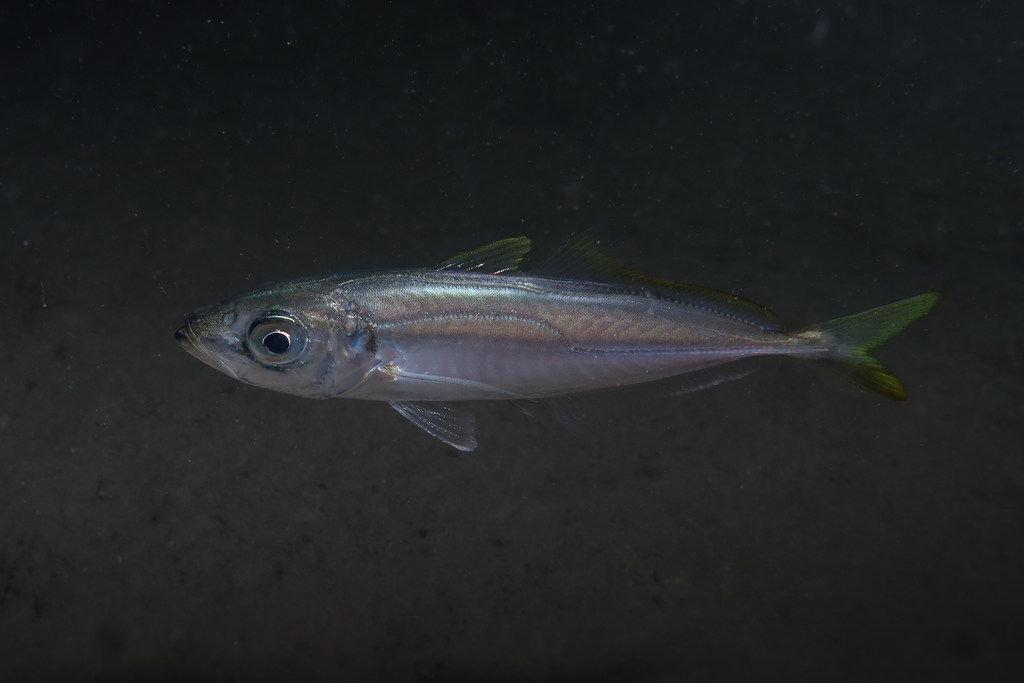
The 15 cm line is the easiest rule to misread on this fish. The EU sets a minimum conservation reference size for Trachurus, while Spain's older national table still prints 12 cm, and the two figures cannot both be right. The fish itself needs no refined tackle: when a school is under the boat almost every drop gets hit. Knowing which one goes back is the harder skill.
A fusiform carangid with a rough lateral line
Start at the lateral line and the tail. The body is fusiform and compressed, the head large, the lower jaw slightly protruding, and the eye covered by a well-developed adipose lid. The back runs blue-grey to near black, the lower two thirds silver-white, the tail yellowish, and a clear black blotch sits on the rear edge of the gill cover. The row of scutes along the lateral line feels rough to the thumb, which is the fastest check on a fish held in poor light. Against the Atlantic horse mackerel, this species is deeper-bodied, carries denser scutes and shows a sharper blotch. The two mix in the same school, so compare body depth and the blotch before colour.
A schooling migrant that follows bait, not structure
FishBase runs the range from the Bay of Biscay down the eastern Atlantic to Mauritania, including the whole Mediterranean; a separate subspecies, T. m. ponticus, occupies the Black Sea, the Marmara and the southern and western Azov. It is a pelagic, long-distance schooling fish, recorded from 0 to 500 m and usually between 5 and 250 m. Adults spend most of their time near the bottom and rise to the surface at times. The working water in the Mediterranean is the slope outside coastal sand and mud, bay mouths and the channels between islands, not one fixed reef. The school follows temperature and bait, so today's mark can be empty tomorrow.
Warm-water schools, then a move offshore
FishBase gives no month-by-month spawning table. Chinese Wikipedia dates spawning to May through August and puts maturity at about two years and 16 cm, while FishBase gives a maturity length of 20 cm. The two figures conflict, so this article follows FishBase and does not repeat the 16 cm number. The usable pattern is simple: as water warms in spring and early summer the schools move into shallow water and bays at the same time as juvenile scad and anchovy gather along the coast; by late autumn they slide out and deeper. Night lights draw fish, but the ones they draw are small, with the larger individuals sitting below them.
Small irons and drifted strips for a fish eater
From shore, a small float rig or a light casting rig sends the bait into the eddy along the outside of a breakwater and lets it sink naturally; most takes come in the middle of that sink. From a boat, the two standard approaches are a slowly worked small iron and a drifted strip. The iron imitates a damaged baitfish; the strip works on smell and on the way it falls. Both exploit the same habit, which is chasing other fish. Sardines, anchovies and small crustaceans make up the diet, so match the size of that year's juveniles. A bait that is too large filters out the bites you wanted.
Light spinning gear sized to a thin-lipped mouth
A 7 to 8 foot medium-action spinning rod with a 2500 or 3000 reel covers shore work, with 0.8 to 1.2 braid to an 8 to 12 lb fluorocarbon leader. The mouth is small and the lips are thin, so use a size 1 or 2 fine-wire single hook or a small wide-gap hook. A heavy-wire hook of the same size will not penetrate and will tear the lip. For boat jigging, a 6 to 6.6 foot rod rated around 150 to 200 g with a 4000 reel is enough. Scutes and fine teeth both abrade the leader, so inspect the middle section after a few fish and re-tie at the first fray. Switch to barbless singles when the school is thick.
One EU size, one outdated Spanish figure
The flesh is lean and low in fat, best pan-fried, salt-grilled or marinated; bleeding and icing early does more for it than any recipe. Read the rules in three layers. EU: Regulation (EU) 2019/1241 Annex IX Part A sets a minimum conservation reference size of 15 cm total length for Trachurus spp., the only species in this batch that appears there. Article 2(2) extends only Articles 7, 10, 11 and 12 to recreational fishing, so the Annex IX size does not automatically bind anglers unless a member state has transposed it. Spain: RD 560/1995 Annex II prints 12 cm for Jurel (Trachurus spp.); because that is below the EU figure, 15 cm prevails and 12 cm should not be used. A regional licence is needed from shore and from a boat (RD 347/2011). France: the arrêté of 26 October 2012 also sets 15 cm; no permit is required, anglers aged 16 and over must register under RecFishing, and the catch cannot be sold. Croatia: the national table has no separate entry, but the fisheries directorate states that Annex 3 of the EU Mediterranean regulation applies to recreational and sport fishing, so 15 cm is enforced; a licence is required from shore and boat, with a 5 kg daily limit plus one fish over 5 kg. Italy: no separate national recreational size table, so the EU MCRS applies; no paid licence, but the annual MASAF recreational fishing declaration is mandatory. No other country here was verified with a species-specific recreational size. Check the current year's official notice before you go.
What FishBase fixes and what the catch reports add
Classification, distribution, the 0 to 500 m depth band, the 60 cm maximum fork length, the 30 cm common fork length, the 20 cm maturity length and IUCN LC (2013) all come from FishBase. The colour, the adipose eyelid and the gill-cover blotch come from the Chinese Wikipedia entry, which also supplies the May to August spawning period; that entry conflicts with FishBase on maturity length, and the main text states which figure was used. The regulatory numbers come from the EU regulation and from Spanish, French and Croatian official texts. Month-by-month migration strength is arranged from coastal catch reports and has no survey behind it.
How to catch it
Boat bottom fishing
Fished with the listed approach, matched to the recorded depth and size.
Where these facts come from
Check these pages before you rely on a size, range or protection status.
- FishBase — Trachurus mediterraneus — FishBase · T2
- GBIF — Trachurus mediterraneus occurrence records — GBIF · T2
- IUCN Red List — Trachurus mediterraneus — IUCN · T1
- Photo record — iNaturalist — iNaturalist · T3
Fish in the same water
These fish live in the same place.
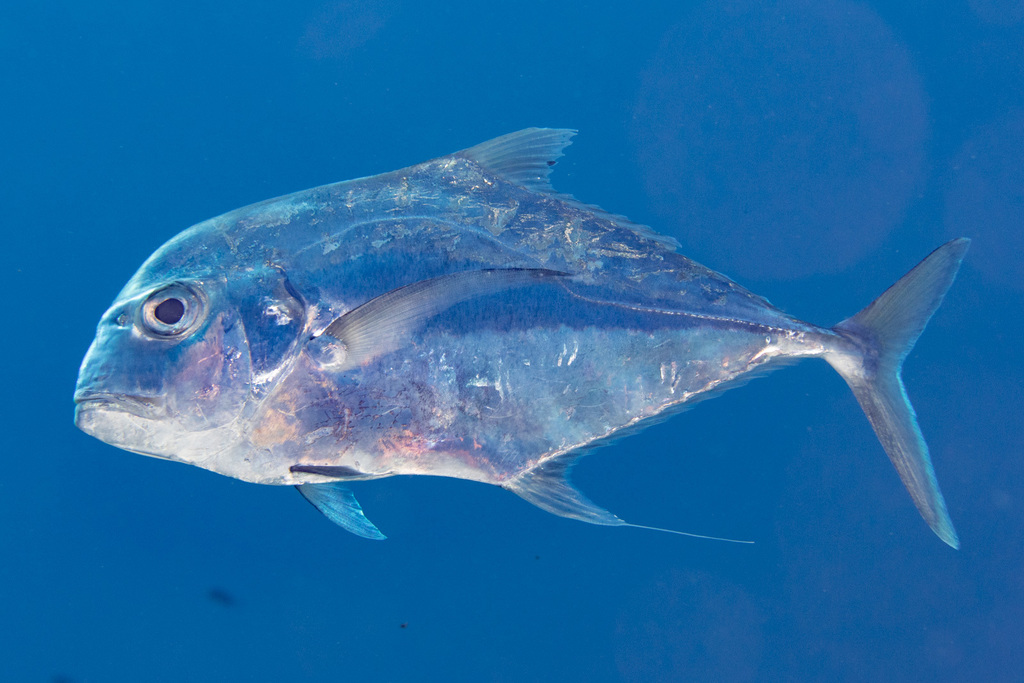
African pompano
- Family
- Carangidae
- Depth
- 60–100 m
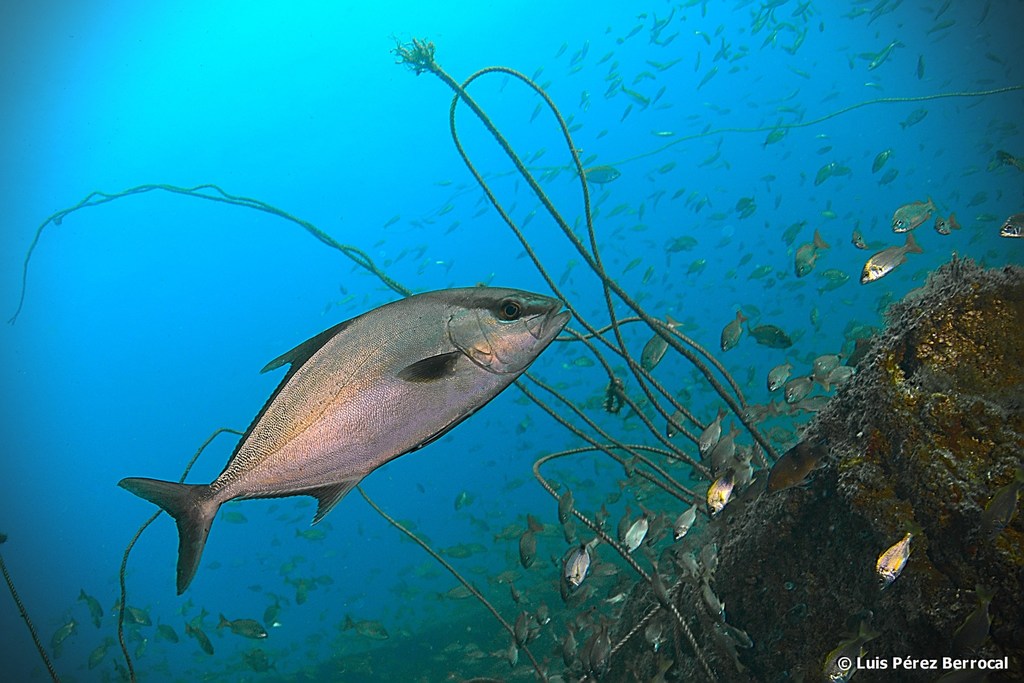
Almaco jack
- Family
- Carangidae
- Depth
- 5–245 m
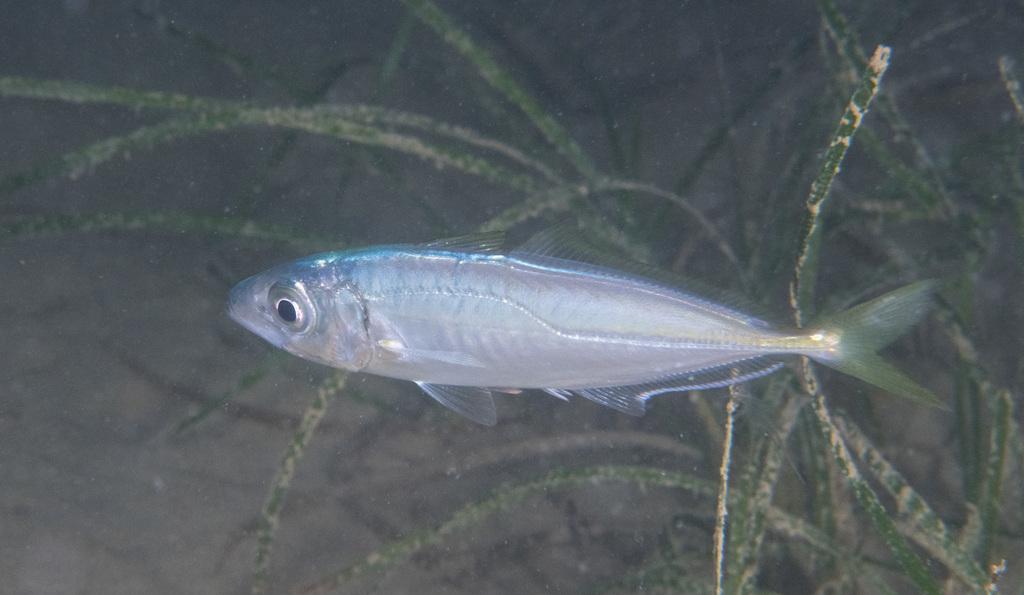
Atlantic horse mackerel
- Family
- Carangidae
- Depth
- 0–1050 m
- Season
- Jan, Feb, Mar, Apr, May, Jun, Jul, Aug, Sep, Oct, Nov, Dec
Guides for this water
Technique, gear and safety guides that fit Mediterranean horse mackerel.