
Chilean jack mackerel
The Chilean jack mackerel is a 70 cm carangid with a 45 cm common length, a 16-year maximum age and 823,994 GBIF records. The record volume is enormous, and the FishBase page still publishes no spawning month. That combination of record volume and missing reproductive data is the frame for this account.
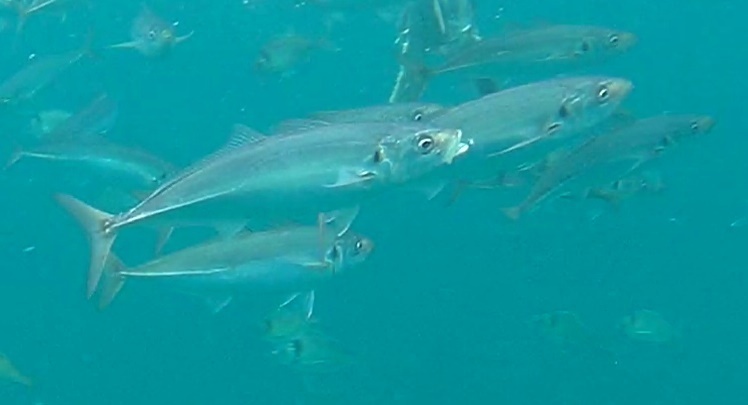
The Chilean jack mackerel is a 70 cm carangid with a 45 cm common length, a 16-year maximum age and 823,994 GBIF records. The record volume is enormous, and the FishBase page still publishes no spawning month. That combination of record volume and missing reproductive data is the frame for this account.
70 cm, 45 cm common, mature at 40.5 cm
The maximum length is 70.0 cm TL and the common length is 45.0 cm FL. The two figures use different length types, so the common length is not a simple percentage of the maximum; the page publishes both without converting one to the other. The maturity estimate is 40.5 cm, with a range of 39–42 cm.
The maximum reported age is 16 years. No maximum weight is published. The maturity estimate sits at 58 percent of the maximum length, and the upper end of its range is 42 cm.
The 45 cm common length is above the maturity estimate, which is consistent with a fished stock but does not by itself prove anything about the stock. The page lists no similar species, so the soft-ray counts and the locality carry the identification.
823,994 records, 822,307 of them Chilean
GBIF holds 823,994 records: 822,307 from Chile, 1,509 from New Zealand, 69 from Peru, 62 from Australia, and a handful from Colombia, Ecuador, Germany, Costa Rica and South Africa. FishBase gives a range that includes Peru and Chile, Juan Fernández, Ecuador, New Zealand and southern Argentina. iNaturalist carries 57 observations.
The Chilean share is 99.8 percent of the record set. That is a sampling and fleet pattern, not a statement that the fish is absent elsewhere. The 69 Peruvian records sit next to a FishBase range that puts Peru inside the distribution, and the 1,509 New Zealand records sit next to a southwest Pacific range statement. Read the counts as effort, and the range text as biology.
10 to 306 metres, usually 10 to 70
The depth range is 10–306 m, with a usual band of 10–70 m. The species is pelagic-oceanic and oceanodromous. The climate is subtropical, with coordinates from 2°N to 56°S and 141°E to 63°W.
The envelope is 296 m deep; the usual band is 60 m deep. Those are not the same fishery. A fish at 306 m is inside the record, but the page says the usual range stops at 70 m, which is the band a trolling or jigging plan can work. The longitudinal span crosses the Pacific, from 141°E to 63°W, which is consistent with the New Zealand and South American records.
A school fish that eats larvae and small crustaceans
Adults are found in shore and open oceanic waters, in schools. They feed mainly on fish larvae and small crustaceans. The page records no other prey group and no feeding time.
The species is marketed fresh, canned for human consumption and made into fishmeal. It is also taken as an incidental catch in the Juan Fernández fishery for Pseudocaranx chilensis. The diet is narrow in the record: larvae and small crustaceans. That points to small-profile lures and small bait rather than large fish baits, though the page publishes no hook or lure recommendation.
Trolling and jigging are the two mainstream methods
Trolling and jigging are both mainstream, and boat fishing is listed as secondary. The terrain tags are open water and shelf. The usual depth band of 10–70 m is the part of the range a boat can work without a deep-drop rig.
Trolling covers the upper part of that band; jigging can work the same band vertically. The page gives no gear specification, no line class and no lure size. The 70 cm maximum is the upper scale for tackle, while the 45 cm common length is the more useful planning figure.
No spawning month is published
The spawning field is empty. There is no month, no region, no temperature and no larval record on the page. For a species with a 16-year maximum age and a fishery described as highly commercial, that is a notable gap.
No preferred temperature is published either. The subtropical label and the 2°N–56°S span are the only climate information. A trip cannot be timed from this page; the seasonal signal has to come from national assessments or local experience, and this account does not invent one.
Data Deficient, and a fishery that may be collapsing
The IUCN category is Data Deficient, assessed on 30 April 2008. CITES and CMS are Not Evaluated, and the species is harmless to humans. The human-uses field says "highly commercial". Wikipedia states that since the 1970s the species has become one of the world's more important commercial fish species, that high volumes have been harvested, and that the fishery may now be in danger of collapsing.
Data Deficient and highly commercial are not a comfortable pair. The assessment is old, the page publishes no stock biomass, and the catch history is described only in general terms. The 57 iNaturalist observations are trivial against 823,994 GBIF records; they show encounters, not abundance.
Chilean and Peruvian rules, no numbers
In Chile, SUBPESCA sets the recreational rules and SERNAPESCA enforces them; a recreational licence, daily limits, minimum sizes and closed seasons (veda) apply, and marine protected areas include AMCP-MU sites and Parque/Reserva Marina designations such as Juan Fernández and Nazca-Desventuradas. In Peru, PRODUCE sets the fisheries rules and IMARPE provides the scientific assessment; management relies on minimum sizes, closed seasons and area measures, and SERNANP's Reserva Nacional de Paracas and Reserva Nacional San Fernando do not allow recreational fishing.
The species is recorded from both countries, and the Juan Fernández incidental catch makes the Chilean island rules relevant to a boat trip. No bag limit, minimum size or closed-season date is given here. Check the current rule and the protected-area map before the trip.
Where these facts come from
Check these pages before you rely on a size, range or protection status.
- FishBase — Trachurus murphyi — FishBase · T2
- GBIF — Trachurus murphyi occurrence records — GBIF · T2
- IUCN Red List — Trachurus murphyi — IUCN · T1
- Photo record — iNaturalist — iNaturalist · T3
Fish in the same water
These fish live in the same place.

African pompano
- Family
- Carangidae
- Depth
- 60–100 m

Almaco jack
- Family
- Carangidae
- Depth
- 5–245 m

Atlantic horse mackerel
- Family
- Carangidae
- Depth
- 0–1050 m
- Season
- Jan, Feb, Mar, Apr, May, Jun, Jul, Aug, Sep, Oct, Nov, Dec
Guides for this water
Technique, gear and safety guides that fit Chilean jack mackerel.