The blue jack mackerel is a carangid of the eastern Atlantic, recorded from the southern Bay of Biscay to southern Morocco, including the Azores, Madeira, the Canary Islands, Tristan da Cunha and Gough Island, and from the western Mediterranean; FishBase also lists Mauritania and notes that eastern Mediterranean reports need confirmation. Maximum length is 60 cm TL, common length 25 cm FL, length at first maturity 24.7 cm with a range of 24–49.5 cm, and maximum reported age 18 years. It is marine, benthopelagic, oceanodromous and subtropical, with a recorded depth range of 170–370 m.
Identification
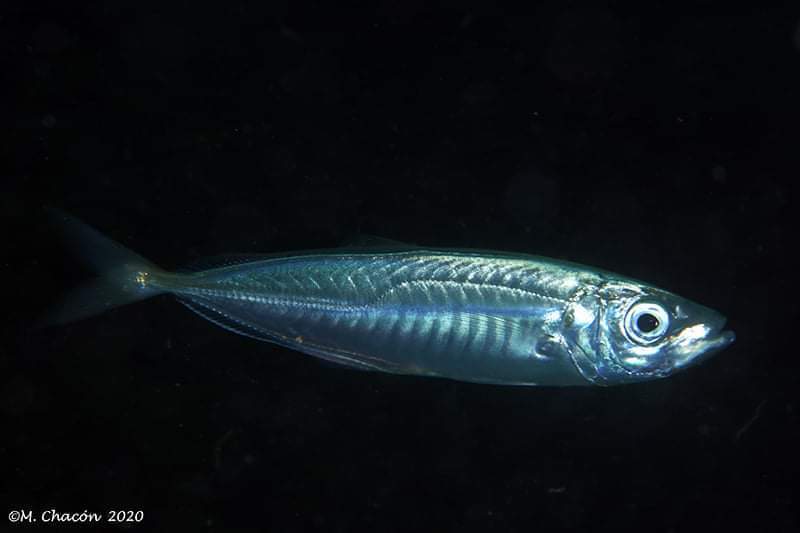
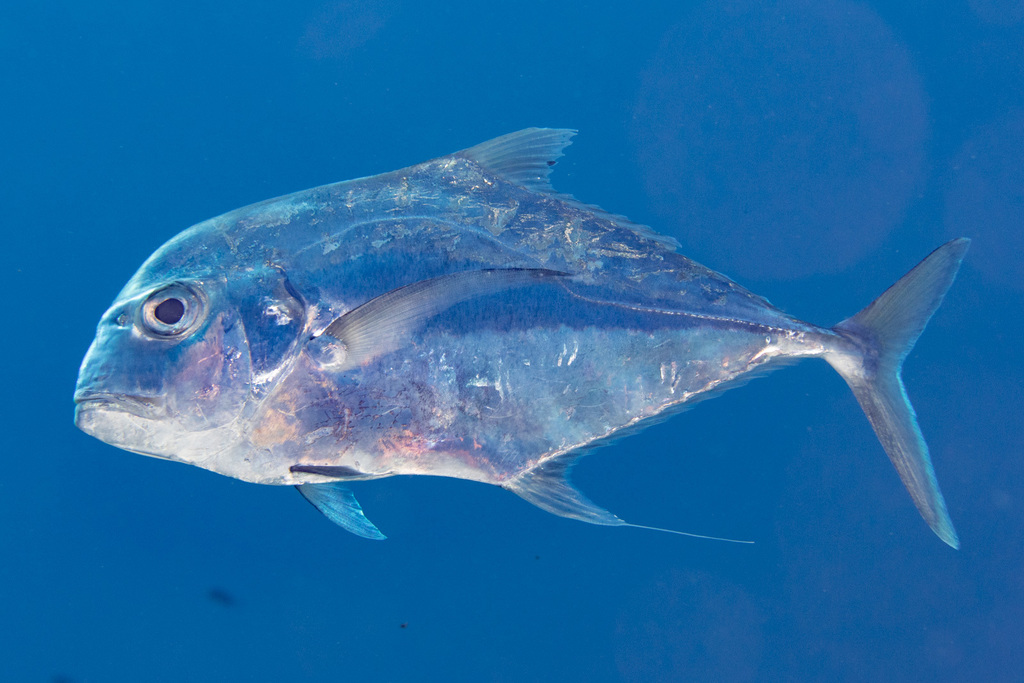
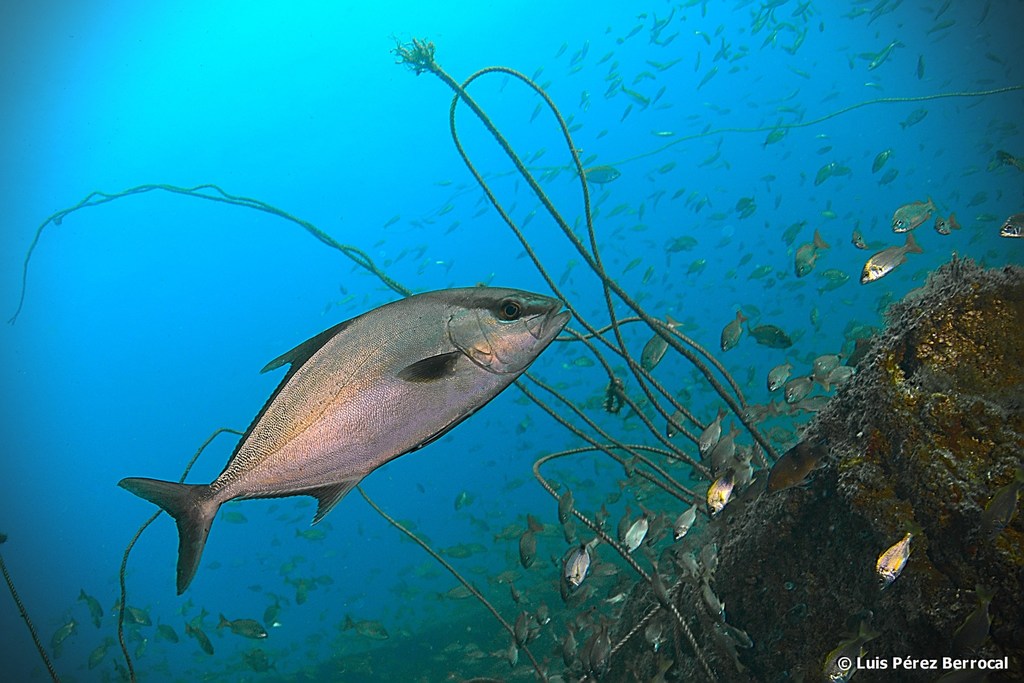
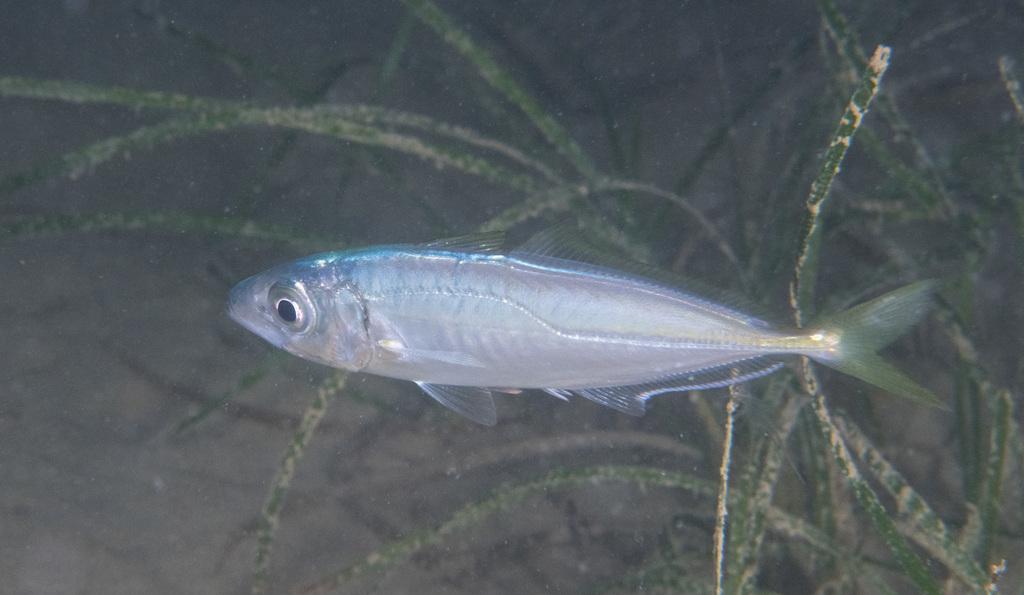
The blue jack mackerel has the carangid build: a fusiform body, a narrow caudal peduncle and a strongly forked tail. The genus character is the lateral line, which is armed with bony scutes toward the tail; the name Trachurus comes from the Greek for rough tail. FishBase's extracted morphology table for this species gives only the body shape, fusiform and normal, with no fin formula, so identification should not rest on counting spines at the rail.
The practical difficulty is that horse mackerel (Trachurus trachurus) occurs in the same waters and looks very similar. Separation relies on meristic characters and on the arrangement of the scutes, which is a bench job with a key or a good identification guide, not a judgement from a photograph. Use the pictures on the species page as a first filter and treat any fish that is not clear as a Trachurus sp.
Habitat and behaviour
FishBase describes the species as confined to neritic zones of island shelves, banks and seamounts, and as a schooling fish. Adults were recorded at 305–368 m in the eastern Ionian Sea, and the overall range is given as 170–370 m. The species is known to migrate between the coast of the Sahara and offshore seamounts, possibly reaching the Cape Verde Islands, and it feeds mainly on crustaceans. Eggs are pelagic.
The depth range is a record of capture, not a rule that the fish can only be caught deep. A schooling, oceanodromous carangid around island shelves also comes high in the water, and that is where trolling and shore casting meet it; the deep records come from research and trawl work. Read the two statements together rather than treating 170 m as a minimum fishing depth.
Seasonal window
The spawning table is split. Madeira records January to May, Portugal January to March, and the northern coast of Chile January, February and August to December; the pooled list has no June or July. The spread across hemispheres shows that the table is a compilation of local studies, not a single season, and it is not a bite forecast.
Around Madeira and the Azores the spring months carry the spawning record; on the Iberian coast the late-winter and spring record is the one that applies. In practice, blue jack mackerel is a warm-season, moving-water fish: it schools on the edges of shelves and around seamounts, and the fish show when the water is clear and there is current. Wind against current at an island point is a better clue than any month.
Gear and approach
A 2.4–2.7 m light spinning rod, a 2500–3000 reel, 10–15 lb braid and a 15–20 lb fluorocarbon leader handle most fish. Metal jigs of 20–40 g and small spoons cast well into a wind; a three-hook sabiki with a 60–100 g weight gets bait from a boat. For trolling, small feathers on 30–50 lb mono at 4–6 knots.
Because the mouth is soft, do not winch a fish to the tip; pump and wind, and lift with a hand on the leader only when the fish is calm. Blue jack mackerel is also a prime bait fish, so a few fish on ice serve two purposes.
Edibility and regulations
FishBase records the species as a commercial catch and harmless to humans. The flesh is oily and strong, and it is at its best bled and iced immediately; grilled, fried or marinated in the Portuguese and Spanish style it is a good fish, and it is also canned.
The IUCN category is LC (Least Concern), assessed on 10 May 2013; no CITES or CMS listing is recorded.
In EU waters the minimum conservation reference size for blue jack mackerel is 15 cm total length, in ICES areas V, VI and VII, the North Sea, the Mediterranean, areas VIII, IX and X, and CECAF area 34; Azores waters are excepted, and that exception should be checked locally. The United Kingdom also lists horse mackerel (Trachurus spp.) at 15 cm. Recreational bag limits are set nationally or regionally, and no EU-wide recreational bag limit was verified.
Where to look
GBIF holds 6,492 occurrence records, dominated by Portugal (5,392) and Spain (898), with much smaller counts from Italy (32), Israel (29), France (27), Greece (8) and the United States (7). FishBase's distribution is the southern Bay of Biscay to southern Morocco, the Azores, Madeira and the Canary Islands, and the western Mediterranean. The habitat keywords are coastal and open-water.
These are distribution signals, not coordinates. Look for shelf edges, seamounts and channel mouths around islands, watch for birds and surface disturbance, and check the landing rule before keeping a fish.
How to catch it
Shore casting
Fished with the listed approach, matched to the recorded depth and size.
Boat fishing
Fished with the listed approach, matched to the recorded depth and size.
Trolling
Fished with the listed approach, matched to the recorded depth and size.
Regulations before you keep it
These are the published regulations for this fish. Read the number first. The notice below it is the actual regulation.
Minimum size1
The minimum size for Blue jack mackerel in Portugal is ≥15 cm.
The 15 cm figure comes from the genus row for Trachurus spp. Portugal's table removes the minimum size for blue jack mackerel in Azorean waters.
Carapau-negrão (Trachurus picturatus) | 15 cm (b)
Every record above names its source and the date it was retrieved. See the regulation register for the full list, or how to read these regulations.
Where these facts come from
Check these pages before you rely on a size, range or protection status.
-
FishBase — Trachurus picturatus
— FishBase · T2
-
GBIF — Trachurus picturatus occurrence records
— GBIF · T2
-
IUCN Red List — Trachurus picturatus
— IUCN · T1
-
Photo record — iNaturalist
— iNaturalist · T3