
Jack mackerel
Jack mackerel is another no-bag-limit species in California, which makes it look free to take in any number. FishBase records a lifespan of up to 30 years and maturity at about 31 cm, so a small carangid that ends up in bait buckets by the dozen is not as expendable as its legal status suggests. It is also the fish most often mistaken for a small yellowtail, and the scutes along the lateral line separate them.
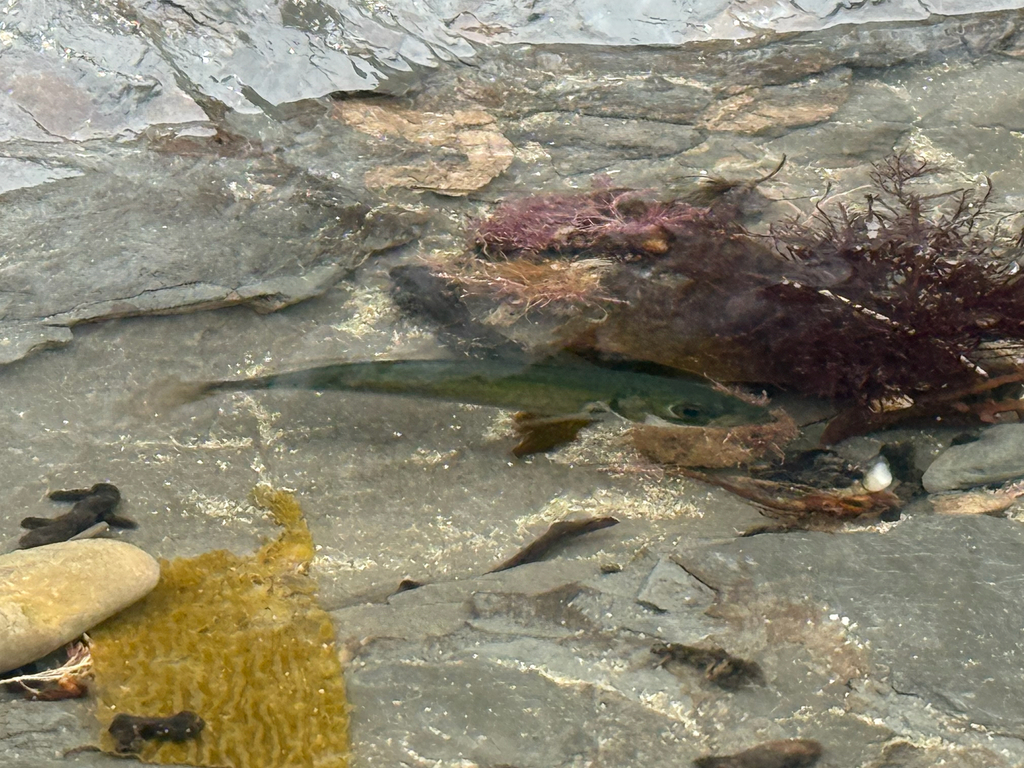
Jack mackerel is another no-bag-limit species in California, which makes it look free to take in any number. FishBase records a lifespan of up to 30 years and maturity at about 31 cm, so a small carangid that ends up in bait buckets by the dozen is not as expendable as its legal status suggests. It is also the fish most often mistaken for a small yellowtail, and the scutes along the lateral line separate them.
Scutes along the lateral line, and not a mackerel
A fusiform body, a blue-green or blue-grey back, a silver belly and a yellowish band along the middle of the flank. The dependable mark is the lateral line itself: in this species the scales along it harden into scutes, a row of raised ridges running from behind the gill cover to the tail base that feels rough under a thumb. A California yellowtail has a smooth wrist and no such row. FishBase gives eight to nine dorsal spines and 28 to 38 soft rays, one to two anal spines and 22 to 33 soft rays, and 23 to 25 vertebrae. The tail is deeply forked. It is a carangid, not a mackerel, whatever the English name says.
Offshore adults, pier-side juveniles
FishBase runs the range from southeastern Alaska to southern Baja California and the Gulf of California, with records at Acapulco and the Galápagos. It is an oceanic pelagic fish, recorded from the surface to 400 m, with adults often far offshore as part of a straddling stock in the northeast Pacific. Large individuals move inshore and north in summer, while young fish school near kelp and under piers. That splits the Southern California fishery in two: juveniles around piers and bays, adults offshore. The note about fish hundreds of miles at sea describes the commercial picture, not a shoreline trip.
Big fish come inshore in summer
FishBase states plainly that large individuals move inshore in summer, and that is the main rhythm of the local fishery; no month-by-month spawning table is given. Fish start showing as the water warms in spring, the run thickens from early to mid summer, autumn still holds schools, and winter pushes the fish offshore. They travel in groups, so a school means fish after fish and an empty stretch means a long quiet day. No preferred temperature is listed. Read water colour and bait instead of the calendar, because within one month the gap between a bay and an offshore bank can matter more than the season. The run is not uniform along the coast either; a pier inside a bay can hold fish a week before the open shore does.
Sabiki, small iron, and a bait that tolerates trolling
A sabiki rig at a pier is the efficient tool: small hooks tipped with glow fibre or a sliver of squid, little or no lead, the whole rig swinging slowly down the water column, several fish at a time. From a boat, a small iron or metal spoon cranked fast imitates the shrimp and small fish it chases, and when a school is up, fast beats slow. The diet is small crustaceans, fish eggs and larvae, so the bait stays small. Kept alive, it back-hooks or nose-hooks well and holds up to a slow troll better than a sardine does.
Light gear, and a mouth that tears
A seven-foot light to medium spinning rod with a 2500 to 4000 reel, 15 to 20-pound braid and a 10 to 15-pound fluorocarbon leader. The sabiki uses its own small hook set, joined to the main line through a swivel to stop the tangles. If bigger fish are the target, step the hooks up to 1/0 or 2/0 and the leader to 20 pounds. Do not lock the drag: the mouth is soft and tears under pressure. After a fish hits a sabiki, pause for a second before lifting, which keeps fish from dropping off and stops you from hanging more than you can handle.
Thirty years of life behind a no-limit label
The flesh is oily and strong and loses quality fast, which suits frying, smoking or canning; its value as bait usually exceeds its value as food. California lists the jack mackerel among the no-bag-limit species in 14 CCR § 27.60(b), with anchovy, sardine and Pacific mackerel, and sets no size limit. No bag limit is not no rules. The licence, the marine protected areas and the gear restrictions still apply, and every other fish in the box still counts against the general 20-fish aggregate with a 10-fish single-species cap. State and federal water can differ, so check the CDFW notice.
What the record supports, and what it leaves out
The 81 cm maximum, the 55 cm common length, the 30-year lifespan, maturity at about 31 cm, the 0 to 400 m depth, the Alaska to Baja range and the summer inshore movement all come from FishBase; no maximum weight is listed. A 30-year life and late maturity mean a population that recovers slowly under heavy removal, but FishBase and IUCN both list the species as Least Concern, assessed in 2008, and this article does not upgrade that to endangered. The no-bag-limit status comes from 14 CCR § 27.60(b). The month-by-month pattern is local fishing experience, not a survey.
How to catch it
Pier fishing
Size 8 to 12 hooks tipped with glow fibre, no lead, the rig sinking slowly through the column.
Small iron fast retrieve
A 20 to 40 g jig cranked steadily from a boat, switched to a jerk-and-pause when a school shows.
Trolling
Back-hooked and trolled at the slowest speed that keeps it swimming, a tougher bait than a sardine.
Where these facts come from
Check these pages before you rely on a size, range or protection status.
- FishBase — Trachurus symmetricus — FishBase · T2
- GBIF — Trachurus symmetricus occurrence records — GBIF · T2
- IUCN Red List — Trachurus symmetricus — IUCN · T1
- Photo record — iNaturalist — iNaturalist · T3
Fish in the same water
These fish live in the same place.

African pompano
- Family
- Carangidae
- Depth
- 60–100 m

Almaco jack
- Family
- Carangidae
- Depth
- 5–245 m

Atlantic horse mackerel
- Family
- Carangidae
- Depth
- 0–1050 m
- Season
- Jan, Feb, Mar, Apr, May, Jun, Jul, Aug, Sep, Oct, Nov, Dec
Guides for this water
Technique, gear and safety guides that fit Jack mackerel.