
Yellowfin croaker
The yellowfin croaker asks for three checks at once: yellow fins, oblique wavy bars along the flank, and two heavy spines in the anal fin. Miss one and it becomes a corbina, which carries a single weak anal spine and dark pectoral fins. It works the sand inside the surf line and the flats inside a bay, bites softly, and fights harder than its size suggests.
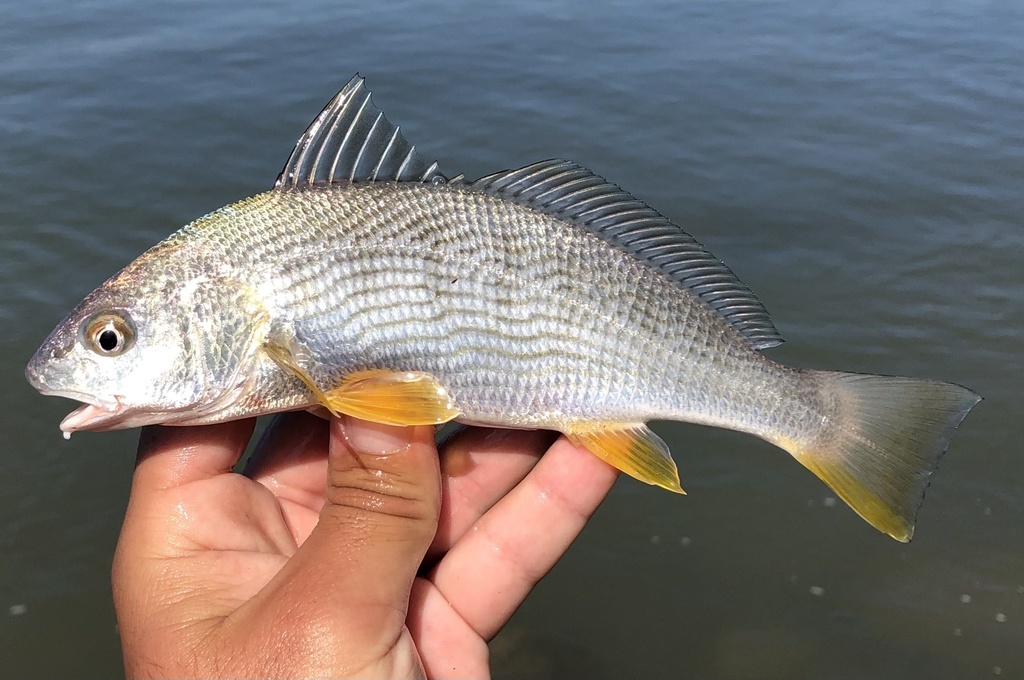
The yellowfin croaker asks for three checks at once: yellow fins, oblique wavy bars along the flank, and two heavy spines in the anal fin. Miss one and it becomes a corbina, which carries a single weak anal spine and dark pectoral fins. It works the sand inside the surf line and the flats inside a bay, bites softly, and fights harder than its size suggests.
Two heavy anal spines and a short chin barbel
Body fusiform, silver-grey with a copper cast above and a white belly. The reliable character is the anal fin: two stout spines, the second noticeably long. The California corbina has a single weak anal spine and distinctly dark pectoral fins, and those two features together settle the identification. Oblique wavy bars run down and back from the dorsal edge; they show best on a live fish and fade once it is on ice. The fins carry obvious yellow, visible in the anal, pelvic and lower caudal lobes. A short barbel hangs under the chin, much shorter than the long whisker on a corbina. In the hand, the barbel is short and stiff, not a long trailing filament.
Shallow sand, from the surf to the bay mouth
FishBase runs the range from Point Conception to the Gulf of California. The fish lives on shallow sand, commonly in the surf zone, bays and tidal sloughs, recorded from 10 to 60 m, though surf-caught fish sit far shallower than that band suggests. In Southern California the working grounds are the trough outside the sandbar, the flats at a bay mouth and the inside edge of a pier. The northern edge sits at Point Conception; treat anything beyond it as occasional. The species is a bay and beach fish before it is a reef fish.
Warm water, dirty surf, better fishing
Spawning is pelagic and FishBase gives neither a monthly table nor a spawning temperature. Local catches improve as the water warms in late spring, hold through summer and early autumn, and thin in winter when the surf schools break up and the fish run smaller. The species tracks swell and turbidity more closely than it tracks the calendar: after a swell lifts the sand, the surf bite usually recovers first and slows again as the water clears. On any given beach, check whether the last storm filled the trough. A flat beach with no gully fishes poorly no matter the month.
Cast past the bar and let the wash work
Surf casting is the main method: put the bait beyond the sandbar into the trough, with a sinker light enough that the wash moves it a little, so the bait travels along the bottom instead of sitting still. Inside a bay or along a pier, a light bottom rig with half a turn of the reel after the sinker lands drags the bait across clean sand. Nothing snags there, so the rig can be fine and the hook gap wide, which lets the fish hook itself as it turns. The bite usually shows as two taps and slack line; strike on the slack, not on the first tap. Circle hooks do most of the work if you let the rod load before lifting.
Long rods, light leaders, circle hooks
A 9 to 11 foot surf rod with a 4000 to 6000 size reel, 20 to 30 lb braid, a 15 to 20 lb fluorocarbon leader, 1/0 to 2/0 circle hooks and a sinker chosen between 1 and 4 oz for the day's swell. Clean sand does not need a heavy abrasion leader; finer line casts farther and lets the bait behave. Set the drag light. A croaker's first run is not fast but it is steady, and in shallow water the fish turns broadside and leans into the current. Do not drag it up the beach; wait until it lies on its side. Wet hands and a wet mat keep the release clean, and the fish swims off stronger.
Firm white flesh under a general bag limit
The flesh is white and firm, with fewer small bones than a white croaker; bleed it, ice it, and cook it whole, pan-fried or steamed. California's general marine bag limit is 20 fish in total with no more than 10 of any single species, and the yellowfin croaker has no size limit and no closed season (14 CCR § 27.60). State waters, generally 0 to 3 nautical miles, and federal waters from 3 to 200 can differ. Several Southern California beaches and bay mouths border MPAs or seasonal closures, so check the CDFW notice and the MPA map. A licence is required from 16.
Where each number came from
Range, the 10 to 60 m depth band, the 56 cm total length and 2.5 kg maximum, the shallow-sand and surf-zone habit, the diet of fish, crustaceans, marine worms and bivalves, and the IUCN LC assessment from 2020 all come from FishBase; that entry gives no maximum age, so none is offered here. The two anal spines and the short barbel follow the batch brief, because the FishBase morphology field describes only body shape. Monthly strength is regional angling experience. The Chinese name follows the master plan, with the FishBase name kept as an alias.
How to catch it
Surf fishing
Cast beyond the sandbar and let a light sinker travel with the wash so the bait works along the bottom instead of sitting pinned.
Boat bottom fishing
After the sinker lands, take half a turn of the reel to drag the bait across clean sand at a bay mouth or pier edge.
Night drag along the shallows
On the first of the ebb, walk the bait through a rip channel; fish leave the trough more readily in low light.
Where these facts come from
Check these pages before you rely on a size, range or protection status.
- FishBase — Umbrina roncador — FishBase · T2
- GBIF — Umbrina roncador occurrence records — GBIF · T2
- IUCN Red List — Umbrina roncador — IUCN · T1
- Photo record — iNaturalist — iNaturalist · T3
Fish in the same water
These fish live in the same place.

Acoupa weakfish
- Family
- Sciaenidae
- Depth
- 1–20 m
- Season
- Jan, Feb, Mar, Apr, May, Jun, Jul, Aug, Sep, Oct, Nov, Dec
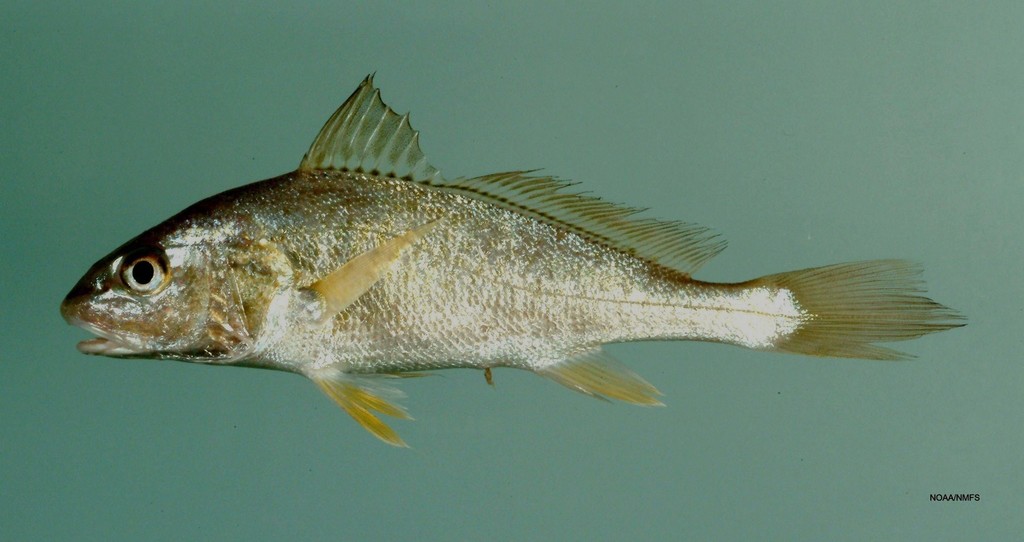
Atlantic croaker
- Family
- Sciaenidae
- Depth
- ≤ 100 m
- Season
- Jan, Feb, Mar, Apr, May, Jun, Jul, Aug, Sep, Oct, Nov, Dec
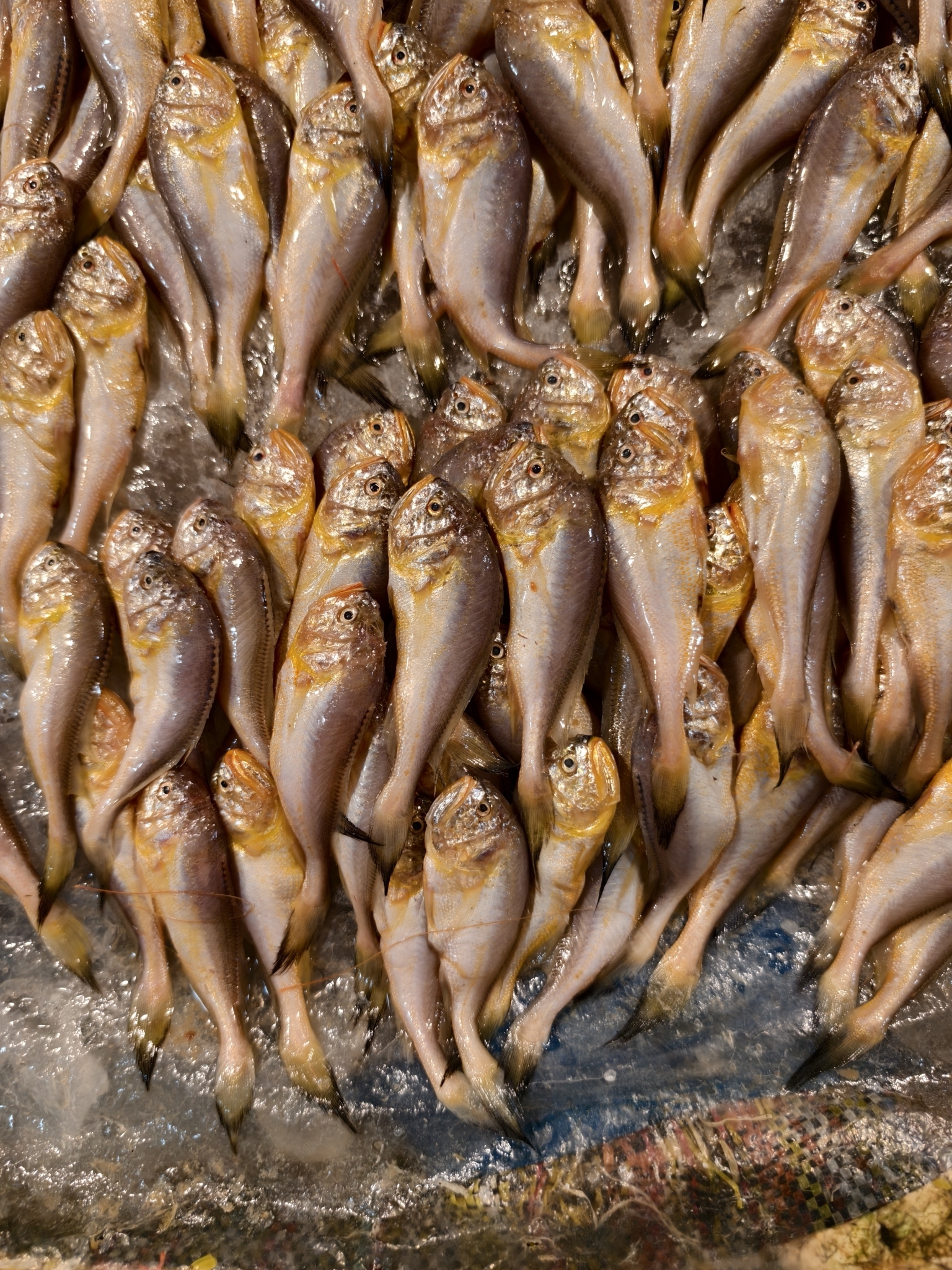
Bighead croaker
- Family
- Sciaenidae
- Depth
- ≤ 90 m
- Season
- Jan, Mar, Apr, May, Jun, Jul, Aug, Sep, Oct, Nov, Dec
Guides for this water
Technique, gear and safety guides that fit Yellowfin croaker.