
Spotted seabass in France: ≥30 cm — France — North Sea, Channel and Atlantic.
| BAR MOUCHETE | Dicentrarchus punctatus | 30 cm |
Quoted from Arrêté du 26 octobre 2012 — tailles minimales de capture (pêche maritime de loisir)
Regulation guide
Official sourcesHow spotted seabass is regulated
Spotted seabass, Dicentrarchus punctatus, is bar moucheté in France. It is a different species from the European seabass, Dicentrarchus labrax, and the two are listed separately where both appear.
Only France publishes a minimum size for spotted seabass in the instruments here: 30 cm in the Atlantic list. Portugal's current table has no entry for the species, and the UK table lists only European bass.
The practical risk is that a spotted seabass is recorded as a European bass, or the reverse, and the wrong figure is applied. The French list separates them, and the separation matters because the figures differ.
A size table that lists only one of the two bass does not give the other a figure by implication; the species has to be matched to its own row.
Source: Légifrance: Arrêté du 26 octobre 2012, annexe I · DGRM: Tabela de Tamanhos Mínimos de Captura (26 February 2026) · GOV.UK / MMO: Minimum Conservation Reference Sizes (MCRS) in UK waters
France: 30 cm in the Atlantic list
Annex I of the arrêté of 26 October 2012 lists BAR MOUCHETE, Dicentrarchus punctatus, at 30 cm in part I, covering the North Sea, the Channel and the Atlantic. Part II, the Mediterranean list, has no bar moucheté entry.
The same table lists BAR COMMUN, Dicentrarchus labrax, at 42 cm in the Atlantic and 30 cm in the Mediterranean. A spotted seabass and a European bass of the same length can therefore fall on different sides of the rule in the Atlantic.
The order applies to fishing from vessels without a commercial permit, swimming and diving, and fishing on foot on the public maritime domain, and it binds French-flagged pleasure craft outside French waters.
The order sets no bag limit or season for bar moucheté. Its 30 cm is the whole of the French species rule.
The 30 cm is 12 cm below the Atlantic figure for European bass, so the two rows cannot be used interchangeably.
Portugal: no entry in the current table
DGRM's table dated 26 February 2026 lists Robalo-legítimo (Dicentrarchus labrax) at 36 cm but has no row for Dicentrarchus punctatus under any Portuguese name.
DGRM's species page states that fish below the minimum sizes fixed for commercial fishing may not be taken, but a species with no entry has no figure to apply from that table.
A 20 cm figure for spotted seabass in Portugal cannot be traced to the current DGRM table, so it should not be relied on without a separate national instrument.
Portugal's general recreational rules still apply to any retained fish: a licence apart from limited exceptions, a 10 kg daily cap with the heaviest fish not counted, 15 kg for spearfishing, and marking before leaving the site or landing.
Source: DGRM: Tabela de Tamanhos Mínimos de Captura (26 February 2026) · DGRM: Pesca Lúdica - Espécies · DGRM: Licenças
Telling the two bass apart
The French list is the clearest official example of the two species side by side: bar commun at 42 cm and bar moucheté at 30 cm in the Atlantic, and bar commun at 30 cm in the Mediterranean with no spotted bass entry.
The UK table lists Bass, Dicentrarchus labrax, at 42 cm and has no spotted seabass row. Spain's Real Decreto 560/1995 lists lubina (Dicentrarchus labrax) at 36 cm on the Atlantic grounds, again without a spotted seabass row.
Where only one of the two species is listed, the unlisted one has no size in that table; it does not inherit the other's figure.
In France the two rows also differ in the Mediterranean: the European bass is 30 cm there, which is the same figure as the Atlantic spotted bass, so the sea area has to be checked as well as the species.
Source: Légifrance: Arrêté du 26 octobre 2012, annexe I · GOV.UK / MMO: Minimum Conservation Reference Sizes (MCRS) in UK waters · BOE: Real Decreto 560/1995, annex I
No bag limit, and how to measure
No instrument cited here sets a bag limit for spotted seabass. France sets a size only, and Portugal's general 10 kg daily cap applies to a retained catch whatever the species.
Measure from the tip of the snout to the end of the caudal fin. The tail is included, and the measurement is taken flat, without stretching the fish.
Because the French Atlantic figures are 30 cm and 42 cm for the two bass, identify the fish before measuring: a 35 cm spotted seabass is legal, while a 35 cm European bass is not.
In Portugal, the 10 kg cap applies to the whole catch, so a retained spotted seabass counts towards it.
The Portuguese 10 kg cap and the French size rule are separate controls: one limits the weight retained, the other the size of each fish, and a catch can comply with one and breach the other.
Source: Légifrance: Arrêté du 26 octobre 2012, annexes I and II · DGRM: Pesca Lúdica - Espécies
Official pages: Légifrance: Arrêté du 26 octobre 2012 (tailles minimales, pêche de loisir) · DGRM: Tabela de Tamanhos Mínimos de Captura · DGRM: Pesca Lúdica - Espécies · GOV.UK / MMO: Minimum Conservation Reference Sizes (MCRS) in UK waters
Spotted seabass regulations at a glance
2 jurisdictions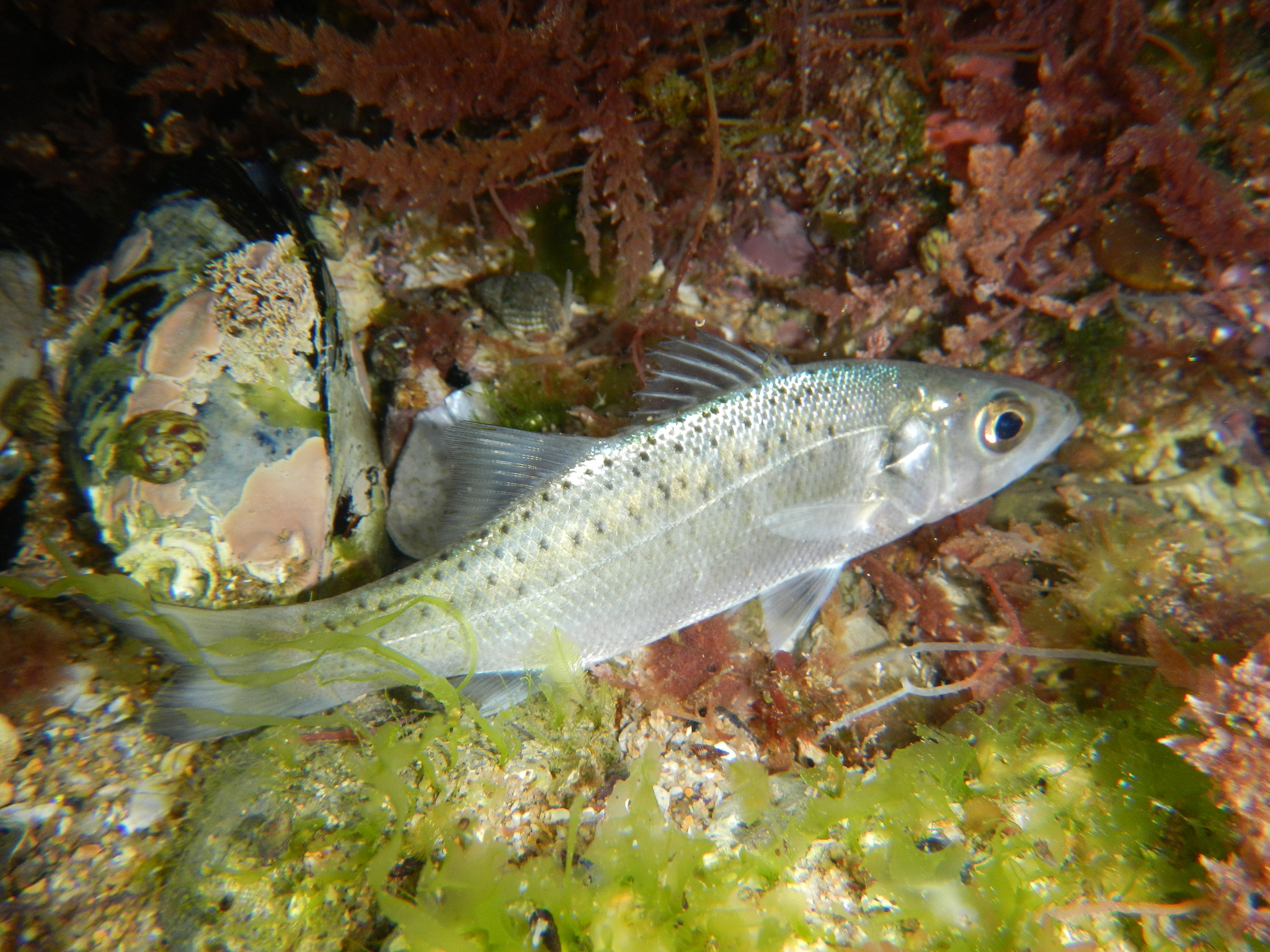
Spotted seabass
Dicentrarchus punctatus · Moronidae
Spotted seabass is recorded across the Eastern Atlantic, from English Channel (occasional) southward along the coasts of Europe and Morocco to Senegal and the Canary Islands, within the family Moronidae. It is caught deeper than 30 m, in subtropical water. It tops out at 70 cm TL, on a diet of fishes. Anglers target it by shore casting or boat fishing. The season runs January to June.
- Family
- Moronidae
- Max length
- 70 cm TL
- Depth
- ≥ 30 m
- IUCN
- LC
- Climate
- Subtropical
- Diet
- fishes
Spotted seabass (Dicentrarchus punctatus) is a fish of the family Moronidae. FishBase gives its range as: Eastern Atlantic: English Channel (occasional) southward along the coasts of Europe and Morocco to Senegal and the Canary Islands; also southern Mediterranean and the Gulf of Suez. It is recorded deeper than 30 m, in subtropical water. The recorded maximum is 70 cm TL. Common length is recorded at 30 cm. Diet includes fishes. IUCN status: Least Concern (LC). Chinese name: .
Techniques
- Shore casting —
- Boat fishing —
Seasonality
Other FR regulations
Same jurisdictionBefore you keep a fish
- Read the recorded value. It is copied from the notice; if the number and the notice disagree, the notice wins.
- Check the area. Federal, state and local waters can set different limits for the same fish.
- Check the date. Seasons, quotas and closures change; confirm the current notice before you go.
Common questions
- What is the minimum size for Spotted seabass in France?
- ≥30 cm
- Where does this regulation apply?
- France — North Sea, Channel and Atlantic
- When was it checked?
- 2026-11-18, against Arrêté du 26 octobre 2012 — tailles minimales de capture (pêche maritime de loisir).
- Do other jurisdictions set different limits?
- Yes. This register lists 2 jurisdictions for Spotted seabass; compare them in the table above.