
European seabass in France: 3 fish per person per day (ICES 7 and 4) · 2 fish (ICES 8) · catch and release only, February 1 – March 31.
Un maximum de trois spécimens de bar européen peut être capturé et détenu par pêcheur et par jour / Un maximum de deux spécimens de bar européen … en zone CIEM 8 / Du 1er février au 31 mars 2026 : a) Seule la pêche de type « capture suivie d’un relâcher » … est autorisée
Quoted from Arrêté 2026:pêche du bar européen (JORF)
This arrêté is the 2026 annual measure and is renewed each year.
Regulation guide
Official sourcesHow European seabass is managed
European seabass is a shared stock, and the rules that decide whether a fish may be kept are written for ICES divisions rather than for a single coastline. In the UK the Marine Management Organisation (MMO) publishes statutory bass guidance that gathers the measures in Council Regulation (EU) 2020/123, as retained in UK law and amended by the Sea Fisheries (Amendment) Regulations 2026.
Within the UK the MMO is the fisheries administration for England, while the Marine Directorate, DAERA and the Welsh Government act for Scotland, Northern Ireland and Wales. The guidance covers commercial and recreational fishing, from boat and from shore, and sets out the size, bag, gear and seasonal limits in one place.
Source: GOV.UK / MMO: Bass Fishing Guidance (updated 27 February 2026)
UK waters: 42 cm, three fish and a spring release period
The minimum conservation reference size for bass in the UK is 42 cm, and fish below it must not be retained on board but returned to the sea immediately. The guidance adds that undersized bass found stored, transported or offered for sale may be seized by officers investigating the source.
Recreational fishing in ICES divisions 4b, 4c, 6a, 7a and 7d to 7j is catch-and-release with rod and handline only from 1 February to 31 March. Outside that window the bag limit is three fish per day. The rules apply whether you fish from a boat or from the shore, and no bass may be taken by fixed nets.
Source: GOV.UK / MMO: Bass Fishing Guidance (updated 27 February 2026)
Bass nursery areas and local closures
The Bass (Specified Areas) (Prohibition of Fishing) Order 1990 prohibits fishing for bass, or fishing for any species of sea fish with sand-eels, from a fishing boat within listed bass nursery areas during the periods set out in the order. The MMO guidance states that nursery-area restrictions apply to commercial and recreational fishers alike, and that they may include additional catch-and-release periods beyond the national one.
In England, Inshore Fisheries and Conservation Authorities can add local restrictions, so the national bag limit is not the end of the check for an angler fishing an estuary or a recognised nursery area.
Source: GOV.UK / MMO: Bass Fishing Guidance (updated 27 February 2026) · The Bass (Specified Areas) (Prohibition of Fishing) Order 1990
Ireland: two fish in 24 hours and a May to June closure
Irish bass rules rest on the Bass Fishing Conservation Bye-Law No. 826 of 2007 (S.I. No. 368 of 2007). The bye-law prohibits taking and killing, or having in possession, more than two bass in any period of twenty-four hours, and prohibits fishing or attempting to fish for bass with any rod, line or weir from 15 May to 15 June each year.
The Sea-Fisheries Protection Authority lists 42 cm as the minimum conservation reference size for sea bass within the Irish exclusive economic zone. A written answer in the Oireachtas in April 2025 records that February and March are catch-and-release only, with a two-fish daily limit in January and from 1 April to 31 December.
Source: Irish Statute Book: S.I. No. 368/2007, Bass Fishing Conservation Bye-Law No. 826 of 2007 · Sea-Fisheries Protection Authority: Minimum Conservation Reference Sizes · Houses of the Oireachtas: Written Answers, 2 April 2025
France: three fish in ICES 7 and 4, two in ICES 8
France regulates recreational bass fishing through a dedicated annual order rather than through the general size table alone. The arrêté of 1 April 2026 authorises recreational bass fishing in ICES divisions 7 and 4, corresponding to the Channel and the North Sea, on foot or from the shore, from a boat, or underwater.
From 1 February to 31 March only catch-and-release with rod or handline is permitted, and bass caught in that period may not be held, transferred, transhipped or landed. In January and from 1 April to 31 December the limit is three fish per fisher per day. In ICES division 8, the Atlantic zone, the limit is two fish per fisher per day. Fixed nets may not be used to catch or hold bass in either area.
Source: Légifrance: Arrêté du 1er avril 2026 réglementant la pêche de loisir du bar européen
Spain and Portugal: 36 cm on the Atlantic coast
Spain sets national minimum sizes in Real Decreto 560/1995, whose annexes were replaced by Real Decreto 936/2025. On the Cantabrian/Northwest and Gulf of Cadiz grounds the table gives bass a minimum of 36 cm, with a footnote raising it to 44 cm in ICES divisions 8a and 8b for both commercial and recreational fishing.
Portugal's Directorate-General for Natural Resources, Safety and Maritime Services (DGRM) lists 36 cm as the minimum size for robalo legítimo, Dicentrarchus labrax, in its species and minimum-size guidance. That is the figure to apply in Portuguese waters, subject to any stricter rule in force.
Source: BOE: Real Decreto 560/1995 (consolidated text, updated 1 November 2025) · DGRM: Espécies / Tamanhos Mínimos / Defesos
Measuring a bass and checking before you keep one
France's minimum-size order measures a fish from the tip of the snout to the end of the caudal fin, in both its Atlantic and Mediterranean lists, following the EU technical rules to which the order refers. The tail is therefore included, and a fish should not be measured to the fork.
Before keeping a bass, check the ICES division, the date, any nursery-area or IFCA rule, and the size that applies on that coast: 42 cm in UK and Irish waters, 42 cm in the French Atlantic and 30 cm in the French Mediterranean, and 36 cm on the Spanish Atlantic grounds, apart from ICES divisions 8a and 8b, where Spain applies 44 cm. Portugal's figure is also 36 cm.
Source: Légifrance: Arrêté du 26 octobre 2012 fixant les tailles minimales de capture (pêche de loisir) · GOV.UK / MMO: Bass Fishing Guidance (updated 27 February 2026)
Official pages: GOV.UK / MMO: Bass Fishing Guidance · Irish Statute Book: S.I. No. 368/2007 · Légifrance: Arrêté du 1er avril 2026 (bar européen) · BOE: Real Decreto 560/1995 · DGRM: Tamanhos mínimos
European seabass regulations at a glance
10 jurisdictions| Jurisdiction | Area | Size | Bag | Season / closure | Closed area | Other |
|---|---|---|---|---|---|---|
| France | Atlantic, Channel and North Sea: 42 cm · Mediterranean: 30 cm | 3 fish per person per day (ICES 7 and 4) · 2 fish (ICES 8) · catch and release only, February 1 – March 31 | — | — | — | |
| Ireland | ≥42 cm (retained fish) | — | — | — | — | |
| Ireland | Ireland | — | 2 bass per person per 24 hours | No bass angling 15 May – 15 June | — | — |
| Portugal | Portugal (mainland) | ≥36 cm | — | — | — | — |
| Spain | Spain — Cantabrian/Northwest and Gulf of Cadiz grounds | ≥36 cm; ≥44 cm in ICES divisions 8a and 8b | — | — | — | — |
| Spain | Spain — Mediterranean | ≥23 cm | — | — | — | — |
| Spain — Canary Islands | Spain — Canary Islands | ≥22 cm | — | — | — | — |
| United Kingdom | — | 42 cm · catch and release only, February 1 – March 31 · 3 fish per day at other times | — | — | — | |
| United Kingdom | UK waters | ≥42 cm | — | — | — | Gear / method: Fixed nets may not be used to take bass |
| United Kingdom | UK waters, ICES divisions 4b, 4c, 6a, 7a, 7d–7j | — | — | Catch and release only, February 1 – March 31 | — | — |
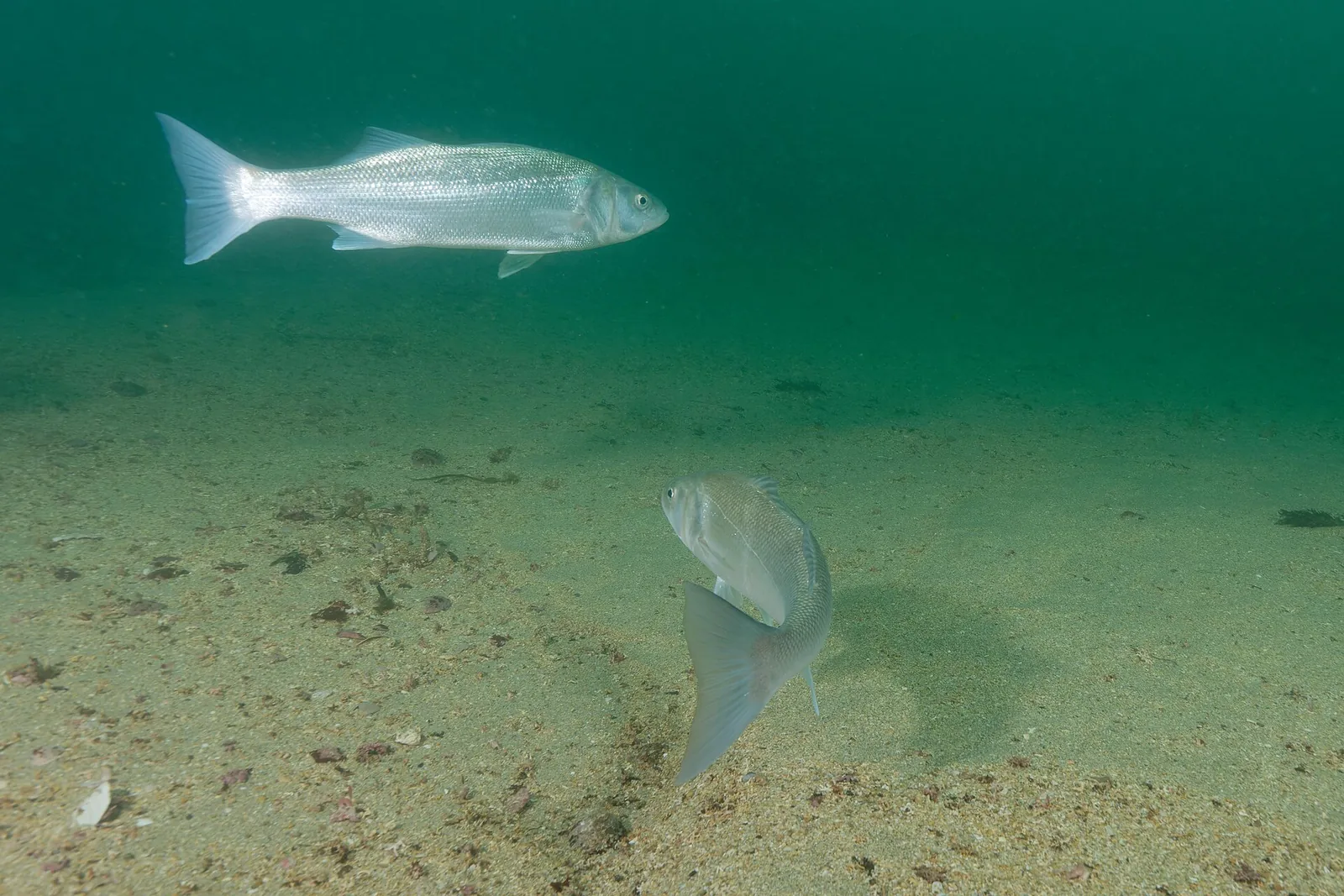
European seabass
Dicentrarchus labrax · Moronidae
European sea bass is a catadromous fish recorded from freshwater through brackish to full seawater, at 10–100 m and 8–24 °C, reaching 103 cm and 12 kg. Its first years are spent in shallow mixed water; adults move between estuary, surf line and open coast. The useful question is which part of the salinity gradient holds fish today.
- Family
- Moronidae
- Max length
- 103 cm TL
- Max weight
- 12 kg
- Max age
- 30 years
- Depth
- 10–100 m
- IUCN
- NT
- Climate
- Subtropical · 8–24 °C
- Diet
- fishes
European sea bass is the fish that makes the salinity line worth reading. FishBase classes it as catadromous, able to live in freshwater, brackish and marine water, and records it from 10 to 100 m over a subtropical range of 8–24 °C. A 103 cm maximum, a 50 cm common length and 12 kg top weight describe an animal that spends its first years in shallow, mixed water and its adult life moving between estuary, surf line and open coast. That movement is why two anglers fishing the same river mouth on the same tide can catch fish of completely different size classes, and why the useful question is not "where is the bass" but "which part of the gradient is holding fish today".
Techniques
- Shore casting —
- Trolling —
- Fly fishing —
Baits
- Sandeel
- Paddle-tail soft plastic
- Surface plug
- Ragworm
Seasonality
Peak May–SepTwo hours either side of high water is the classic window, especially on spring tides.
A warm south-westerly and lightly coloured water improve the surf zone. Cold north wind usually pushes fish deep.
Other FR regulations
Same jurisdictionBefore you keep a fish
- Read the recorded value. It is copied from the notice; if the number and the notice disagree, the notice wins.
- Check the area. Federal, state and local waters can set different limits for the same fish.
- Check the date. Seasons, quotas and closures change; confirm the current notice before you go.
Common questions
- What is the bag limit for European seabass in France?
- 3 fish per person per day (ICES 7 and 4) · 2 fish (ICES 8) · catch and release only, February 1 – March 31
- Where does this regulation apply?
- When was it checked?
- 2026-11-11, against Arrêté 2026:pêche du bar européen (JORF).
- Do other jurisdictions set different limits?
- Yes. This register lists 10 jurisdictions for European seabass; compare them in the table above.