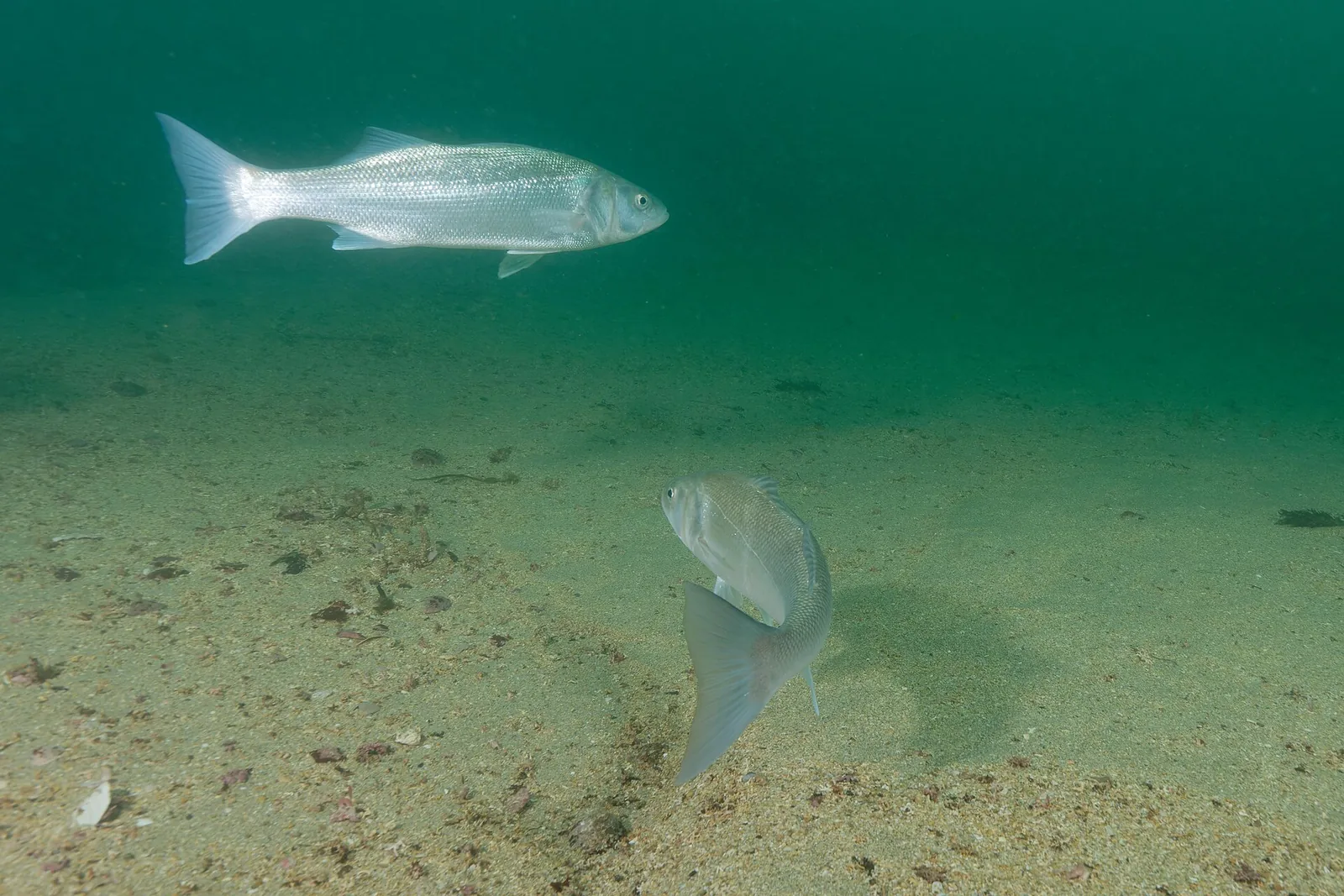
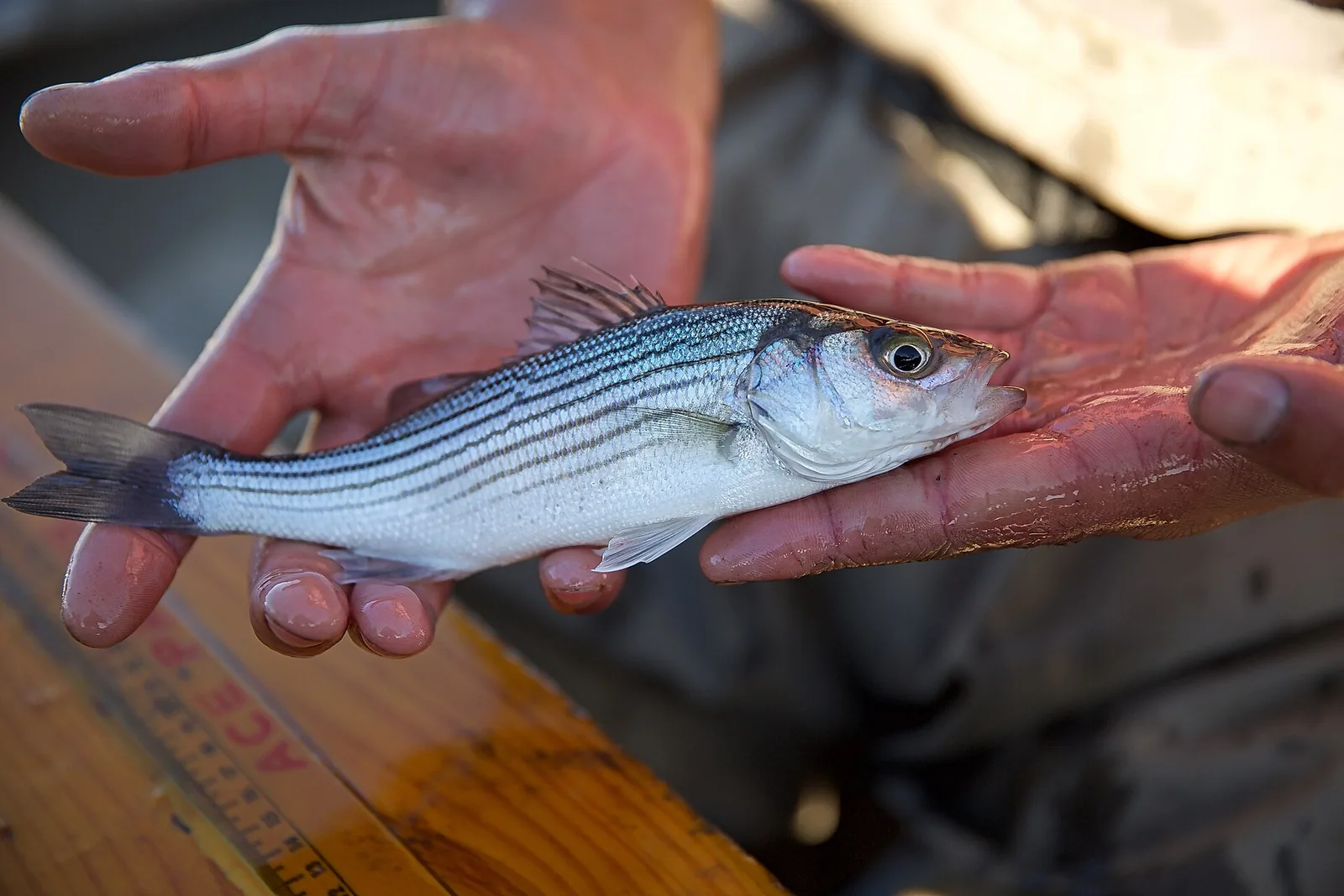
European sea bass is the fish that makes the salinity line worth reading. FishBase classes it as catadromous, able to live in freshwater, brackish and marine water, and records it from 10 to 100 m over a subtropical range of 8–24 °C. A 103 cm maximum, a 50 cm common length and 12 kg top weight describe an animal that spends its first years in shallow, mixed water and its adult life moving between estuary, surf line and open coast. That movement is why two anglers fishing the same river mouth on the same tide can catch fish of completely different size classes, and why the useful question is not "where is the bass" but "which part of the gradient is holding fish today".
A species that moves across the salinity line
The bass is not a freshwater fish that tolerates salt, nor a sea fish that strayed upstream. It is built to cross the boundary repeatedly. Nursery grounds sit in estuaries and coastal lagoons, where small fish find cover and warmer water; the adults range out over the continental shelf and return to saltier water to spawn. FishBase's spawning table for the species lists records from January to June and again in November and December, drawn from Algeria, Croatia, Egypt, France, Tunisia and Britain. A spawn that long, spread over that many latitudes, means there is no single closed season to plan around: the stock spawns in pulses, and the estuary refills with juveniles on its own schedule.
For an angler the practical consequence is that a mark can hold three populations at once. Resident sub-adults live in the estuary year round. Pre-spawn adults push in during late winter and spring. Post-spawn fish filter back out through the same channel in early summer. Each group responds to different cues, and the same lure fished the same way will only reach one of them.
What the estuary fish and the surf fish have in common
Both are ambush predators that use structure rather than open water. FishBase's habitat keywords for the species are estuary, coastal, deep and open-water, which reads like four different fish until you notice that all four share one property: an edge. In the estuary the edge is the channel wall, the pier shadow or the line where the ebb scours a hole. On the coast it is the first gut behind the bar, the rock-to-sand transition, or the shadow line under a harbour light. The fish holds on the dark side of that edge and waits for prey to be swept across.
That is the reason a bass mark that produces at dawn can go dead at noon without any change in fish numbers. The edge is still there, but the light has moved the ambush point. Fishing a shadowed wall at midday is usually more productive than fishing the same wall in full sun, and the difference is visible from the shore before the first cast.
Reading the tide on a brackish flat
Estuary bass fishing is a tide problem before it is a lure problem. In a narrow channel, the current reverses within minutes of slack water and the fish reposition with it. The productive window is not the whole flood or the whole ebb; it is the two hours on either side of the turn, when the current is still moving but no longer ripping, and baitfish are being pushed against structure they cannot pass.
A simple sequence works on most European estuary marks. Fish the last of the ebb where the channel narrows, because that is where bait is being flushed out. Follow the flood back up the same bank as the water covers the flat, casting to the new edge rather than the old one. When the tide is at full and movement stops, move to the deepest hole within casting range and work it slowly. Fish holding in a slack estuary are not chasing; they are waiting for the current to start again, and a slow-swum lure at their level beats a fast one retrieved past them.
The salinity gradient itself is a usable marker. After heavy rain the brackish layer pushes seaward and the fish move with it, so the lower estuary fishes better than the upper. In a dry spell the salt wedge runs further upstream and the upper marks come back into play. This is a mechanism, not a rule of thumb: the fish follow the water they can tolerate, and the water moves with rainfall.
Seasons: a long spawn that resets the estuary
FishBase's spawning records run from January to June and again in November and December, which covers most of the year once latitude is taken into account. The Mediterranean populations spawn earlier than the Atlantic ones, and the Atlantic ones earlier than the North Sea margin. For a visiting angler the useful reading is that late winter and spring fish are pre-spawn and heavy, early summer fish are post-spawn and thin, and autumn fish are rebuilding.
FishBase lists the species as subtropical with a recorded range of 8–24 °C. Water below about 8 °C slows feeding sharply, and the coldest weeks push fish into deeper water or into the warmest available estuary. That is when a slow, deep presentation at the harbour mouth outperforms working the flats.
Lures and baits that cross the gradient
Because the fish move between salinities, the forage changes with them. In the estuary the diet is dominated by small fish and crustaceans; on the open coast it shifts toward sandeels, small scads and whatever is schooling. FishBase's diet record lists fishes, which is accurate and not very helpful. The workable version is to match the length of the bait you can see: 6–9 cm in the estuary in spring, 10–14 cm on the coast in autumn.
Soft plastics on a 10–20 g jig head cover most estuary situations. A shallow-running minnow works the surface layer over a flooded flat. A metal lure is the coast tool, for reaching the gut behind the bar when the wind is against you. Live bait is legal in some jurisdictions and not others, and that is a rule question rather than a fishing question.
Tackle for 50 cm fish that can reach 103 cm
The common length of 50 cm sets the working tackle; the 103 cm maximum and 12 kg top weight set the margin. A 2.4–2.7 m rod rated for 10–40 g handles estuary work and most coastal days. Braid of 0.13–0.16 mm with a 0.30–0.35 mm fluorocarbon leader covers both, and the leader is the part that matters around rock and pier legs.
Set drag by pulling line off the spool by hand until it slips at roughly a third of the leader's stated breaking strain. A bass of 5 kg can make two hard runs on the same tide, and a drag set for a 2 kg fish will either break the leader or exhaust the fish past release. Carry a landing net with soft mesh: the fish is often released, and a treble hook in a gill cover is the usual way a release goes wrong.
Eating, farming and the NT listing
FishBase records the species as commercially fished and commercially farmed, and as a gamefish. The IUCN Red List category carried in the same record is NT, Near Threatened, assessed on 3 March 2022. NT is not a prohibition. It means the species is close to qualifying for a threatened category, and the assessment refers to the wild stock, not to farmed fish sold in shops.
That distinction matters at the counter and on the boat. A farmed bass and a wild bass are the same species with different histories, and a market label rarely separates them. For an angler the relevant consequence is that retention rules are local and change: EU member states, the UK and Mediterranean states each set their own minimum size and bag limit. Read the rule for the water in front of you, not the one from a forum post in another country.
Two places to start, and how to read them
GBIF's occurrence index returns 53,255 European sea bass records, led by Belgium at 17,558, the Netherlands at 14,304, France at 11,300, Britain at 5,517 and Spain at 1,709. That ranking is a statement about where records are collected, not where the fish are most abundant. Belgian and Dutch numbers reflect dense coastal monitoring in the southern North Sea; Spanish numbers are lower despite a long coastline and a large bass fishery.
iNaturalist's 3,593 observations add a different bias: they cluster where photographers fish and dive. Use both as a coarse map of the species' European range, then narrow by the two things that decide a session — salinity structure and the position of the tide. A mark with a channel, a flat and a hard edge within one cast is a bass mark. A featureless beach is not, however many records the grid square holds.
Where and when it feeds
Tide. Two hours either side of high water is the classic window, especially on spring tides.
Weather. A warm south-westerly and lightly coloured water improve the surf zone. Cold north wind usually pushes fish deep.
How to catch it
Shore casting
Cast from shore or a breakwater, within reach of the recorded inshore range.
Trolling
Trolled from a moving boat; suits roaming or pelagic species.
Fly fishing
Fly fishing; a regional or specialist approach for this species.
Bait and lures
SandeelPaddle-tail soft plasticSurface plugRagworm
Regulations before you keep it
These are the published regulations for this fish. Read the number first. The notice below it is the actual regulation.
Minimum size7
≥36 cm; ≥44 cm in ICES divisions 8a and 8b
Spain · ES
Spain sets a 36 cm minimum size for bass, except in ICES divisions 8a and 8b where it is 44 cm.
Recreational sea fishing in external waters must respect these minimum sizes (Real Decreto 347/2011, article 4).
| Lubina (Dicentrarchus labrax) | 36 (***) | ... (***) Excepto en las divisiones 8a y 8b del Consejo Internacional para la Exploración del Mar, tanto para la pesca profesional como para la pesca recreativa, en las que la talla mínima es de 44 centímetros.
The minimum size for European seabass in Spain is ≥23 cm.
| Lubina (Dicentrarchus Iabrax) | 23 |
≥22 cm
Spain — Canary Islands · ES-CN
The minimum size for European seabass in the Canary Islands is ≥22 cm.
| Lubina (Dicentrarchus labrax) | Lubina | 22 |
Atlantic, Channel and North Sea: 42 cm · Mediterranean: 30 cm
France · FR
France recreational angling: the minimum keep size for European sea bass is 42 cm in the Atlantic, Channel and North Sea, and 30 cm in the Mediterranean.
The same arrêté sets two tiers by sea area; this page lists them by species.
BAR COMMUN | Dicentrarchus labrax | 42 cm / BAR COMMUN / LOUP | Dicentrarchus labrax | 30 cm
≥42 cm (retained fish)
Ireland · IE
Ireland: the minimum size for a retained European sea bass is 42 cm, measured from the tip of the nose to the end of the tail. How many bass may be retained, and in which periods, is set annually by EU regulation and Irish notices and changes from year to year, so no fixed bag limit is stated here; check the current Inland Fisheries Ireland notice before you go.
The page's example year is 2020, where “2 fish per 24 hours” conflicts with recent notices (recent years allow 1 fish per day in set periods or catch and release only); only the stable 42 cm minimum is recorded here, and the limit and season should be checked against the annual notice.
There is currently a minimum size limit of 42 cm for each Bass retained.
Portugal's minimum capture size for European seabass (robalo) is 36 cm.
DGRM applies the commercial minimum-size table to pesca lúdica: catches below these sizes are prohibited.
| Robalo-legítimo ( Dicentrarchus labrax ) | 36 cm |
≥42 cm
United Kingdom · UK
The UK minimum size for European seabass is 42 cm; fish below that size must be released.
Section 6.3 of the MMO bass guidance; MCRS is 42 cm in all UK waters.
The minimum size of European seabass is 42 cm. All specimens below this size must be released.
Bag limit3
3 fish per person per day (ICES 7 and 4) · 2 fish (ICES 8) · catch and release only, February 1 – March 31
France · FR
France: recreational anglers may keep at most three European sea bass per person per day in ICES divisions 7 and 4, and two in ICES division 8; from 1 February to 31 March only catch-and-release is permitted.
This arrêté is the 2026 annual measure and is renewed each year.
Un maximum de trois spécimens de bar européen peut être capturé et détenu par pêcheur et par jour / Un maximum de deux spécimens de bar européen … en zone CIEM 8 / Du 1er février au 31 mars 2026 : a) Seule la pêche de type « capture suivie d’un relâcher » … est autorisée
2 bass per person per 24 hours
Ireland · IE
Irish bye-law limits anglers to 2 bass in any 24-hour period; any bass taken must be handled carefully and returned.
Article 3 defines “Bass” as Dicentrarchus labrax.
Subject to Article 5 of this Bye-law it is hereby prohibited to take and kill or have in possession more than 2 bass (other than imported bass) in any period of twenty-four hours and such bass which may be taken shall be carefully handled and returned to the water from which they were taken.
42 cm · catch and release only, February 1 – March 31 · 3 fish per day at other times
United Kingdom · UK
UK recreational bass rules (ICES divisions 4b, 4c, 6a, 7a and 7d to 7j): the minimum conservation reference size is 42 cm and all specimens below this size must be released; from 1 February to 31 March fishing is catch-and-release with rod and handline only; outside that period the bag limit is three fish per day.
The minimum size of European seabass is 42 cm. All specimens below this size must be released. Recreational fisheries, including from shore, in ICES divisions 4b, 4c, 6a, 7a and 7d to 7j are limited to catch-and-release using rod and handline only during 1 February to 31 March. Outside of this period, recreational fishers are limited to three fish per day bag limits as agreed in annual negotiations with the EU and amended by The Sea Fisheries (Amendment) Regulations 2026.
Season / closure2
No bass angling 15 May – 15 June
Ireland · IE
Angling for bass is prohibited in Ireland from 15 May to 15 June each year.
The annual closed period protects the spawning season.
It is hereby prohibited to fish or attempt to fish for bass with any rod, line or weir during the period commencing on 15 May to 15 June each and every year.
Catch and release only, February 1 – March 31
United Kingdom · UK
Recreational bass fishing in ICES divisions 4b, 4c, 6a, 7a and 7d–7j is catch-and-release only from February 1 through March 31.
The minimum size remains 42 cm; outside the release window the bag limit is 3 fish per day.
Recreational fisheries, including from shore, in ICES divisions 4b, 4c, 6a, 7a and 7d to 7j are limited to catch-and-release using rod and handline only during 1 February to 31 March.
Gear / method1
Fixed nets may not be used to take bass
United Kingdom · UK
Recreational bass fishing in the UK may not take bass with fixed nets, from boat or shore.
Section 6.4 of the guidance, which states at the start of section 6 that all recreational rules apply from a boat or from the shore.
No bass can be taken by fixed nets
Every record above names its source and the date it was retrieved. See the regulation register for the full list, or how to read these regulations.
Where these facts come from
Check these pages before you rely on a size, range or protection status.
-
FishBase — Dicentrarchus labrax
— FishBase · T2
-
GBIF — Dicentrarchus labrax occurrence records
— GBIF · T2
-
IUCN Red List — Dicentrarchus labrax
— IUCN · T1
-
Photo record — iNaturalist
— iNaturalist · T3