
Pacific halibut in United States — federal (2A): 1 fish per person per day (2 in Oregon) · no size limit.
Washington — The daily bag limit is one Pacific halibut of any size per person. Oregon — The daily bag limit is two Pacific halibut of any size per person unless otherwise specified through inseason action.
Quoted from NOAA Fisheries:2026 Pacific Halibut Recreational Fishery
Opening dates differ by area (for example Puget Sound April 2 – June 30 and August 16 – September 30); check the current area notice before you go.
Regulation guide
Official sourcesWho manages Pacific halibut
Pacific halibut is managed internationally. Since 1923 the United States and Canada have coordinated through the International Pacific Halibut Commission, which sets annual catch limits from stock assessments, sets the commercial season dates and establishes a commercial minimum size. NOAA Fisheries reports that the stock is not overfished and is fished at the level recommended by the IPHC.
NOAA Fisheries, with the North Pacific Fishery Management Council and the Pacific Fishery Management Council, allocates the U.S. share among harvesters. Off Washington, Oregon and California, the three states form IPHC Regulatory Area 2A. The Pacific Council divides the Area 2A non-tribal catch limit through the Pacific Halibut Catch Sharing Plan, and NOAA Fisheries implements and enforces the resulting federal measures. Charter vessels that take recreational anglers for halibut off the U.S. West Coast need an open-access NOAA Fisheries permit.
Source: NOAA Fisheries: Pacific Halibut · NOAA Fisheries: 2026 Pacific Halibut Recreational Fishery
How the 2026 Area 2A quota is divided
For 2026 the IPHC set an Area 2A total constant exploitation yield of 1,650,000 pounds and a fishery constant exploitation yield, or catch limit, of 1,540,000 pounds. NOAA Fisheries allocated 286,356 pounds to the Washington recreational fishery, 286,835 pounds to Oregon and 40,040 pounds to California.
California receives 4.0 percent of the non-tribal portion of the Area 2A quota under the current Catch Sharing Plan, according to CDFW. Seasons and bag limits are set each year in federal rulemaking and can be changed in season; NOAA announces closures and reallocations through the Federal Register and a halibut hotline.
Source: NOAA Fisheries: 2026 Pacific Halibut Recreational Fishery · California Department of Fish and Wildlife: Pacific Halibut
Washington
Washington's recreational halibut bag limit is one fish per person per day, of any size. Puget Sound and the Strait of Juan de Fuca are open April 2 through June 30 and August 16 through September 30, seven days a week.
The North Coast and South Coast subareas use a series of set fishing days from late April into June, then reopen daily in August through September 30. If South Coast allocation remains after the primary season, a nearshore fishery can open on the first Saturday after the primary closes and run until the remaining allocation is used.
Recreational halibut fishing is closed inside the Recreational Yelloweye Rockfish Conservation Areas off the north and south Washington coasts. NOAA also directs anglers to Washington Department of Fish and Wildlife rules for additional 2026 closures in the Puget Sound subarea.
Source: NOAA Fisheries: 2026 Pacific Halibut Recreational Fishery
Oregon
Oregon allows two Pacific halibut per person per day in the Central Coast and Southern Oregon subareas, with no length limit. The Central Coast nearshore, Central Coast all-depth and Southern Oregon seasons run May 1 through October 31, seven days a week, or until the quota is reached; the Columbia River subarea has a one-fish limit.
The possession limit is one daily bag limit at sea and three daily bag limits on land, and the annual limit is six fish. Halibut may be taken by angling with a single line and no more than two hooks, or by spear.
A functional descending device must be on board when fishing for halibut, and it must be used to release rockfish taken outside the 30-fathom line. The Stonewall Bank Yelloweye Rockfish Conservation Area is closed to halibut fishing, and vessels carrying halibut may not fish there. Seasons are enforced by port of landing, and halibut may be landed only at ports in an area open to retention. Most ocean anglers also need Oregon's Ocean Endorsement.
Source: Oregon Department of Fish and Wildlife: Pacific Halibut Sport Regulations
California
California's recreational season opens April 1. North of Point Arena it runs through November 15; south of Point Arena it runs through December 31. The daily bag and possession limit is one fish, and there is no minimum size.
When angling, no more than one line with two hooks may be used. A harpoon, gaff or net may be used to assist a halibut that has already been legally caught by angling, and spearfishing is allowed under California rules.
CDFW states that state halibut regulations conform to the federal regulations, and it tracks quota attainment during the season. Anglers should check the CDFW page or hotline before fishing because the fishery closes when the subarea allocation is used.
Source: California Department of Fish and Wildlife: Pacific Halibut
What to check before keeping a halibut
There is no recreational minimum size in Area 2A, but the daily limit is one fish in Washington and California and two in most Oregon subareas, and Oregon adds possession and annual limits. The season, subarea and depth rules differ by state and can change in season.
Check the current federal notice and the state hotline before launching, confirm which subarea you are in, and count the fish already on board against the possession limit. The NOAA halibut hotline carries the latest closure information.
Source: NOAA Fisheries: 2026 Pacific Halibut Recreational Fishery · Oregon Department of Fish and Wildlife: Pacific Halibut Sport Regulations · California Department of Fish and Wildlife: Pacific Halibut
Official pages: NOAA Fisheries: Pacific Halibut · NOAA Fisheries: 2026 Pacific Halibut Recreational Fishery · International Pacific Halibut Commission: Fishery Regulations · Washington Department of Fish and Wildlife: Halibut Regulations · Oregon Department of Fish and Wildlife: Pacific Halibut Sport Regulations · California Department of Fish and Wildlife: Pacific Halibut
Pacific halibut regulations at a glance
7 jurisdictions| Jurisdiction | Area | Size | Bag | Season / closure | Closed area | Other |
|---|---|---|---|---|---|---|
| United States — Alaska | Alaska — IPHC Regulatory Areas 2C and 3A | — | 2 fish per person per day · any size (unguided, IPHC Areas 2C and 3A) | — | — | — |
| United States — California | California coast north of Point Arena (Northern California Coast subarea) | — | — | April 1 – November 15 north of Point Arena · closes early if the quota is reached | — | — |
| United States — California | California ocean waters | No minimum size limit | 1 fish per person per day | — | — | — |
| United States — Oregon | Oregon Central Coast and Southern Oregon subareas (IPHC Regulatory Area 2A) | — | 2 fish per person per day · no length limit | — | — | — |
| United States — Oregon | Oregon state waters and ocean waters off Oregon | — | — | — | — | Possession limit: 1 daily bag limit at sea · 3 daily bag limits on land |
| United States — Washington | Puget Sound and the Strait of Juan de Fuca | — | — | Puget Sound: April 2 – June 30 and August 16 – September 30 | — | — |
| United States — federal (2A) | — | 1 fish per person per day (2 in Oregon) · no size limit | — | — | — |
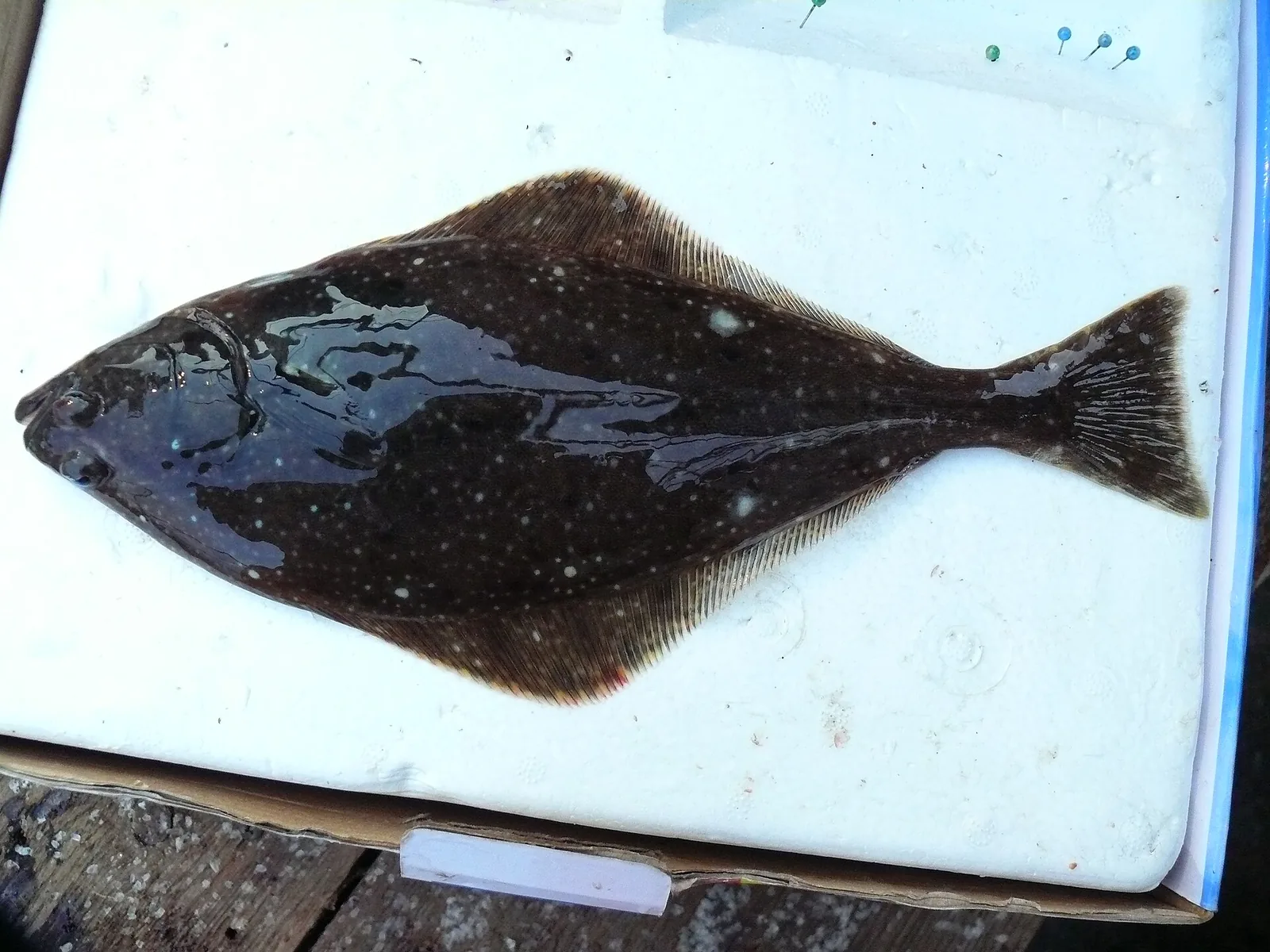
Pacific halibut
Hippoglossus stenolepis · Pleuronectidae
Pacific halibut is a flatfish that refuses flatfish habits: recorded from 0 to 1200 m, demersal and oceanodromous, reaching 258 cm, 363 kg and 55 years. The depth field explains why two boats on the same coastline get completely different results — one is fishing the shelf, the other the slope. Match gear and bait to the depth band you are actually on.
- Family
- Pleuronectidae
- Max length
- 258 cm TL
- Max weight
- 363 kg
- Max age
- 55 years
- Depth
- 0–1200 m
- IUCN
- LC
- Climate
- Temperate
- Diet
- fishes
Pacific halibut is a flatfish that refuses to behave like one. Most flatfish on this site are shallow-water ambushers, fished over sand in 5–40 m. Halibut is recorded from 0 to 1200 m, classed as demersal and oceanodromous, and reaches 258 cm and 363 kg with a maximum age of 55 years. The depth field in the catalogue is the single most useful number in it, because it explains why two boats fishing the same coastline can have completely different results: one is on the shelf, the other is on the slope.
Techniques
- Boat bottom fishing —
- Trolling —
Baits
- Whole herring
- Salmon head
- Squid
- Large jig
Seasonality
Peak Jun–AugModerate current is best. Too much current makes the drift uncontrollable and tangles gear.
Cold, settled weather with low swell. Halibut grounds are exposed; pick a calm day.
Before you keep a fish
- Read the recorded value. It is copied from the notice; if the number and the notice disagree, the notice wins.
- Check the area. Federal, state and local waters can set different limits for the same fish.
- Check the date. Seasons, quotas and closures change; confirm the current notice before you go.
Common questions
- What is the bag limit for Pacific halibut in United States — federal (2A)?
- 1 fish per person per day (2 in Oregon) · no size limit
- Where does this regulation apply?
- When was it checked?
- 2026-11-10, against NOAA Fisheries:2026 Pacific Halibut Recreational Fishery.
- Do other jurisdictions set different limits?
- Yes. This register lists 7 jurisdictions for Pacific halibut; compare them in the table above.