
Atlantic sailfish in United States — North Carolina: 63 in lower jaw fork length · 1 fish per person per day — North Carolina coastal and joint waters.
Sailfish (G) 63" LJFL 1/Day
Quoted from Recreational Size and Bag Limits
Regulation guide
Official sourcesWhich fish this is, and who manages it
Istiophorus albicans is the Atlantic sailfish, a separate species from white marlin (Kajikia albida). The two are often discussed together because both are Atlantic billfish, but they carry different federal minimum sizes: sailfish 63 inches lower jaw fork length and white marlin 66 inches.
Atlantic sailfish are managed domestically by NOAA Fisheries under the Atlantic Highly Migratory Species regulations in 50 CFR part 635. ICCAT Recommendation 19-05 sets retention minimums for blue marlin, white marlin and roundscale spearfish; sailfish is not one of the species covered by that recommendation and is governed by the federal HMS minimum described below.
Inside state waters, the coastal state adds its own rules. North Carolina publishes a sailfish entry in its recreational size and bag table alongside the federally managed billfish.
Source: NOAA Fisheries: Recreational Atlantic Billfish Fishery Statuses, Minimum Sizes, and Bag Limits · ICCAT Recommendation 19-05: Rebuilding Programs for Blue Marlin and White Marlin/Roundscale Spearfish · NC DEQ Division of Marine Fisheries: Species Profiles
The federal minimum is 63 inches
Section 635.20(d)(3) prohibits any person from taking, retaining or possessing a sailfish taken from its management unit that is less than 63 inches (160 cm) lower jaw fork length, shoreward of the outer boundary of the Atlantic EEZ. The federal billfish status page lists the same figure.
Lower jaw fork length is the straight-line distance from the anterior tip of the lower jaw to the fork of the caudal fin. The measurement is taken with the fish lying straight, and it is the only measurement NOAA uses for the billfish minimums.
The geographic wording of the rule matters. The 63-inch minimum is written for sailfish shoreward of the outer boundary of the EEZ, which covers state waters and the EEZ itself. A sailfish that does not reach 63 inches cannot be retained in that area, and there is no allowance for a fish that is close to the line.
Unlike the marlin minimums, the sailfish figure is not tied to the annual 250-fish landings limit. NOAA's billfish page applies that cap to blue marlin, white marlin and roundscale spearfish only.
Source: 50 CFR 635.20: Size limits (eCFR) · NOAA Fisheries: Recreational Atlantic Billfish Fishery Statuses, Minimum Sizes, and Bag Limits
North Carolina: 63 inches and one per day
North Carolina's recreational size and bag table lists sailfish at 63 inches lower jaw fork length with a bag limit of one per day. The state figure matches the federal minimum, and the state entry adds a daily count that the federal table does not express as a per-angler number.
The sailfish line sits in the group of federally managed billfish, and the state marks the group as federal HMS management. The state rule does not replace the federal one: the 63-inch minimum still comes from 50 CFR 635.20(d)(3), and the state adds its own daily limit inside coastal and joint waters.
North Carolina also requires a Coastal Recreational Fishing License for recreational fishing in coastal waters under G.S. 113-174.2. That licence is separate from the federal HMS permit that the vessel needs for billfish.
Source: NC DEQ Division of Marine Fisheries: Recreational Size and Bag Limits · 50 CFR 635.20: Size limits (eCFR)
Permits and gear
A vessel fishing for Atlantic billfish needs a valid HMS Angling permit or an HMS Charter/Headboat permit, and the permit covers everyone fishing aboard. A vessel in a registered HMS tournament may instead fish under an Atlantic Tunas General category or Swordfish General Commercial permit.
Recreational billfish are taken by rod and reel. In a registered HMS tournament, natural bait or a natural-and-artificial combination must be fished with non-offset circle hooks; artificial bait may be fished with J-hooks, offset circle hooks or non-offset circle hooks. Secondary gear such as a gaff or tail rope may be used only at boatside, and not to take a free-swimming or undersized fish.
There is no federal bag limit expressed for sailfish on the billfish status page, but there is a condition attached to retention: billfish cannot be retained if a hammerhead or oceanic whitetip shark is already on board or has been offloaded from the vessel.
Source: NOAA Fisheries: Recreational Atlantic Billfish Fishery Statuses, Minimum Sizes, and Bag Limits · NOAA Fisheries: HMS Recreational Compliance Guide (billfish gear and hooks)
Reporting and sale
A retained sailfish must be reported to NOAA Fisheries within 24 hours, through the HMS permit website, the HMS Catch Reporting App or the toll-free number. If the fish is entered in a registered tournament, the tournament operator reports it.
Billfish taken under recreational rules may not be sold or transferred for a commercial purpose. Section 635.22(a)(1) applies that prohibition to all HMS retained under the recreational limits, and a sailfish is no exception.
Reporting applies to the landing, not to a released fish. A sailfish that is measured and released is handled under the release rule and does not enter the landings count.
Source: NOAA Fisheries: HMS Recreational Compliance Guide (reporting) · 50 CFR 635.22: Recreational retention limits (eCFR)
Release, handling and before keeping
A sailfish that will not be kept must be released in a manner that gives it the greatest chance of survival, without removing it from the water. If it is hooked and not retained, the line is cut near the hook or a dehooking device is used, again without lifting the fish from the water, under 50 CFR 635.21(a).
NOAA's handling advice is consistent with the rule: keep the fish in the water even for a photograph, use circle hooks and a dehooking device so the hook comes free at the jaw or corner of the mouth, and use tackle heavy enough to shorten the fight.
Before keeping a sailfish, confirm the measurement against the 63-inch lower jaw fork length minimum, confirm the vessel permit and the 24-hour reporting route, and confirm there is no hammerhead or oceanic whitetip shark on board that would make retention unlawful. In North Carolina, also check the one-fish daily limit.
Source: 50 CFR 635.21: Gear operation and deployment restrictions (eCFR) · NOAA Fisheries: HMS Recreational Compliance Guide (handling and release) · NC DEQ Division of Marine Fisheries: Recreational Size and Bag Limits
Official pages: NOAA Fisheries: Recreational Atlantic Billfish Fishery Statuses, Minimum Sizes, and Bag Limits · 50 CFR 635.20: Size limits (eCFR) · NC DEQ Division of Marine Fisheries: Recreational Size and Bag Limits
Atlantic sailfish regulations at a glance
1 jurisdictions| Jurisdiction | Area | Size | Bag | Season / closure | Closed area | Other |
|---|---|---|---|---|---|---|
| United States — North Carolina | North Carolina coastal and joint waters | — | 63 in lower jaw fork length · 1 fish per person per day | — | — | — |
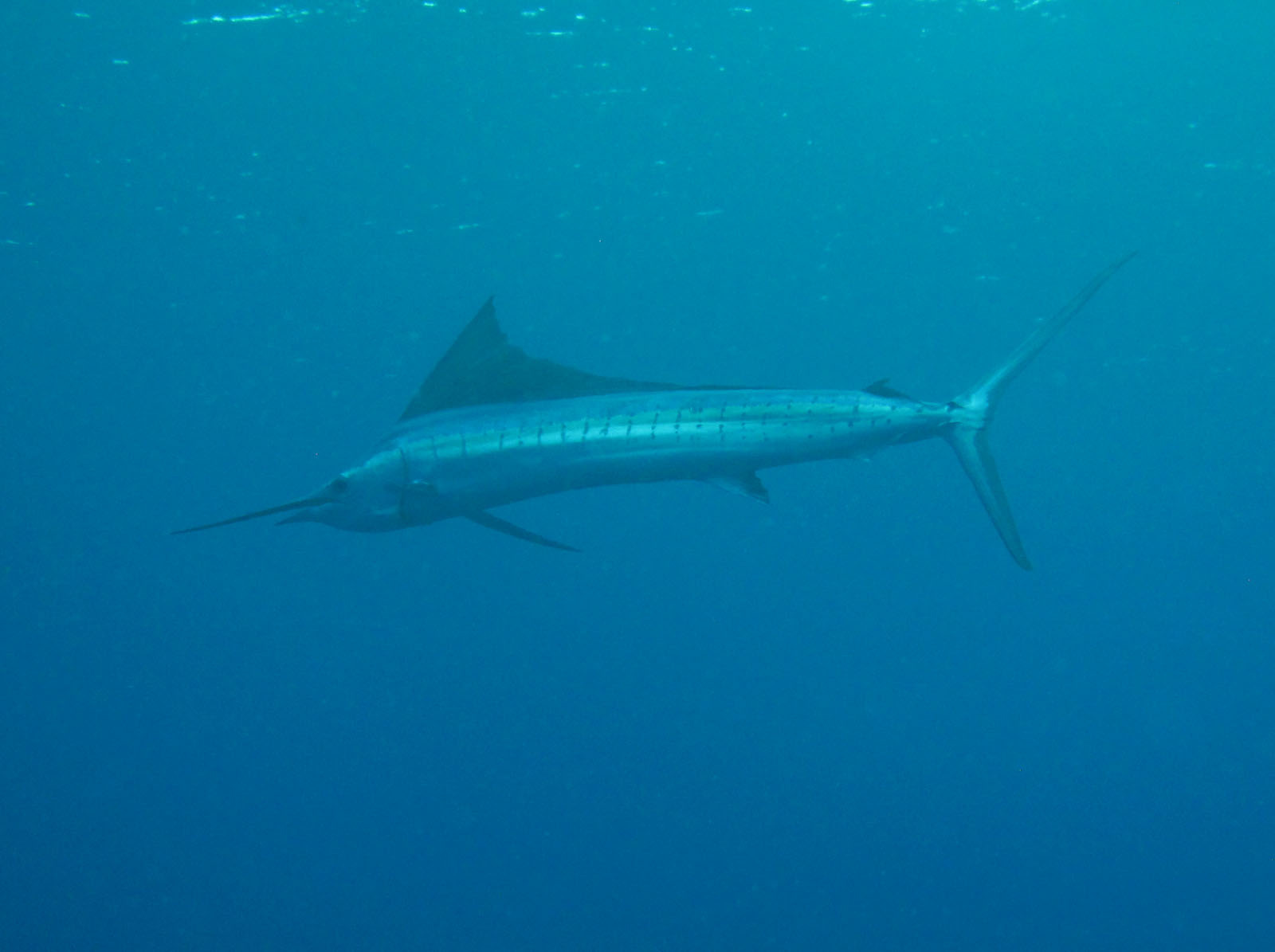
Atlantic sailfish
Istiophorus albicans · Istiophoridae
Atlantic sailfish is a billfish of tropical and temperate Atlantic waters, roughly from 40°N in the northwest and 50°N in the northeast to 40°S in the southwest and 32°S in the southeast. It lives from the surface to 200 m, reaches 315 cm TL and 58.1 kg, can live four years, and feeds on fish. It is present year-round in water of 21 to 28 °C.
- Family
- Istiophoridae
- Max length
- 315 cm TL
- Max weight
- 58.1 kg
- Max age
- 4 years
- Depth
- 0–200 m
- IUCN
- NE
- Climate
- Subtropical · 21–28 °C
- Diet
- fishes
Atlantic sailfish (Istiophorus albicans) is a fish of the family Istiophoridae. FishBase gives its range as: Atlantic Ocean: in tropical and temperate waters approximately 40°N in the northwest Atlantic, 50°N in the northeast Atlantic, 40°S in the southwest Atlantic, and 32°S in the southeast Atlantic. Migrating to Mediterranean Sea, mostly based on juvenile specimens. It is recorded from 0 to 200 m, in subtropical water at 21–28 °C. The recorded maxima are 315 cm TL, 58.1 kg, 4 years. Diet includes fishes. IUCN status: Not Evaluated (NE). Chinese name: .
Seasonality
Other US-NC regulations
Same jurisdictionBefore you keep a fish
- Read the recorded value. It is copied from the notice; if the number and the notice disagree, the notice wins.
- Check the area. Federal, state and local waters can set different limits for the same fish.
- Check the date. Seasons, quotas and closures change; confirm the current notice before you go.
Common questions
- What is the bag limit for Atlantic sailfish in United States — North Carolina?
- 63 in lower jaw fork length · 1 fish per person per day
- Where does this regulation apply?
- North Carolina coastal and joint waters
- When was it checked?
- 2026-11-18, against Recreational Size and Bag Limits.