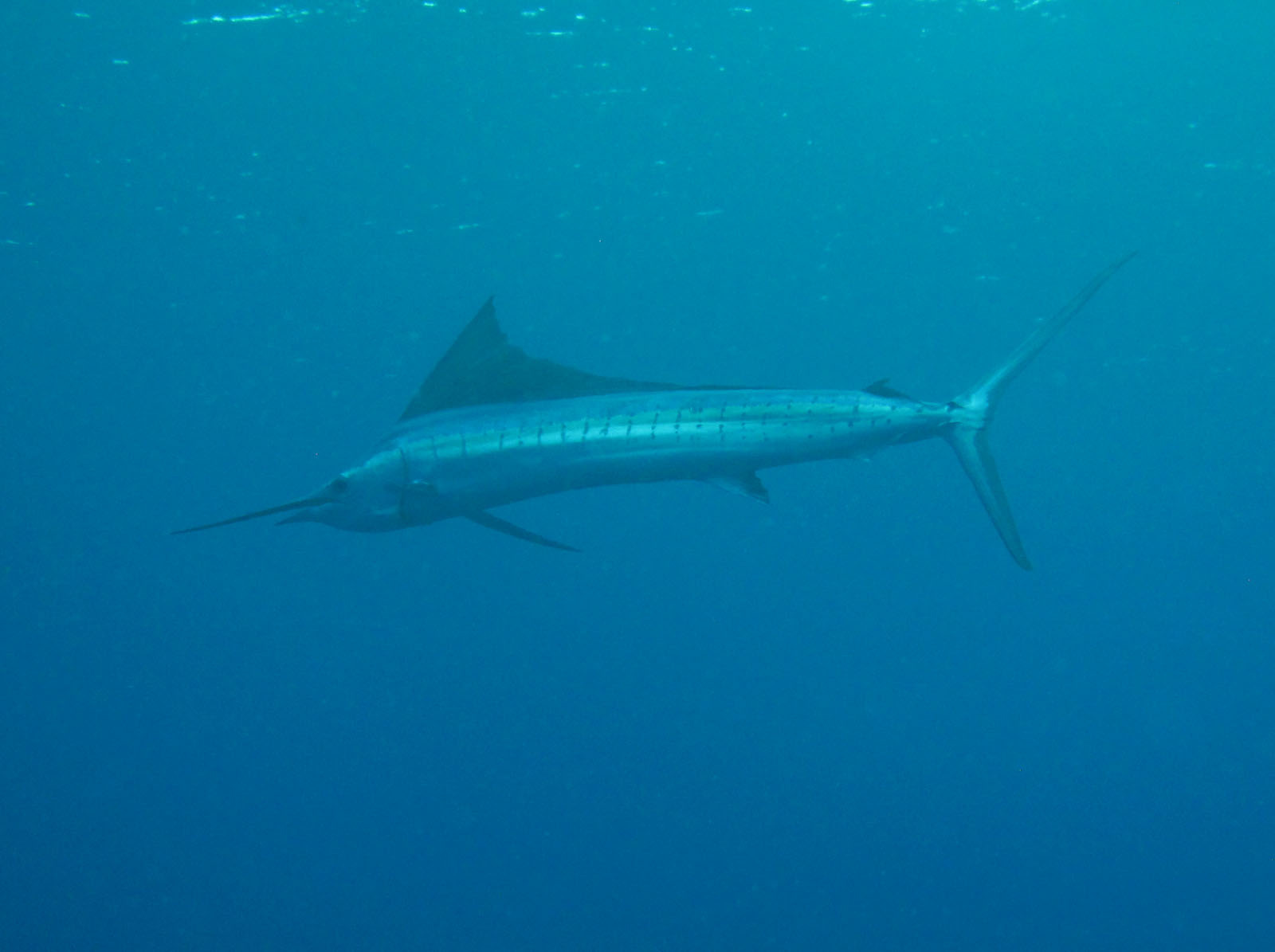
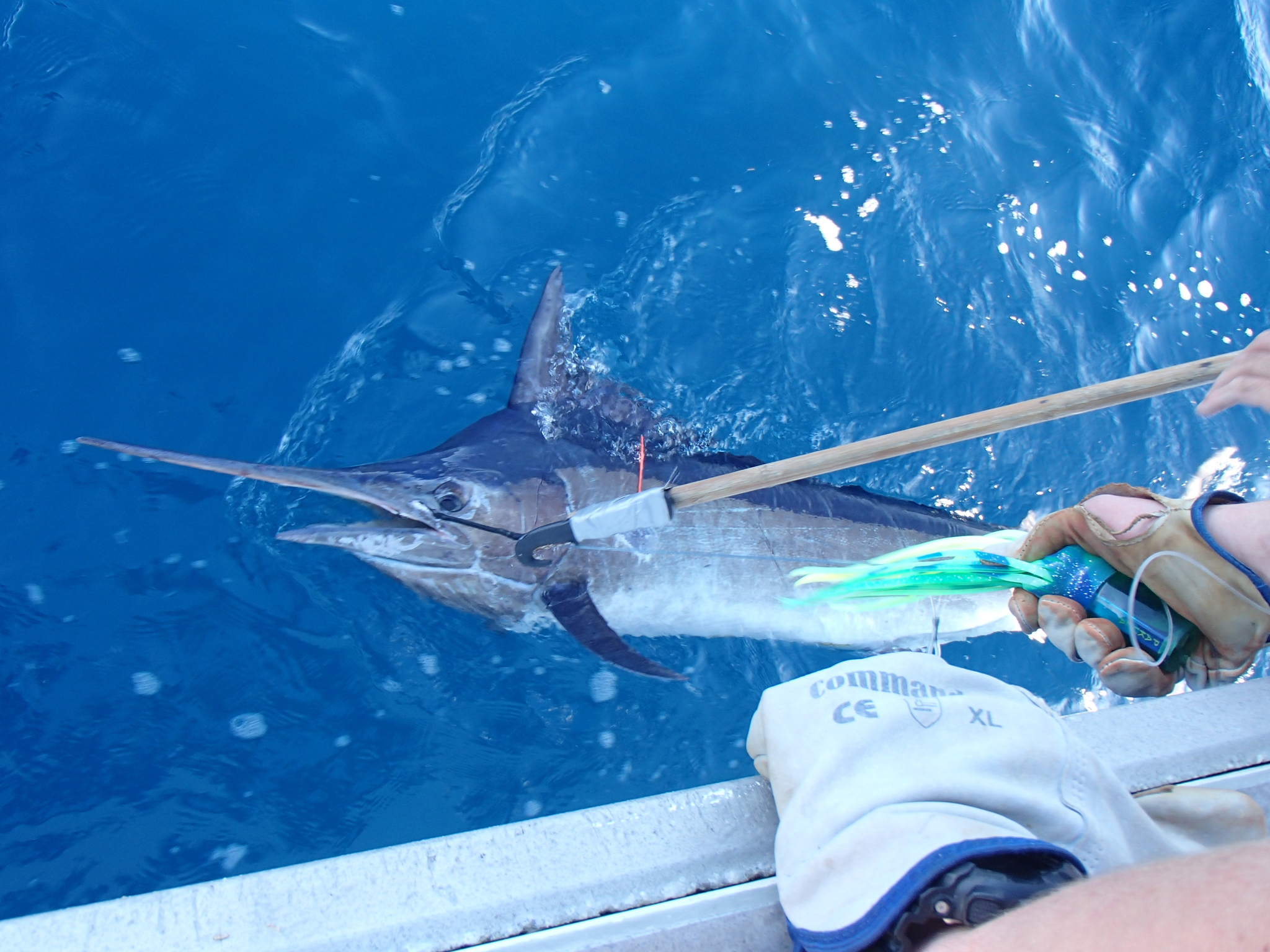
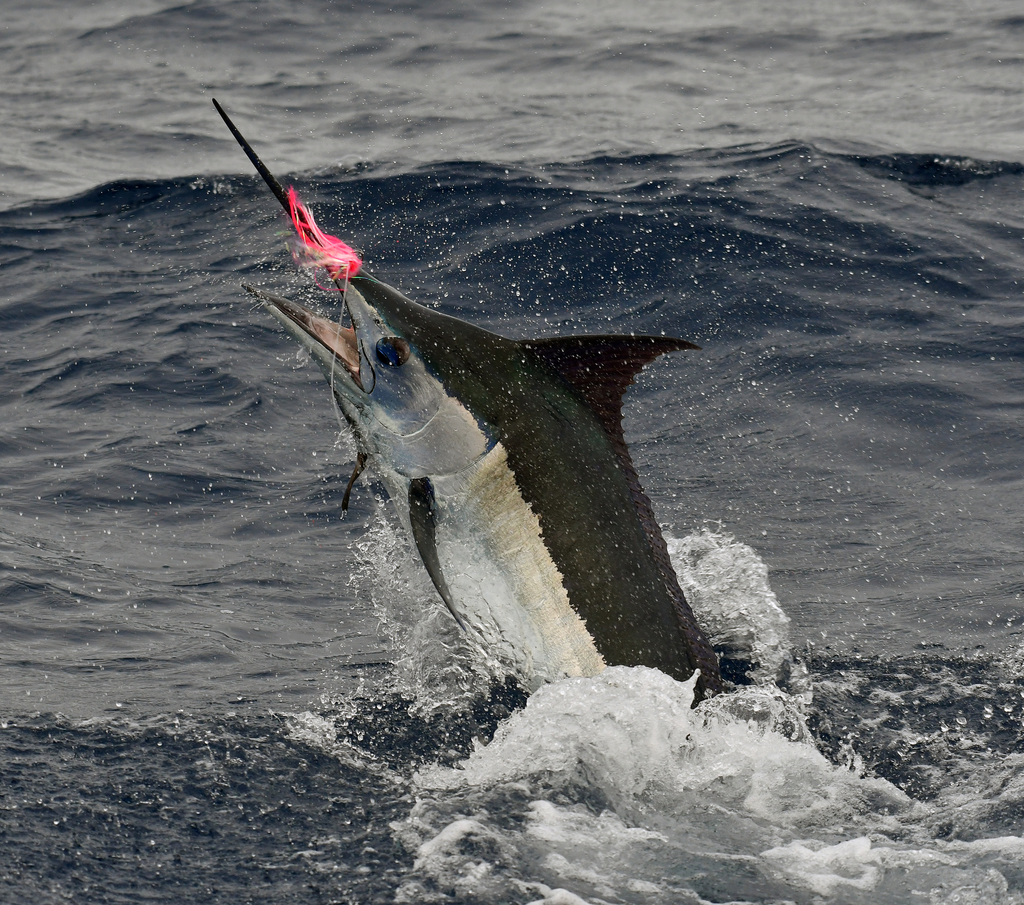
Atlantic sailfish (Istiophorus albicans) is a fish of the family Istiophoridae. FishBase gives its range as: Atlantic Ocean: in tropical and temperate waters approximately 40°N in the northwest Atlantic, 50°N in the northeast Atlantic, 40°S in the southwest Atlantic, and 32°S in the southeast Atlantic. Migrating to Mediterranean Sea, mostly based on juvenile specimens. It is recorded from 0 to 200 m, in subtropical water at 21–28 °C. The recorded maxima are 315 cm TL, 58.1 kg, 4 years. Diet includes fishes. IUCN status: Not Evaluated (NE). Chinese name: .
A pelagic fish with one contour
FishBase lists the species as marine, pelagic-oceanic, oceanodromous, surface to 200 m, subtropical 21–28°C. There is no bottom-type field, and the biology text never names a substrate. The only hard line appears in the spawning note: fish spawn in shallow inshore water around Florida and also "in offshore waters beyond the 100 fathom isobath" from south of Cuba to Carolina.
One hundred fathoms is 182.9 m, seventeen metres inside the stated maximum: the page's only depth landmark sits at the outer edge of the range.
A sailfish is no ambush fish on sand or rock; it feeds mainly on small pelagic fishes. But the same sentence adds that it "also takes bottom-dwelling organisms". That clause is the only reason a bottom question is legitimate: the body is built for the surface, and the diet still reaches down.
The line has two sides
Spawning is recorded on both sides, unranked. Inshore Florida: females swim slowly with the dorsal fin extended, each followed by one or more males, spawning near the surface in the warm season. Offshore: the same behaviour is reported beyond the isobath, Cuba to Carolina.
The line is therefore not a habitat boundary in the text. It is where two records of one behaviour fall on opposite sides. The species uses both the shelf and the water beyond it; the page never says which holds more fish. A charter treating the line as "the sailfish mark" is inventing a rule.
The thermocline is a ceiling, not a floor
The biology text puts the fish in "the upper layers of warm water above the thermocline, but also capable of descending to rather deep water". The thermocline is a ceiling: the fish lives above it and can drop through.
Two numbers then fail to meet. The temperature band is 21–28°C; the maximum depth is 200 m. At 200 m in the open Atlantic the water is far below 21°C, so a fish recorded at the maximum is outside the band the page gives. Both figures sit in separate boxes, unreconciled. A combined "21–28°C, to 200 m" would be false at one end, so the two figures stay apart. What survives: warm surface water, a ceiling, and an occasional documented dive of unknown frequency.
What the spawning table actually records
The spawning table has seven rows: Ceará in Brazil, two Guinea rows, the eastern Mediterranean, Florida beyond the 100-fathom isobath, Cuba beyond the same line, and South Carolina beyond it. Four rows carry month windows: Ceará in March–April, and Florida, Cuba and South Carolina all in April–September. The two Guinea rows and the eastern Mediterranean row are marked for every month. The calendar is real but coarse, and it points the same way as the geography.
What it carries is geography. Three of the seven rows name the isobath explicitly. The biology text mentions it once; the table repeats it in three territories. For a page with no substrate field, that is the closest thing to a defined position.
What the fish is doing above that ceiling
The biology paragraph otherwise describes movement, not position. Schools of 3 to 30 or loose aggregations over a wide area; regular migration into near-shore waters; females larger than males. No wreck, ledge or weed patch is named anywhere on the page.
So the "spot" is a moving patch of bait, not a piece of bottom. The contour tells a boat where the depth changes, not where the fish are.
Three numbers that do not sit together
The size box gives length at maturity 133.5 cm (range 121–146), maximum 315 cm total length, common length 240 cm total length, maximum published weight 58.1 kg, maximum reported age 4 years.
Three frictions appear. A 315 cm sailfish at 58.1 kg is slender; the weight is published, but it is not a number for imagining a three-metre animal. Four years is a short maximum age for a fish of that length, with no growth curve to soften it. And a common length of 240 cm is three-quarters of the maximum. None of the three is resolved on the page.
Maturity at 133.5 cm is far from the 240 cm common fish, so the size class a boat meets depends on which part of the spread it fishes. The only fecundity figure is equally specific: off southeast Florida, a 33.4 kg female may shed up to 4.8 million eggs in three batches in one season.
Where the records actually sit
GBIF returns 1,676 present records, of which 817 carry no country at all. The named countries run Colombia 86, Netherlands 42, Guinea-Bissau 36, Equatorial Guinea 35, United States 23, Great Britain 21, Guinea 21, São Tomé and Príncipe 7, France 5.
The blank-country records are the point. For an oceanic, highly migratory species a large share of occurrences are logged at sea, where no country applies. The dataset looks the way the distribution text reads: a basin, not a coastline.
Two named countries still sit awkwardly against that text. The distribution gives roughly 50°N in the northeast Atlantic; the Netherlands and Great Britain both appear. The page offers no explanation.
The photo record has its own naming problem: the taxon ID attached to this species resolves on iNaturalist to Istiophorus platypterus, with 558 observations. The Atlantic fish's photographs are filed under the Indo-Pacific name.
The common-name table is looser: 113 names, including "Ocean gar", "Ocean guard", "Squadron" and plain "Marlin". WoRMS accepts Istiophorus albicans and lists eleven synonyms as unaccepted, among them Makaira albicans, Makaira velifera and Skeponopodus guebucu. A catch entered under Makaira albicans is invisible to a search for the current combination.
Which side of the line to fish
Find the 100-fathom isobath: the one line the source names, seventeen metres inside the stated maximum depth. Inside it lie the shelf and the inshore spawning water; outside, the offshore spawning record and the open Atlantic. Both are documented, neither ranked.
Above the line the fish is in warm surface water over a thermocline it can cross. That supports a surface spread for small pelagic fishes, and one deep bait on the strength of the single clause about bottom-dwelling organisms. Not a claim that the deep bait is better; the page never compares them.
The release card should carry total length, since both figures already are; 58.1 kg as a published maximum, not a target; and 4 years as the maximum reported age, the number that sits least comfortably beside a 315 cm fish.
That is the whole bottom story. This fish does not hold a reef or a mud line. It holds a contour, and the records put spawning on both sides without saying which is better.
Regulations before you keep it
These are the published regulations for this fish. Read the number first. The notice below it is the actual regulation.
Bag limit1
63 in lower jaw fork length · 1 fish per person per day
United States — North Carolina · US-NC
North Carolina requires sailfish to measure 63 inches lower-jaw fork length with a 1-fish daily bag.
Sailfish
(G)
63" LJFL
1/Day
Every record above names its source and the date it was retrieved. See the regulation register for the full list, or how to read these regulations.
Where these facts come from
Check these pages before you rely on a size, range or protection status.
-
FishBase — Istiophorus albicans
— FishBase · T2
-
GBIF — Istiophorus albicans occurrence records
— GBIF · T2
-
IUCN Red List — Istiophorus albicans
— IUCN · T1
-
Photo record — iNaturalist
— iNaturalist · T3