
Shortfin mako in United States — Maine: Taking prohibited in Maine territorial waters — Maine territorial waters.
Anglers are prohibited from taking coastal sharks including shortfin mako in Maine’s territorial waters.
Quoted from 2026 Maine Saltwater Recreational Fishing Regulations
Federal HMS rules prohibit retaining shortfin mako in all Atlantic HMS fisheries, including in state waters, since 5 July 2022.
Regulation guide
Official sourcesWhy the retention limit is zero
The shortfin mako (Isurus oxyrinchus) is a highly migratory shark managed under the Consolidated Atlantic Highly Migratory Species Fishery Management Plan. The 2019 stock assessment update indicated the resource is overfished and experiencing overfishing, with a rebuild date of 2070.
In 2021 the International Commission for the Conservation of Atlantic Tunas adopted a recommendation for the species. NOAA Fisheries then set the shortfin mako retention limit at zero in both the commercial and recreational Atlantic HMS fisheries, effective July 5, 2022.
The Atlantic States Marine Fisheries Commission took the matching step for state waters in May 2022, approving a zero retention limit for both sectors. The federal and interstate measures are intended to be consistent.
Source: NOAA Fisheries: Zero Atlantic Shortfin Mako Shark Retention Limit · ASMFC: Coastal Sharks
The federal rule: release, dead or alive
No shortfin mako may be landed or retained in any U.S. Atlantic HMS fishery until further notice. The prohibition applies to recreational anglers who target or catch the species, including those fishing tournaments or on for-hire vessels.
Anglers with HMS permits must release any shortfin mako captured while the retention limit is zero, whether the shark is dead or alive at haulback. The 2026 HMS recreational compliance guide puts it more precisely: shortfin mako must remain in the water and be released at haulback.
The zero limit stays in place until ICCAT provides for U.S. harvest. NOAA Fisheries has said it could raise the limit based on regulatory criteria and the amount of retention ICCAT allows, and would announce any change by Federal Register notice.
Source: NOAA Fisheries: Zero Atlantic Shortfin Mako Shark Retention Limit · NOAA Fisheries: 2026 HMS Recreational Compliance Guide
Permits for shark fishing
A vessel fishing recreationally for Atlantic sharks in federal waters needs an HMS Angling permit, and a shark endorsement is required on the permit to fish for sharks. Charter and headboat vessels need the HMS Charter/Headboat permit instead.
Anglers holding a federal HMS permit who fish in state waters must follow federal HMS rules there, unless the state rule is more restrictive, in which case the state rule applies.
For a species with a zero retention limit, that hierarchy produces the same answer everywhere on the coast: the fish goes back.
Source: NOAA Fisheries: 2026 HMS Recreational Compliance Guide
Maine: coastal shark take prohibited
Maine's Chapter 50 defines "coastal sharks" to include the North Atlantic shortfin mako, and section 50.02 prohibits the take of coastal sharks in Maine's territorial waters.
The same chapter prohibits finning and requires that vessels landing spiny dogfish, porbeagle or coastal sharks keep the head, fins and tails attached naturally to the carcass through landing. A fish may be bled, but the parts stay on.
Maine's recreational summary states the rule for anglers in plain terms: anglers are prohibited from taking coastal sharks, including shortfin mako, in Maine's territorial waters, and it points readers to Chapter 50.
Source: Maine DMR: Chapter 50, Spiny Dogfish and Coastal Sharks · Maine DMR: 2026 Maine Saltwater Recreational Fishing Regulations
Rhode Island: taking or possession prohibited
Rhode Island's Finfish regulations address shortfin mako separately from the general prohibited list. Section 3.18.1(B) states that the taking or possession of shortfin mako sharks is prohibited.
The same section sets landings requirements for sharks that may be kept: no recreational angler may possess or land a shark without heads, tails and fins attached naturally to the carcass. Sharks may be gutted and bled at the base of the caudal peduncle if the tail stays on.
Rhode Island also bars filleting a shark at sea or cutting it into pieces at sea, and it sets fork-length minimums for other shark species, from 54 inches for several coastal species to 78 inches for the hammerheads.
The state-water backstop
The Commission's zero retention limit for shortfin mako in state waters means an angler cannot rely on a state line to keep a fish that federal rules require be released. Maine and Rhode Island also write the prohibition into their own codes.
Coastal shark fishing in state waters also carries gear rules. Since 2020, recreational shark anglers in state waters have been required to use non-offset, corrodible, non-stainless steel circle hooks, except when fishing with flies or artificial lures.
The Commission manages 40 coastal shark species under its interstate plan, so the mako rule sits inside a broader structure of prohibited species, size limits and gear requirements rather than standing alone.
Source: ASMFC: Coastal Sharks
If you hook a shortfin mako
Leave the shark in the water and release it at haulback. Under the federal rule it is released whether it is alive or dead, so there is no lawful reason to bring one aboard.
Bringing a mako aboard for a photograph or a measurement would contradict the in-water release requirement. The federal guidance is that the shark stays in the water and is released at haulback.
If you are unsure whether an animal is a shortfin mako or a legal species such as a blue shark, release it. The cost of a misidentification is a dead prohibited shark and a possible violation.
Source: NOAA Fisheries: Zero Atlantic Shortfin Mako Shark Retention Limit · NOAA Fisheries: 2026 HMS Recreational Compliance Guide
Official pages: NOAA Fisheries: Zero Atlantic Shortfin Mako Shark Retention Limit · NOAA Fisheries: 2026 HMS Recreational Compliance Guide · Maine DMR: Chapter 50, Spiny Dogfish and Coastal Sharks · Rhode Island DEM: Finfish regulations (250-RICR-90-00-3)
Shortfin mako regulations at a glance
2 jurisdictions| Jurisdiction | Area | Size | Bag | Season / closure | Closed area | Other |
|---|---|---|---|---|---|---|
| United States — Maine | Maine territorial waters | — | — | — | — | Protected species: Taking prohibited in Maine territorial waters |
| United States — Rhode Island | Rhode Island state waters | — | — | — | — | Protected species: Taking or possession prohibited |
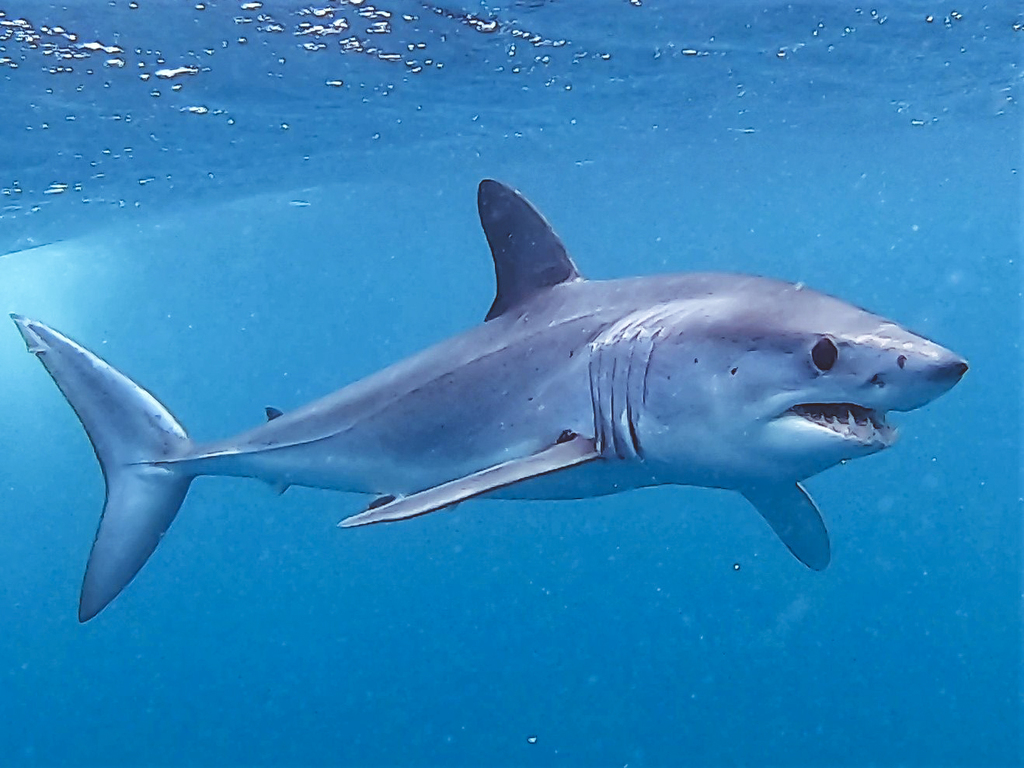
Shortfin mako
Isurus oxyrinchus · Lamnidae
Shortfin mako is a large lamnid shark with a cosmopolitan range in temperate and tropical seas, recorded from the surface to 888 m. It reaches 445 cm TL with a common length of 270 cm, a published weight of 505.8 kg and a maximum age of 32 years. Size at maturity is about 278 cm. Trolling, boat fishing and jigging are the methods listed.
- Family
- Lamnidae
- Max length
- 445 cm TL
- Max weight
- 505.8 kg
- Max age
- 32 years
- Depth
- 0–888 m
- IUCN
- EN
- Climate
- Subtropical
- Diet
- fishes, molluscs
The shortfin mako is a large lamnid shark with a cosmopolitan range in temperate and tropical seas. FishBase records a maximum length of 445 cm TL, a common length of 270 cm, a maximum published weight of 505.8 kg and a maximum reported age of 32 years; size at maturity is given as 278.3 cm, with a range of 275–285 cm. In the western Atlantic it runs from the Gulf of Maine south to southern Brazil and Argentina, including the Gulf of Mexico and the Caribbean. It is an oceanic, fast-swimming predator that sometimes comes close inshore.
Techniques
- Trolling —
- Boat fishing —
- Jigging —
Seasonality
Other US-ME regulations
Same jurisdictionBefore you keep a fish
- Read the recorded value. It is copied from the notice; if the number and the notice disagree, the notice wins.
- Check the area. Federal, state and local waters can set different limits for the same fish.
- Check the date. Seasons, quotas and closures change; confirm the current notice before you go.
Common questions
- What is the protected species for Shortfin mako in United States — Maine?
- Taking prohibited in Maine territorial waters
- Where does this regulation apply?
- Maine territorial waters
- When was it checked?
- 2026-11-18, against 2026 Maine Saltwater Recreational Fishing Regulations.
- Do other jurisdictions set different limits?
- Yes. This register lists 2 jurisdictions for Shortfin mako; compare them in the table above.