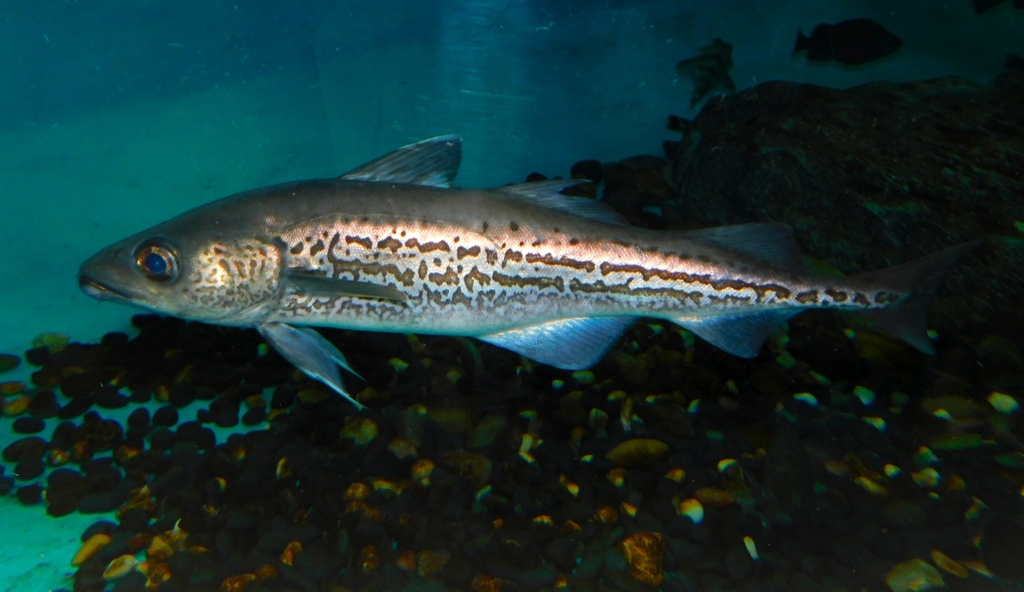
The shortfin mako is a large lamnid shark with a cosmopolitan range in temperate and tropical seas. FishBase records a maximum length of 445 cm TL, a common length of 270 cm, a maximum published weight of 505.8 kg and a maximum reported age of 32 years; size at maturity is given as 278.3 cm, with a range of 275–285 cm. In the western Atlantic it runs from the Gulf of Maine south to southern Brazil and Argentina, including the Gulf of Mexico and the Caribbean. It is an oceanic, fast-swimming predator that sometimes comes close inshore.
Identification
The body is spindle-shaped and heavy through the middle, tapering to a slender caudal peduncle. The snout is sharply pointed, the eyes are large and black, and the mouth carries large, narrow, hooked teeth with smooth edges. The caudal fin is lunate and the lower lobe is strongly developed; the second dorsal and anal fins are tiny. Colour is dark blue above and white below. FishBase does not publish a fin formula for this species, so identification rests on body form, lamnid features, photographs and the head and tail profile at the boat.
Two relatives overlap here. The porbeagle is stockier and shows a white patch at the rear base of the first dorsal fin; the longfin mako has noticeably longer pectoral fins. Blue sharks are slender with a longer, more conical snout and a different tooth shape. Check the pectoral length, snout and teeth before deciding what is on the line.
Habitat and behaviour
The species is pelagic-oceanic and oceanodromous, recorded from the surface down to 888 m but usually between 100 and 150 m. FishBase gives a minimum temperature of 16 °C, which places it in warm temperate and tropical water.
FishBase's biology summary describes an oceanic shark that sometimes comes close inshore, usually swimming in surface waters. Adults feed on bony fishes, other sharks and cephalopods, and larger individuals take bigger prey such as billfish and small cetaceans. Reproduction is ovoviviparous, with 4 to 16 young of about 60–70 cm, a gestation of 15–18 months and a three-year cycle. Tagging in New Zealand shows seasonal migrations.
Seasonal window
FishBase's spawning table has no records for the shortfin mako, so there is no month-by-month spawning signal to lean on. The record does give the reproductive cycle and the migration evidence: a 15–18 month pregnancy on a three-year cycle, and tagged fish moving seasonally.
Off the northeastern states, mako encounters cluster in the warm months, when blue water pushes closer to the shelf edge and bait gathers along temperature breaks. That is a pattern, not a promise. The fish is present year-round; only the run offshore changes. Sea surface temperature, current edges and the activity of birds and bait are better guides than a date on the calendar.
Gear and approach
A 30–50 lb class stand-up or chair outfit is a sensible starting point: a reel with a reliable strike drag and 300–500 m of line, 100–150 lb leader material and a large circle hook. Circle hooks reduce deep hooking and are easier to remove at the boat. Carry a long-handled dehooker, bolt cutters and a release leader. Leave the gaff at home.
The fish should be identified at the leader, not lifted. Keep it in the water, hold it by the leader or alongside the hull, cut the leader close if the hook cannot be removed quickly, and never bring it aboard for a photograph. A large mako is powerful and is recorded as traumatogenic, so a tired fish at the boat is still a hazard. Tackle heavy enough to end the fight quickly is the better choice here.
Edibility and regulations
FishBase records the species as a minor commercial catch and as a gamefish, and lists it as traumatogenic. Any market for the flesh is irrelevant here, because the fish may not be kept. The IUCN Red List category is EN (Endangered), assessed on 5 November 2018. The species is listed on CITES Appendix II and CMS Appendix II.
In U.S. federal Atlantic HMS fisheries the retention limit is zero, for both the commercial and the recreational sector, and it has been zero since July 2022. There is no minimum size to manage, because no fish may be retained at all: release it immediately, without removing it from the water. Do not lift it aboard, do not gaff it and do not keep it for a photograph or a weight. Canadian waters are governed separately; verify the current DFO rules before targeting or retaining any shark north of the border.
Where to look
GBIF holds 58,004 occurrence records for the matched taxon. The largest country counts are Chile (48,227), New Zealand (3,529), Australia (1,654) and the United States (1,144); these reflect sampling and tagging effort, not availability to anglers. FishBase's distribution runs from the Gulf of Maine to southern Brazil and Argentina, including the Gulf of Mexico and the Caribbean. The habitat keywords are coastal and open-water.
Look for blue water, temperature breaks, current edges and surface activity, and check the forecast and fuel range before leaving the dock.
How to catch it
Trolling
Fished with the listed approach, matched to the recorded depth and size.
Boat fishing
Fished with the listed approach, matched to the recorded depth and size.
Jigging
Fished with the listed approach, matched to the recorded depth and size.
Regulations before you keep it
These are the published regulations for this fish. Read the number first. The notice below it is the actual regulation.
Protected species2
Taking prohibited in Maine territorial waters
United States — Maine · US-ME
Maine prohibits taking coastal sharks, including shortfin mako, in territorial waters.
Federal HMS rules prohibit retaining shortfin mako in all Atlantic HMS fisheries, including in state waters, since 5 July 2022.
Anglers are prohibited from taking coastal sharks including shortfin mako in Maine’s territorial waters.
Taking or possession prohibited
United States — Rhode Island · US-RI
Rhode Island prohibits taking or possessing shortfin mako sharks.
Federal HMS rules prohibit retaining shortfin mako in all Atlantic HMS fisheries, including in state waters, since 5 July 2022.
B.Shortfin mako: The taking or possession of shortfin mako sharks is prohibited.
Every record above names its source and the date it was retrieved. See the regulation register for the full list, or how to read these regulations.
Where these facts come from
Check these pages before you rely on a size, range or protection status.
-
FishBase — Isurus oxyrinchus
— FishBase · T2
-
GBIF — Isurus oxyrinchus occurrence records
— GBIF · T2
-
IUCN Red List — Isurus oxyrinchus
— IUCN · T1
-
Photo record — iNaturalist
— iNaturalist · T3