
Atlantic white marlin in United States — North Carolina: 66 in lower jaw fork length — North Carolina coastal and joint waters.
White Marlin (G) 66" LJFL
Quoted from Recreational Size and Bag Limits
The 1-fish-per-vessel blue/white marlin aggregate is a North Carolina state rule. Federal HMS sets only the 66-inch minimum, with annual landings limits and in-season closures.
Regulation guide
Official sourcesTwo rulebooks: federal HMS and North Carolina
Atlantic white marlin (Kajikia albida) is an Atlantic highly migratory species managed by NOAA Fisheries under the Atlantic Tunas Convention Act and the regulations in 50 CFR Part 635. The federal rules cover minimum size, permitted gear, vessel permits and reporting.
North Carolina adds its own billfish rule in 15A NCAC 03M .0507, which applies in state coastal and joint waters. An angler fishing off North Carolina is therefore working under two instruments at once, and the stricter provision governs the trip.
A state fishing licence does not replace the federal vessel permit. The Coastal Recreational Fishing License and the HMS permit are separate requirements, and a trip may need both.
Source: eCFR: 50 CFR 635.20, Size limits · North Carolina Administrative Code: 15A NCAC 03M .0507, Billfish
The 66-inch lower-jaw fork length minimum
Federal regulation 50 CFR 635.20(d)(2) prohibits taking, retaining or possessing a white marlin that is less than 66 inches (168 cm) lower-jaw fork length. The same section sets blue marlin at 99 inches and roundscale spearfish at 66 inches.
North Carolina's rule repeats the figure: it is unlawful to possess white marlin or roundscale spearfish less than 66 inches from the lower jaw to the fork in the tail. The two instruments agree on the number, so there is no state relaxation of the federal minimum.
Roundscale spearfish, which can be confused with white marlin, carries the same 66-inch figure in both instruments.
Source: eCFR: 50 CFR 635.20, Size limits · North Carolina Administrative Code: 15A NCAC 03M .0507, Billfish
How lower-jaw fork length is measured
NOAA defines lower-jaw fork length as the straight-line measurement from the anterior tip of the lower jaw to the fork of the caudal fin. The tape starts at the jaw, not at the tip of the bill, and ends at the fork, not at the tip of the tail.
That definition excludes the bill and the upper lobe of the tail, both of which can add length to a casual measurement. A white marlin measured along the top of the bill or to the tail tip may appear legal when it is not, so the measurement should follow the published definition.
Source: NOAA Fisheries: Recreational Atlantic Billfish Fishery Statuses, Minimum Sizes and Bag Limits · NOAA Fisheries: HMS Recreational Compliance Guide 2025
The one-per-vessel limit is a North Carolina rule
North Carolina's billfish rule makes it unlawful to possess more than one blue marlin, white marlin or roundscale spearfish in the aggregate per vessel per trip. A boat that has kept a white marlin cannot then keep a blue marlin on the same trip.
That limit comes from 15A NCAC 03M .0507(b)(3) and applies in North Carolina coastal and joint waters. It is a state possession rule, not a federal one, and it is the provision that supports the 'one per vessel' figure often quoted in summaries.
Source: North Carolina Administrative Code: 15A NCAC 03M .0507, Billfish · NC DEQ: Recreational Size and Bag Limits
Federal retention is capped by quota, not by vessel
The federal recreational retention section, 50 CFR 635.22, imposes no per-vessel billfish bag. Its billfish paragraph addresses only longbill spearfish, which may not be taken or possessed shoreward of the outer boundary of the EEZ.
NOAA's billfish page accordingly lists the white marlin bag limit as 'no limit', subject to the combined annual U.S. landings limit of 250 blue marlin, white marlin and roundscale spearfish, and to any in-season closure. It also bars retaining billfish if a hammerhead or oceanic whitetip shark is on board or has been offloaded.
When the combined landings limit is reached, retention closes even though the bag column continues to read 'no limit'. That is why the federal position has to be checked on the day of the trip rather than remembered from a previous season.
Source: eCFR: 50 CFR 635.22, Recreational retention limits · NOAA Fisheries: Recreational Atlantic Billfish Fishery Statuses, Minimum Sizes and Bag Limits
Permits and reporting
A vessel must have a valid HMS Angling or HMS Charterboat/Headboat permit to fish for Atlantic billfish, and the permit covers everyone fishing on that vessel. Tournament vessels may instead fish these species with an Atlantic Tunas General category or Swordfish General Commercial permit.
All anglers must report recreational billfish landings within 24 hours, either online at hmspermits.noaa.gov, through the HMS Catch Reporting App, or by calling the HMS customer service line. The reporting duty applies even when the fish is released or landed in a tournament.
Source: NOAA Fisheries: Recreational Atlantic Billfish Fishery Statuses, Minimum Sizes and Bag Limits · NOAA Fisheries: HMS Recreational Compliance Guide 2025
What to check before keeping a white marlin
A Coastal Recreational Fishing License is required to take finfish in North Carolina coastal waters, and fish harvested under it are for personal consumption and cannot be sold. The billfish rule separately prohibits selling or offering for sale blue marlin, white marlin or roundscale spearfish.
Before a fish comes aboard, check the vessel's HMS permit, measure the lower jaw to the fork against 66 inches, count the vessel's billfish against the one-fish aggregate in North Carolina, and confirm that the federal landings quota is open. Federal recreational retention limits may not be combined with state limits, so an angler cannot add a state allowance to a federal one. Report the landing within 24 hours. If any of those steps is uncertain, release the fish.
Source: NC DEQ: Purchase a North Carolina Coastal Recreational Fishing License · North Carolina Administrative Code: 15A NCAC 03M .0507, Billfish · NOAA Fisheries: Recreational Atlantic Billfish Fishery Statuses, Minimum Sizes and Bag Limits
Official pages: NOAA Fisheries: Recreational Atlantic Billfish Statuses, Minimum Sizes and Bag Limits · NOAA Fisheries: HMS Recreational Compliance Guide 2025 · eCFR: 50 CFR 635.20 (Size limits) · NC DEQ: Recreational Size and Bag Limits · 15A NCAC 03M .0507 Billfish
Atlantic white marlin regulations at a glance
1 jurisdictions| Jurisdiction | Area | Size | Bag | Season / closure | Closed area | Other |
|---|---|---|---|---|---|---|
| United States — North Carolina | North Carolina coastal and joint waters | 66 in lower jaw fork length | — | — | — | — |
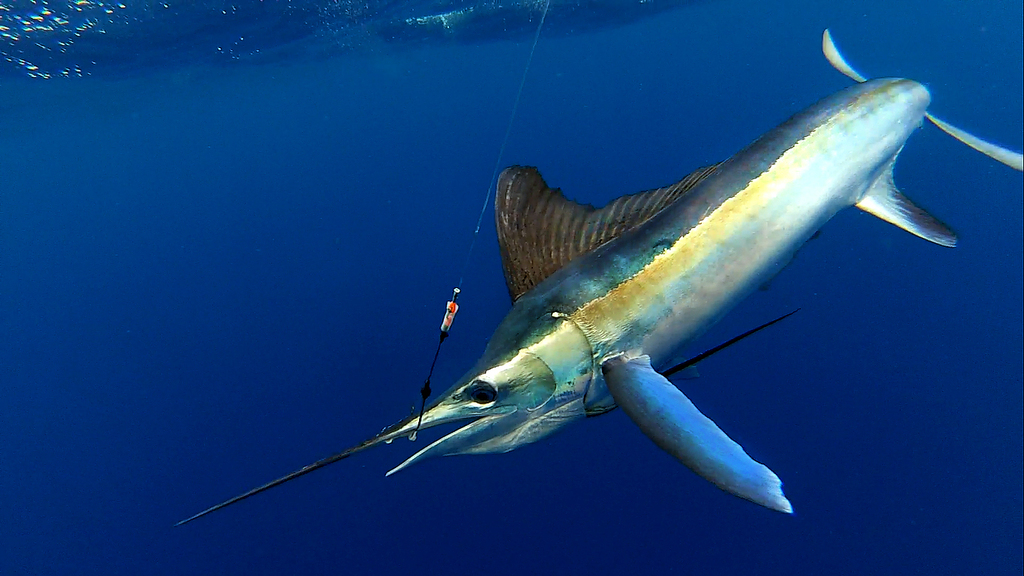
Atlantic white marlin
Kajikia albida · Istiophoridae
This fish carries four English names and two Chinese ones, and no single one names the animal. The record's own range note then adds a second layer of uncertainty: the Atlantic population is classified as "reduced", and it is unclear whether there are two stocks or one. Before any trolling spread is discussed, the names and the stock question have to be separated, because both are labels rather than measurements.
- Family
- Istiophoridae
- Max length
- 300 cm TL
- Max weight
- 82.5 kg
- Depth
- 0–150 m
- IUCN
- LC
- Climate
- Subtropical
- Diet
- fishes
This fish carries four English names and two Chinese ones, and no single one names the animal. The record's own range note then adds a second layer of uncertainty: the Atlantic population is classified as "reduced", and it is unclear whether there are two stocks or one. Before any trolling spread is discussed, the names and the stock question have to be separated, because both are labels rather than measurements.
Seasonality
Other US-NC regulations
Same jurisdictionBefore you keep a fish
- Read the recorded value. It is copied from the notice; if the number and the notice disagree, the notice wins.
- Check the area. Federal, state and local waters can set different limits for the same fish.
- Check the date. Seasons, quotas and closures change; confirm the current notice before you go.
Common questions
- What is the minimum size for Atlantic white marlin in United States — North Carolina?
- 66 in lower jaw fork length
- Where does this regulation apply?
- North Carolina coastal and joint waters
- When was it checked?
- 2026-11-18, against Recreational Size and Bag Limits.