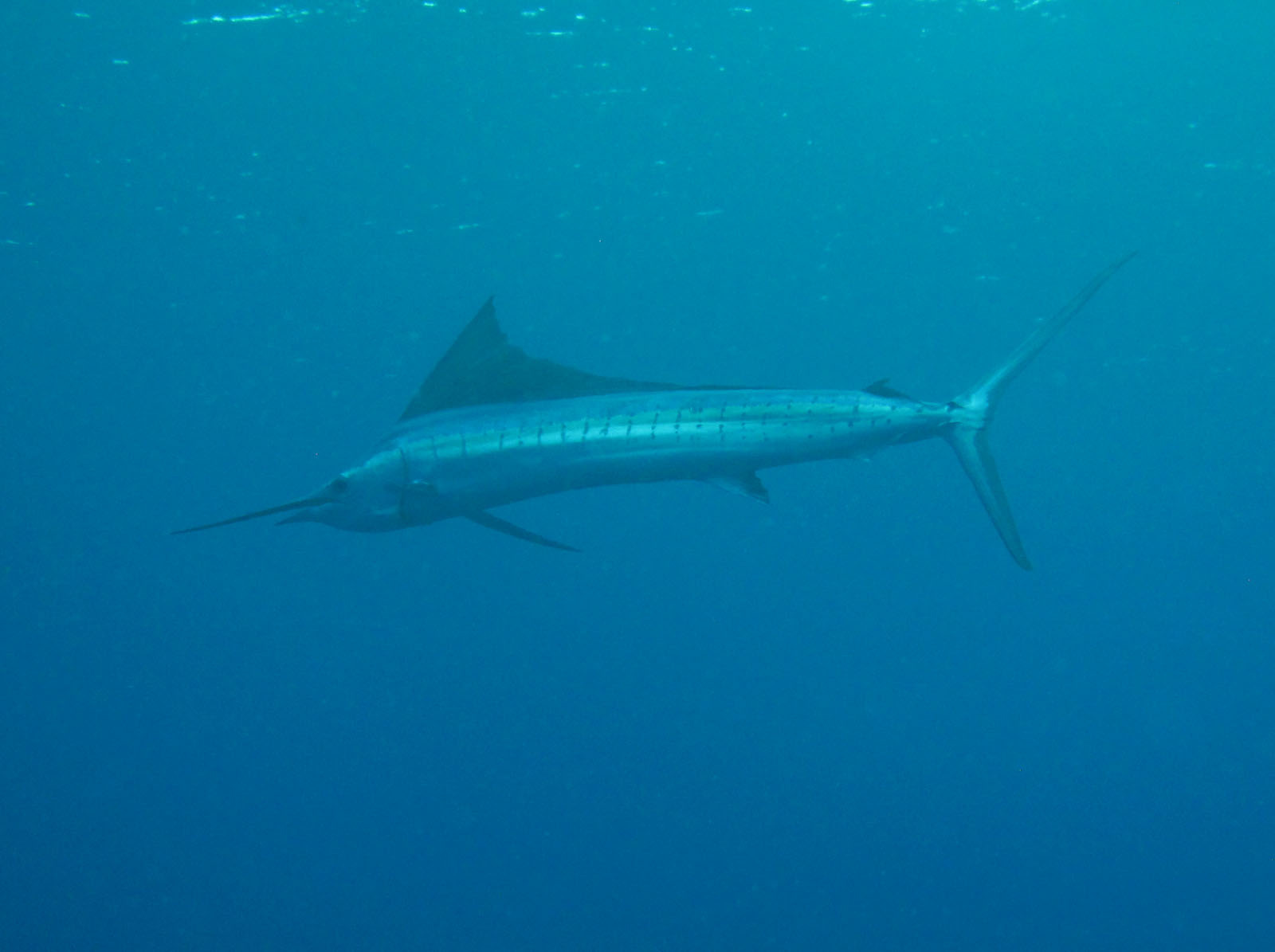
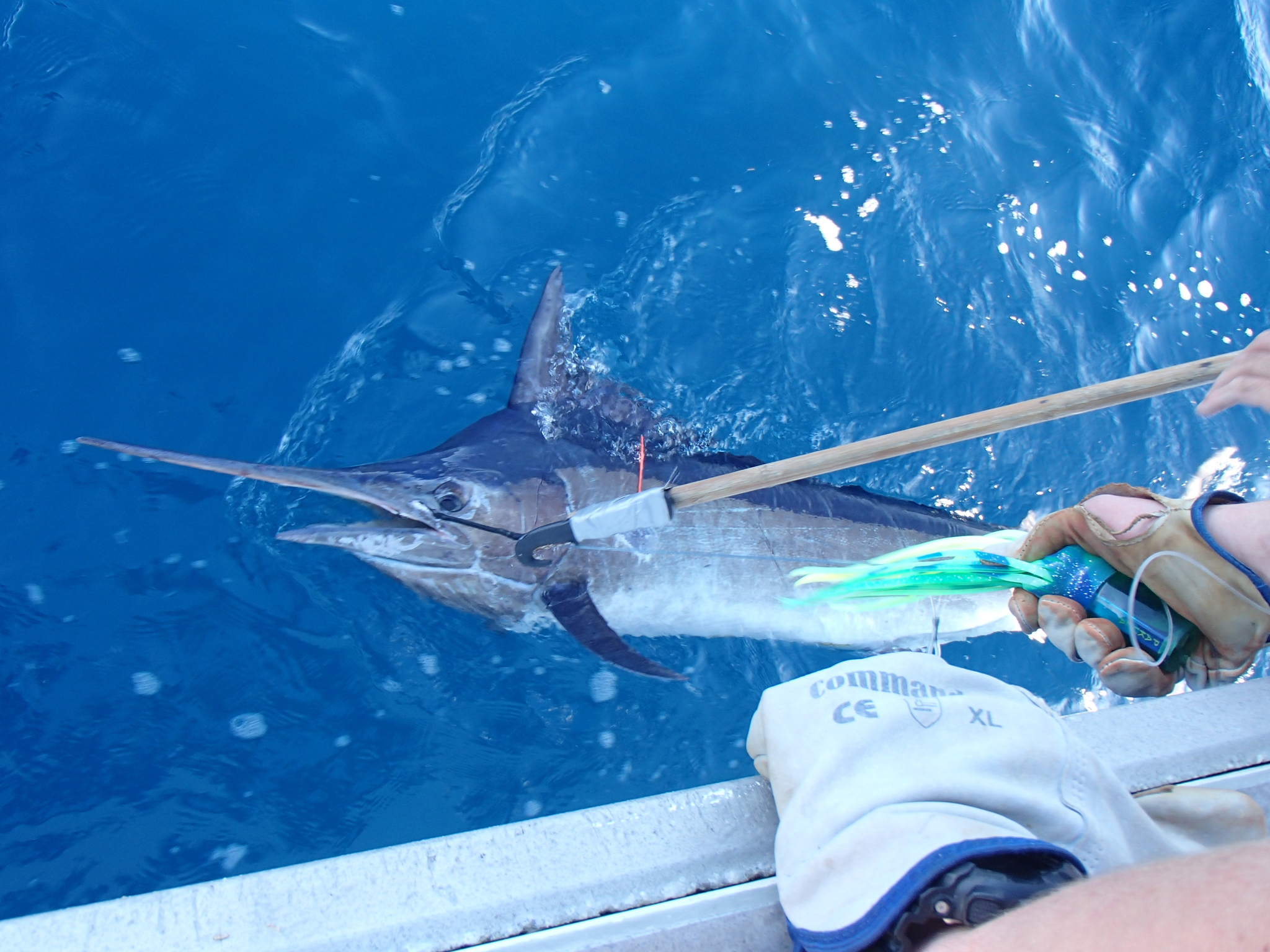
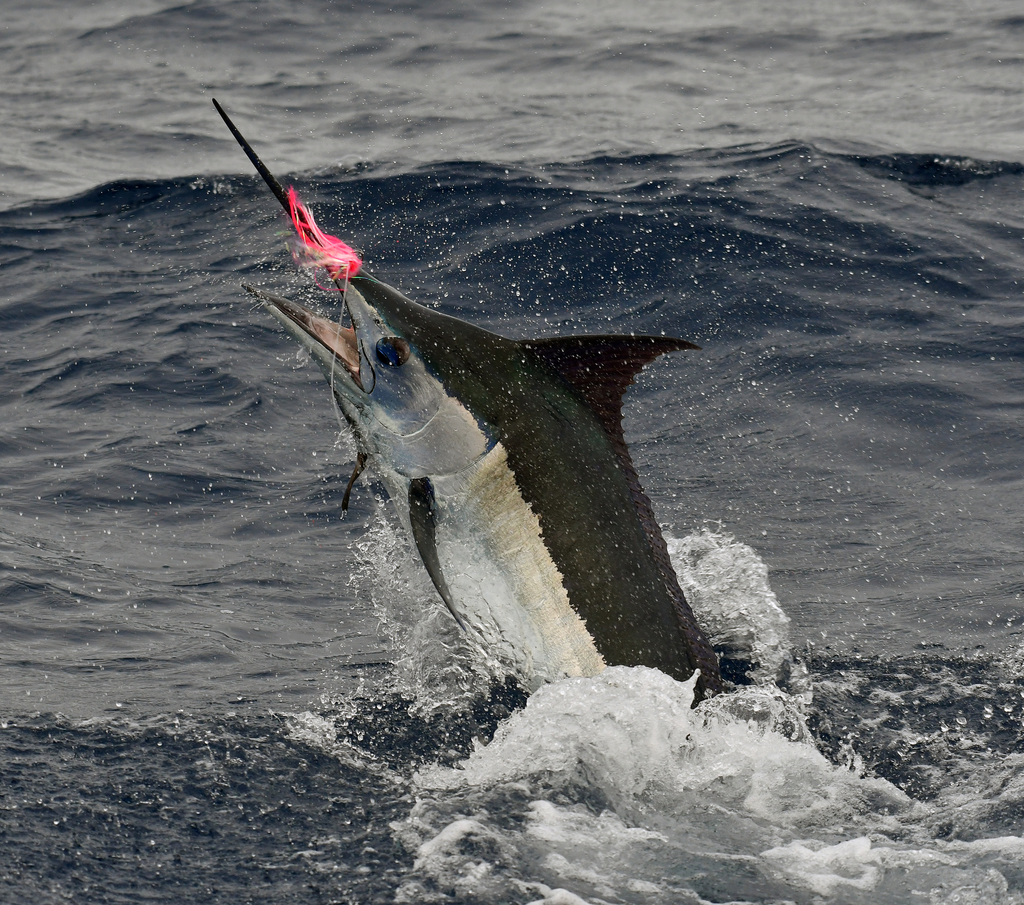
This fish carries four English names and two Chinese ones, and no single one names the animal. The record's own range note then adds a second layer of uncertainty: the Atlantic population is classified as "reduced", and it is unclear whether there are two stocks or one. Before any trolling spread is discussed, the names and the stock question have to be separated, because both are labels rather than measurements.
Four English handles, one binomial
FishBase's common-name table lists Atlantic white marlin for France, Uruguay and the FAO, White marlin for Canada, Cuba, Ghana, the Azores, Puerto Rico, Saint Helena, South Africa, Britain and the American Fisheries Society, and Skilligalee for the United States. The encyclopaedic summary adds "marlin" as a plain-language label and repeats Atlantic white marlin.
Each handle describes a different thing. "Atlantic" qualifies the range; "white" describes a colour; "skilligalee" is a local trade word with no descriptive content at all. None of them is wrong, and none is precise enough to sort a record. Only the binomial is unambiguous when another billfish is on the line.
and
The Chinese table splits the same way: and name the bill, while and name the colour and the fin count. Japanese entries give Nishimaka and Nishimakajiki.
The two Chinese descriptions are not synonyms in emphasis. One identifies the fish by its weapon, the other by its silhouette and shade. is the more literal translation; is the shorter working name this site uses. A reader who searches the longer string will find the same animal, and a reader who searches "white marlin" will find several.
The word "reduced" in the range note
The distribution text runs from roughly 45°N to 45°S in the southwestern Atlantic and to 35°S in the southeast, notes that Mediterranean and Bretagne records seem to be straying individuals, and then says the population is classified as "reduced". In the same paragraph it states that it is unclear whether there are two separate stocks or a single Atlantic population, and that the species is highly migratory.
Those are two different kinds of uncertainty. "Reduced" is a status word with no number attached: the page does not say reduced against what baseline, over what period, or by what measure. The stock question is structural: if there are two populations, an Atlantic-wide status hides two histories. The record leaves both open, and this article does not close them. What a reader can take is that the label and the assessment are not the same kind of claim.
Three hundred and two hundred ten
The record maximum is 300 cm TL; a typical specimen is 210 cm; the heaviest specimen weighed 82.5 kg; first maturity is 164 cm. The age field is empty.
The common fish is therefore 70% of the maximum, and the maturity line sits at 78% of the common length. A typical fish in the record is mature, but only just: at 164 cm it is on the line, and anything below that is a fish the source does not count as spawning. Because no age is given, the page cannot say how long the 210 cm fish needed to grow, and neither will this text.
The depth column says 150, the text says 100
The environment row gives a depth range of 0 to 150 metres, usually 0 to 100. The summary describes the species as epipelagic, found in water deeper than 100 metres but tending to stay near the surface, often around banks, shoals and canyons, and preferring surface temperatures above 22°C.
The two numbers describe different things: 150 is the outer limit of the recorded range, 100 is where the fish is usually found. Neither is a bottom figure. A trolled spread at the surface is working inside the usual band, and a bait sent deep is leaving the part of the water column the sources actually describe. The 22°C preference is the more useful threshold of the two, because it can be read off a sea-surface chart before the boat leaves.
April to June, two rows
Two rows make up the spawning table: April to June, and May alone. No sea or coast is attached to either row.
A three-month window and a single repeated month are consistent with one broad season, or with two regional seasons merged into a table. The record does not choose. For a highly migratory fish, that matters: a spawning month in one part of the Atlantic is not a spawning month everywhere, and the table has already lost the geography that would let a reader tell the difference.
Seventy-two countries and a 45-degree line
GBIF's distribution layer returns 84 records for this taxon, covering 72 country codes, all marked native, with localities grouped as Eastern Atlantic, Western Atlantic and Global. FishBase's country table runs to a similar length, from Algeria and Angola through the Caribbean to Uruguay and Venezuela.
The country count is larger than the number of meaningful range segments because the Caribbean and the Gulf of Mexico are divided into many small jurisdictions. It is a political map, not a habitat map. What matters is that three sources agree on the same envelope: the 45°N to 45°S band in FishBase is repeated in the summary, and the GBIF records sit inside it. Only FishBase puts a status word on top of that envelope, and only FishBase calls it reduced.
The iNaturalist taxon page carries 34 observations. That is a photo sample rather than a range statement, and it is far too thin to add a country to the map; it is useful only as a check that the name is in circulation among people who photograph fish.
What to write on the tag
Write the binomial. Use white marlin or in conversation, and keep as the descriptive alternative.
The numbers to carry are 164 cm for first maturity and 210 cm for a typical fish, with the 300 cm figure read as a record, not a target. Keep the trolling spread at the surface, inside the usual 0–100 metre band and above 22°C, and treat the 150 metre limit and the "reduced" status as two separate notes that the record has not connected.
Regulations before you keep it
These are the published regulations for this fish. Read the number first. The notice below it is the actual regulation.
Minimum size1
66 in lower jaw fork length
United States — North Carolina · US-NC
North Carolina applies a 66-inch lower-jaw fork length minimum to white marlin.
The 1-fish-per-vessel blue/white marlin aggregate is a North Carolina state rule. Federal HMS sets only the 66-inch minimum, with annual landings limits and in-season closures.
White Marlin
(G)
66" LJFL
Every record above names its source and the date it was retrieved. See the regulation register for the full list, or how to read these regulations.
Where these facts come from
Check these pages before you rely on a size, range or protection status.
-
FishBase — Kajikia albida
— FishBase · T2
-
GBIF — Kajikia albida occurrence records
— GBIF · T2
-
IUCN Red List — Kajikia albida
— IUCN · T1
-
Photo record — iNaturalist
— iNaturalist · T3