
Dotted gizzard shad in Japan — Hiroshima: Closed 1 May – 30 September — Hiroshima Prefecture sea area.
Regulation guide
Official sourcesWho makes the rule
Dotted gizzard shad (Konosirus punctatus), コノシロ in Japanese, is a herring-like fish of sheltered coastal water and estuaries. In Hiroshima it is managed under the prefecture's fishing adjustment rules (漁業調整規則), not under a national size standard.
The Japan Fisheries Agency explains that prefectural governors make these rules under the Fisheries Law and the Aquatic Resources Protection Law, with national approval, and that they cover gear, closed areas, closed seasons and size limits. The same page states that the rules bind recreational anglers as well as commercial fishers.
Hiroshima's fisheries division publishes the sea-area table and states plainly that the restrictions apply to everyone, not only to the fishing industry.
Source: Japan Fisheries Agency: prefectural fishing adjustment rules · Hiroshima Prefecture, Fisheries Division: sea areas, size limits and closed seasons
7 cm and the closed season
The Hiroshima table, made under Articles 35, 36 and 40 of the prefectural rules, lists このしろ at a body length of 7 cm or less with a closed period of 1 May to 30 September. The prefecture introduces the table by saying that animals at or below the listed size may not be taken during the period shown.
That wording ties the size to the season rather than stating a free-standing minimum. The prefecture's angling guidance adds that a size-limited fish should be released at once and that the species should not be fished during a closed period.
For a recreational angler the safe reading is to treat 7 cm as a release threshold at any time of year and 1 May to 30 September as a no-take window for konoshiro. A larger fish taken outside the window is not caught by the size entry.
Source: Hiroshima Prefecture, Fisheries Division: sea areas, size limits and closed seasons · Hiroshima Prefecture, Fisheries Division: rules for recreational fishing in Hiroshima
What the 7 cm measures
The table uses 体長 (body length) for konoshiro. Elsewhere in the same table it uses 全長 (total length) for eel, which the Japan Fisheries Agency defines as running from the tip of the mouth to the tip of the caudal fin.
Body length is therefore the shorter of the two measures, and a fish should not be laid against a total-length rule that does not apply to it. Measuring to the tail fin tips flatters a konoshiro and can make an undersized fish appear to pass; starting the ruler behind the snout works the other way.
The table also states that where no size is shown for an entry, the species is protected for the whole period regardless of size. That rule does not apply to konoshiro, which has a size figure.
Source: Hiroshima Prefecture, Fisheries Division: sea areas, size limits and closed seasons · Japan Fisheries Agency: prefectural fishing adjustment rules
Sea areas, not rivers
The table sits on the page headed 海(海面), meaning sea areas. Hiroshima publishes a separate set of size and season rules for rivers and lakes, so a konoshiro taken in tidal water and one taken upstream are not under the same text.
Two marine protection waters are closed to all taking of aquatic animals and plants under Article 34 of the rules: the sea off the south-west side of Ikuno Island in Osakikamijima and the sea off the east side of Kuroshima in Kure.
Much of the Hiroshima coast also carries third- and fourth-class common fishing rights, granted for fishing around artificial reefs and natural fish-gathering points. The prefecture warns that even hand-line and rod fishing inside those areas can infringe the right, so the shoreline is not open everywhere.
Source: Hiroshima Prefecture, Fisheries Division: sea areas, size limits and closed seasons · Hiroshima Prefecture, Fisheries Division: areas where fishing is restricted
Gear a shore angler may use
Article 44 of the prefectural rules limits recreational fishing to rod and hand line, hand nets and small dip nets used without a boat, cast nets used without a boat, simple spears without a launcher, and taking by hand. Bait fishing from a boat is a licensed fishery and is not open to recreational anglers.
Bait fishing from land or a breakwater is allowed in principle, but the prefecture's fisheries coordination committee has banned it in specified areas by instruction. Lights used to attract fish are prohibited, as are oil-soaked baits, electric current, trolling, longlines and gang hooks used for snagging.
Hiroshima also asks anglers to avoid obstructing commercial operations and to keep rod numbers and lengths within what can be lifted clear in an emergency.
Source: Hiroshima Prefecture, Fisheries Division: gear and methods open to the public in sea areas · Hiroshima Prefecture, Fisheries Division: fishing (recreational rules by method)
Penalties and checks before keeping one
Fishing outside the methods allowed by Article 44 carries a fine (科料). Using a prohibited gear or method under Article 37 carries up to six months' detention or a fine of up to 100,000 yen, and unlicensed operation under Article 57 of the Fisheries Law carries up to three years or a fine of up to 3 million yen.
Before keeping a konoshiro, confirm the date against the 1 May to 30 September window, confirm that the spot is not inside a protection water or a fishing-right area closed to anglers, and measure the fish on the body-length basis.
The prefecture's recreational fishing page is the version to check before a trip, because the table and the area instructions are updated on that site rather than in a single consolidated notice.
Source: Hiroshima Prefecture, Fisheries Division: rules to note in recreational fishing · Hiroshima Prefecture, Fisheries Division: sea areas, size limits and closed seasons
Official pages: Hiroshima Prefecture: sea areas, size limits and closed seasons · Hiroshima Prefecture: rules for recreational fishing · Hiroshima Prefecture: gear and methods open to the public · Japan Fisheries Agency: prefectural fishing adjustment rules
Dotted gizzard shad regulations at a glance
1 jurisdictions| Jurisdiction | Area | Size | Bag | Season / closure | Closed area | Other |
|---|---|---|---|---|---|---|
| Japan — Hiroshima | Hiroshima Prefecture sea area | ≤7 cm body length may not be taken | — | Closed 1 May – 30 September | — | — |
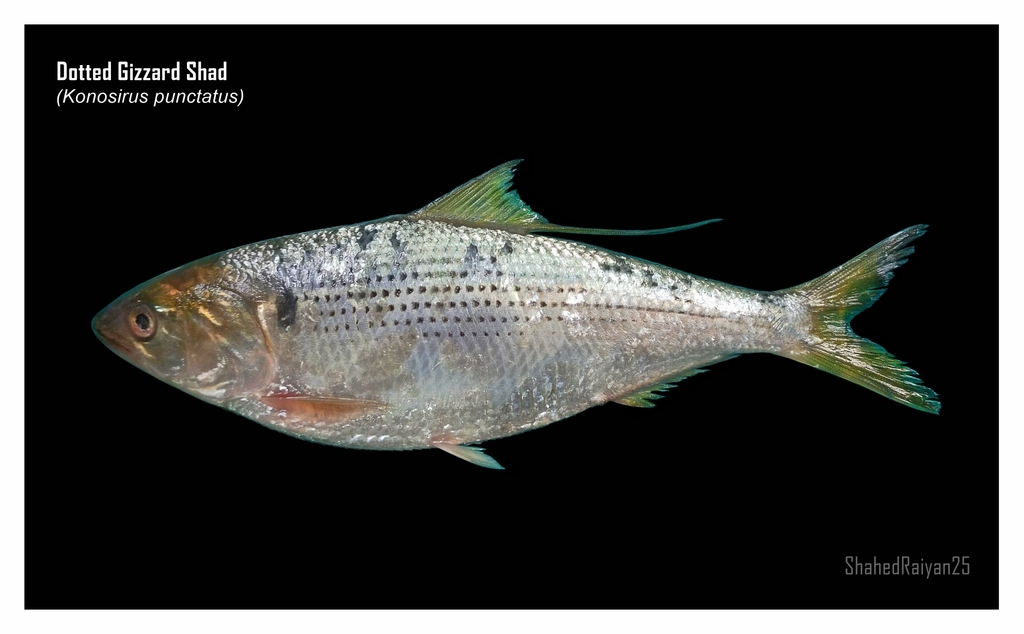
Dotted gizzard shad
Konosirus punctatus · Dorosomatidae
Dotted gizzard shad is a small coastal herring of the East China Sea and Yellow Sea, found along the Japanese coast from about 38 degrees north southward. It lives in subtropical water and reaches 32 cm TL, with maturity from about 15 cm. It is present year-round, so there is no narrow window when it is worth planning a trip.
- Family
- Dorosomatidae
- Max length
- 32 cm TL
- IUCN
- LC
- Climate
- Subtropical
Dotted gizzard shad (Konosirus punctatus) is a fish of the family Dorosomatidae. FishBase gives its range as: Indo-West Pacific: coasts of Japan from about 38°N southward; Sea of Japan north to Vladivostok on mainland; also Yellow Sea, including Gulf of Pohai and East China Sea south to Taiwan Island and Hong Kong). A school of 10–12 cm fish is all juveniles, and moving on to find a bigger grade is better than filling a bucket with them. It is recorded in subtropical water. The recorded maximum is 32 cm TL. IUCN status: Least Concern (LC). Chinese name: .
Seasonality
Other JP-34 regulations
Same jurisdictionBefore you keep a fish
- Read the recorded value. It is copied from the notice; if the number and the notice disagree, the notice wins.
- Check the area. Federal, state and local waters can set different limits for the same fish.
- Check the date. Seasons, quotas and closures change; confirm the current notice before you go.
Common questions
- What is the season / closure for Dotted gizzard shad in Japan — Hiroshima?
- Closed 1 May – 30 September
- Where does this regulation apply?
- Hiroshima Prefecture sea area
- When was it checked?
- 2026-11-18, against www.pref.hiroshima.lg.jp.