
Japanese seabass in Japan — Hiroshima: Closed 1 March – 31 July — Hiroshima Prefecture sea waters.
Based on 広島県漁業調整規則第35条・第36条・第40条; the restrictions apply to everyone, not only fishers.
Regulation guide
Official sourcesHow Japanese seabass is managed
Japanese seabass, suzuki, is managed in Japan through prefectural rules rather than a single national size limit. The Fisheries Agency explains that catches are regulated by the Fishery Act, the Aquatic Resources Protection Act, prefectural fishing adjustment rules and sea-area committee instructions, which set species, sizes, gear, seasons and areas for recreational anglers as well as fishers. The agency lists gear, closed areas, closed seasons, species-specific size limits and restrictions on night lighting among the matters these rules cover, and says they protect reproduction and the orderly use of fishing grounds.
The same agency warns that breaches are punishable, so a size printed on a prefecture page is not merely guidance. The species is also taken in Chinese waters, where Shandong and Hainan set provincial minimum sizes.
Source: 水産庁 遊漁・海面利用の基本的ルール · 水産庁 外国人による遊漁について · 山东省渔业资源保护办法 · 海南省实施《中华人民共和国渔业法》办法
Hiroshima: 10 cm body length, 1 March to 31 July
Hiroshima's table of size and season limits lists すずき at 体長10cm以下 with a prohibited period of 1 March to 31 July. During that window, seabass of 10 cm body length or less may not be taken in the prefecture's sea waters. The table's preamble states that animals at or below the listed size may not be taken during the period shown, so the date is part of the rule.
The restrictions come from Articles 35, 36 and 40 of the Hiroshima Prefectural Fishing Adjustment Rules. The prefecture states that they apply not only to commercial fishers but to everyone, so an angler is bound by the same table. For species where the table shows no size, the whole species is closed for the period; suzuki is listed with a size.
Source: 広島県 海(海面) 体長等の制限・禁止期間
Hiroshima: protected waters and closed ground
Article 34 closes two protected water surfaces to all taking of aquatic animals: the sea off Ikuno-jima in Osaki-Kamijima, and the sea off Kuroshima in Kure. The prefecture adds that other areas are not free to fish and links a separate page of restricted zones.
Those closures sit alongside the size and season table, so a legal fish can still be unlawful to keep if it was taken inside a protected surface. The protected-surface ban is separate from the size table and applies to every species, including suzuki.
Source: 広島県 海(海面) 体長等の制限・禁止期間
Gear and access rules
Hiroshima's page reproduced here covers size, season and protected waters; it does not set out the gear list. The Fisheries Agency publishes a national table of the gear each prefecture allows and warns that anglers may use only the methods listed for that prefecture.
The agency also states that scuba gear, spearguns and similar equipment are not on the table and cannot be used to take aquatic animals. Its table marks which methods each prefecture allows, so the same method may be open in one prefecture and closed in another. The agency warns that even a permitted method may be limited by area, gear size or number, and that chumming and lights need particular attention. Anglers heading to Hiroshima should read the prefecture's rule text and any sea-area committee instructions before choosing a method.
Source: 水産庁 都道府県漁業調整規則で定められている遊漁で使用できる漁具・漁法(海面のみ) · 広島県 海(海面) 体長等の制限・禁止期間
Shandong: 40 cm fork length
Shandong lists 花鲈(鲈鱼), Japanese seabass, among its key protected fishery resources. The minimum catch standard is 40 cm fork length, measured from the snout to the fork of the tail. The province's table uses the same fork-length method for other species such as 蓝点马鲛 at 45 cm.
In a net or haul, undersized individuals of key protected species may not exceed 25% of the sea catch. Taking seedlings or spawning adults needs provincial approval, and the province sets closed seasons and closed areas over spawning, feeding, wintering and migration grounds. Fully farmed fish are exempt from the closed-season, closed-area and minimum-size rules.
Source: 山东省渔业资源保护办法
Hainan: 18 cm fork length
Hainan's implementing measures for the Fishery Law set a minimum catch standard of 18 cm fork length for 鲈鱼. The same article gives 真鲷 at 12 cm fork length and 大黄鱼 at 20 cm body length. It also lists 马鲛 at 25 cm fork length and 鲳鱼 at 12 cm, so the schedule covers a wide mix of coastal species.
Fish below the standard, and their juveniles, must be returned immediately. If undersized animals reach 20% or more of a catch, fishing must stop, and the provincial fisheries department may adjust the list with provincial approval.
Source: 海南省实施《中华人民共和国渔业法》办法
Before you keep a suzuki
Measure by the method the rule uses. Hiroshima's limit is 体長, body length; Shandong and Hainan use 叉长, fork length, so a fish measured one way cannot be judged by the other figure.
Check the season in Hiroshima before keeping a small fish, check the protected surfaces, and check the local gear rules. In China, return undersized fish at once and stop when the undersize share reaches the threshold. If the fish is close to the limit, measure it before it is kept, and check the date as well as the length in Hiroshima.
Source: 広島県 海(海面) 体長等の制限・禁止期間 · 水産庁 都道府県漁業調整規則で定められている遊漁で使用できる漁具・漁法(海面のみ) · 山东省渔业资源保护办法 · 海南省实施《中华人民共和国渔业法》办法
Official pages: 水産庁 遊漁・海面利用の基本的ルール · 水産庁 都道府県漁業調整規則で定められている遊漁で使用できる漁具・漁法(海面のみ) · 広島県 海(海面) 体長等の制限・禁止期間 · 山东省渔业资源保护办法 · 海南省实施《中华人民共和国渔业法》办法
Japanese seabass regulations at a glance
3 jurisdictions| Jurisdiction | Area | Size | Bag | Season / closure | Closed area | Other |
|---|---|---|---|---|---|---|
| China — Hainan | Fork length ≥18 cm | — | — | — | — | |
| China — Shandong | Fork length ≥40 cm | — | — | — | — | |
| Japan — Hiroshima | Hiroshima Prefecture sea waters | ≤10 cm body length may not be taken | — | Closed 1 March – 31 July | — | — |
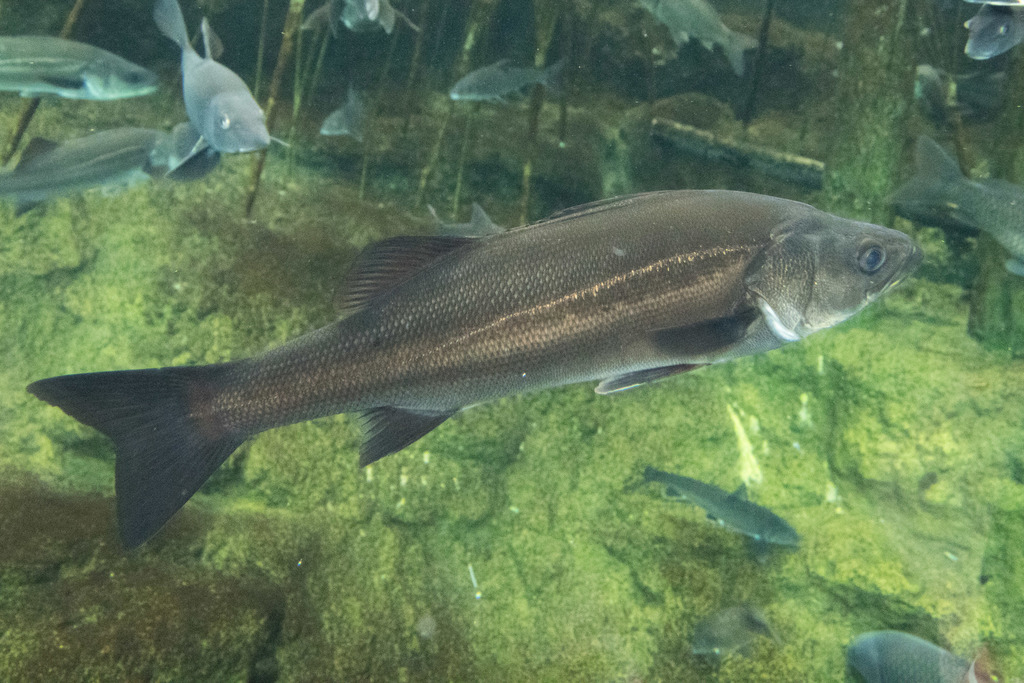
Japanese seabass
Lateolabrax japonicus · Lateolabracidae
The Japanese seabass is recorded as marine, freshwater and brackish at the same time. All three labels are true, because the fish is not a single habitat but a route between them. FishBase also calls it catadromous and reef-associated, and gives a temperature-and-space envelope from 44°N to 15°N and 106°E to 143°E. The first thing is the movement; the second is a size contradiction no angler should paper over.
- Family
- Lateolabracidae
- Max length
- 102 cm TL
- Max weight
- 8.7 kg
- Depth
- ≥ 5 m
- IUCN
- LC
- Climate
- Subtropical
- Diet
- fishes, zooplankton
The Japanese seabass is recorded as marine, freshwater and brackish at the same time. All three labels are true, because the fish is not a single habitat but a route between them. FishBase also calls it catadromous and reef-associated, and gives a temperature-and-space envelope from 44°N to 15°N and 106°E to 143°E. The first thing is the movement; the second is a size contradiction no angler should paper over.
Techniques
- Shore casting lure —
- Boat fishing —
- Live bait —
Seasonality
Other JP-34 regulations
Same jurisdictionBefore you keep a fish
- Read the recorded value. It is copied from the notice; if the number and the notice disagree, the notice wins.
- Check the area. Federal, state and local waters can set different limits for the same fish.
- Check the date. Seasons, quotas and closures change; confirm the current notice before you go.
Common questions
- What is the season / closure for Japanese seabass in Japan — Hiroshima?
- Closed 1 March – 31 July
- Where does this regulation apply?
- Hiroshima Prefecture sea waters
- When was it checked?
- 2026-11-18, against www.pref.hiroshima.lg.jp.
- Do other jurisdictions set different limits?
- Yes. This register lists 3 jurisdictions for Japanese seabass; compare them in the table above.