
Yellowstriped butterfish in Japan — Tokyo: ≤10 cm total length may not be taken — Tokyo sea area.
Regulation guide
Official sourcesTokyo's name for the fish: takabe
Tokyo's guidance for recreational fishing lists the species as たかべ (takabe), in the table of aquatic animals with a minimum size under Article 35 of the Tokyo Metropolitan Fisheries Adjustment Regulation.
The page is written for people fishing for recreation and states that the fisheries regulations apply to recreational fishers as well as to commercial fishers.
The regulatory content is grouped by article of the regulation, so the size table, the closed-period table and the gear list are read as separate controls rather than as one list of rules.
The table gives the size in total length (全長), not body length or fork length, so the entry has to be read with that axis in mind.
Source: Tokyo Metropolitan Government: Guidance for recreational fishing in the sea (海で楽しむ皆さんへ)
10 cm total length
The entry reads 全長 10cm以下, meaning fish of 10 cm total length or less may not be taken. A fish has to be over 10 cm before it can be kept.
Total length runs from the tip of the snout to the tip of the tail. That is a different axis from the body length used in some other prefectural tables, so the figure should be checked against total length rather than against a body-length measurement.
The rule is a size rule only. It is not tied to a season, so the 10 cm floor applies throughout the year.
The sizes in the table are minimums. A larger fish is not restricted by the entry, and the page sets no maximum for the species.
Source: Tokyo Metropolitan Government: Guidance for recreational fishing in the sea (海で楽しむ皆さんへ)
No closed period for takabe
Tokyo's closed-period table under Article 34 lists only あさひがに, from 1 to 31 July, and みつかどぱいぷうに, from 1 July to 31 August. Takabe is not on that list.
The page notes that some species outside the tables have size limits but are covered by fishing rights, so recreational fishers may not take them at all. Because takabe appears in the Article 35 table, it is not one of those reserved species.
The distinction matters because a species absent from both tables is not automatically open. The page points readers to the regulation and to local rules for anything that is not listed.
Source: Tokyo Metropolitan Government: Guidance for recreational fishing in the sea (海で楽しむ皆さんへ)
Other fish in the same table
The same table sets 15 cm total length for ぶり (yellowtail), 24 cm total length for うなぎ (eel), and shell sizes for あさり at 2.5 cm, はまぐり at 4 cm and みつかどぱいぷうに at 6 cm.
The table is short, which makes it easy to check before a trip. It is also the complete list of size limits that the page presents to recreational anglers.
The page describes the regulation as the legal text and the guidance as a summary, so the table is a pointer to Article 35 rather than a substitute for it.
Source: Tokyo Metropolitan Government: Guidance for recreational fishing in the sea (海で楽しむ皆さんへ)
Fishing rights and where you can fish
Around the Izu and Ogasawara islands, fishing rights are licensed to local fisheries cooperatives within set distances of the coast, from 1,000 m to 2,000 m depending on the island.
The distances are measured from the maximum high-tide shoreline of each island, so the boundary follows the coast rather than a straight line between islands.
People who are not members of the cooperative must not take the species covered by those rights, which the page lists as shellfish and seaweed such as abalone, turban shell, lobster, sea urchin and nori.
The page also identifies no-take areas: the Ogasawara marine park areas around Chichijima and Anijima, and around Hahajima, where aquatic life may not be collected. Around the Tokyo Bay Aqua-Line stop known as Sea Hotal, both collecting aquatic animals and plants and guiding recreational fishing are prohibited.
Source: Tokyo Metropolitan Government: Guidance for recreational fishing in the sea (海で楽しむ皆さんへ)
Gear allowed to recreational anglers
Article 40 limits recreational gear to rod and handline, excluding berley fishing; scoop and sade nets; cast nets used without a boat; spear and hagu; hand gathering; and trolling.
Berley fishing is prohibited for recreational anglers. Scuba gear, underwater guns and fish-collecting lights may not be used to take fish, shellfish or seaweed, and crab nets are prohibited.
Trolling is subject to area and period restrictions set by the Tokyo Sea Area Fisheries Adjustment Commission and may be conducted in approved tournaments.
The commission may also issue instructions to recreational fishers, for example banning live bait for akahata and kasago within 1,500 m of the Izu islands.
Source: Tokyo Metropolitan Government: Guidance for recreational fishing in the sea (海で楽しむ皆さんへ)
What to check before keeping a takabe
Check 10 cm total length, measured from snout to tail tip, and return fish at or below that size.
Check the area for fishing rights and no-take zones, and check the gear rules before leaving.
Check the commission's current instructions and any local rules for the island or bay, because the prefectural page points to both.
Source: Tokyo Metropolitan Government: Guidance for recreational fishing in the sea (海で楽しむ皆さんへ)
Official pages: Tokyo Metropolitan Government: Guidance for recreational fishing in the sea (海で楽しむ皆さんへ)
Yellowstriped butterfish regulations at a glance
1 jurisdictions| Jurisdiction | Area | Size | Bag | Season / closure | Closed area | Other |
|---|---|---|---|---|---|---|
| Japan — Tokyo | Tokyo sea area | ≤10 cm total length may not be taken | — | — | — | — |
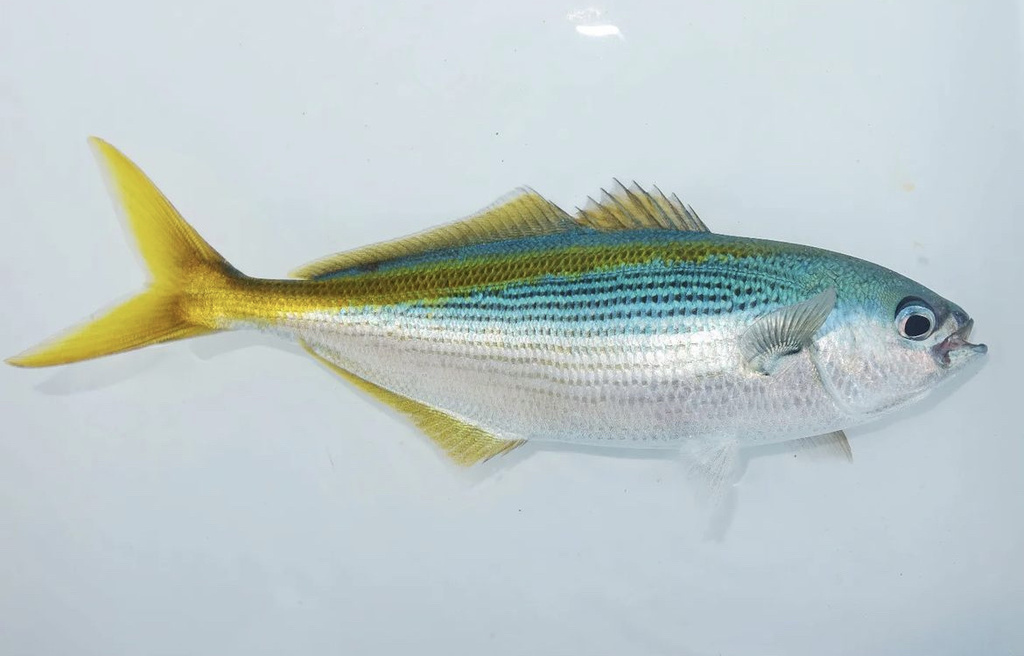
Yellowstriped butterfish
Labracoglossa argenteiventris · Centrarchiformes
A small schooling fish of Japanese coastal rock, marked by a bright yellow band along the flank. It feeds on plankton, spawns in autumn, grows slowly, and reaches the Kanto market in summer, where salt-grilling is the standard treatment. Records thin out west of Kanto and on the Japan Sea side.
- Family
- Centrarchiformes
- Max length
- 20 cm TL
- Depth
- 0–50 m
- IUCN
- NE
- Climate
- Temperate
A small schooling fish of Japanese coastal rock, marked by a bright yellow band along the flank. It feeds on plankton, spawns in autumn, grows slowly, and reaches the Kanto market in summer, where salt-grilling is the standard treatment. Records thin out west of Kanto and on the Japan Sea side.
Techniques
- Float fishing —
- Boat bottom fishing —
- Shore fishing —
Seasonality
Other JP-13 regulations
Same jurisdictionBefore you keep a fish
- Read the recorded value. It is copied from the notice; if the number and the notice disagree, the notice wins.
- Check the area. Federal, state and local waters can set different limits for the same fish.
- Check the date. Seasons, quotas and closures change; confirm the current notice before you go.
Common questions
- What is the minimum size for Yellowstriped butterfish in Japan — Tokyo?
- ≤10 cm total length may not be taken
- Where does this regulation apply?
- Tokyo sea area
- When was it checked?
- 2026-11-18, against www.sangyo-rodo.metro.tokyo.lg.jp.