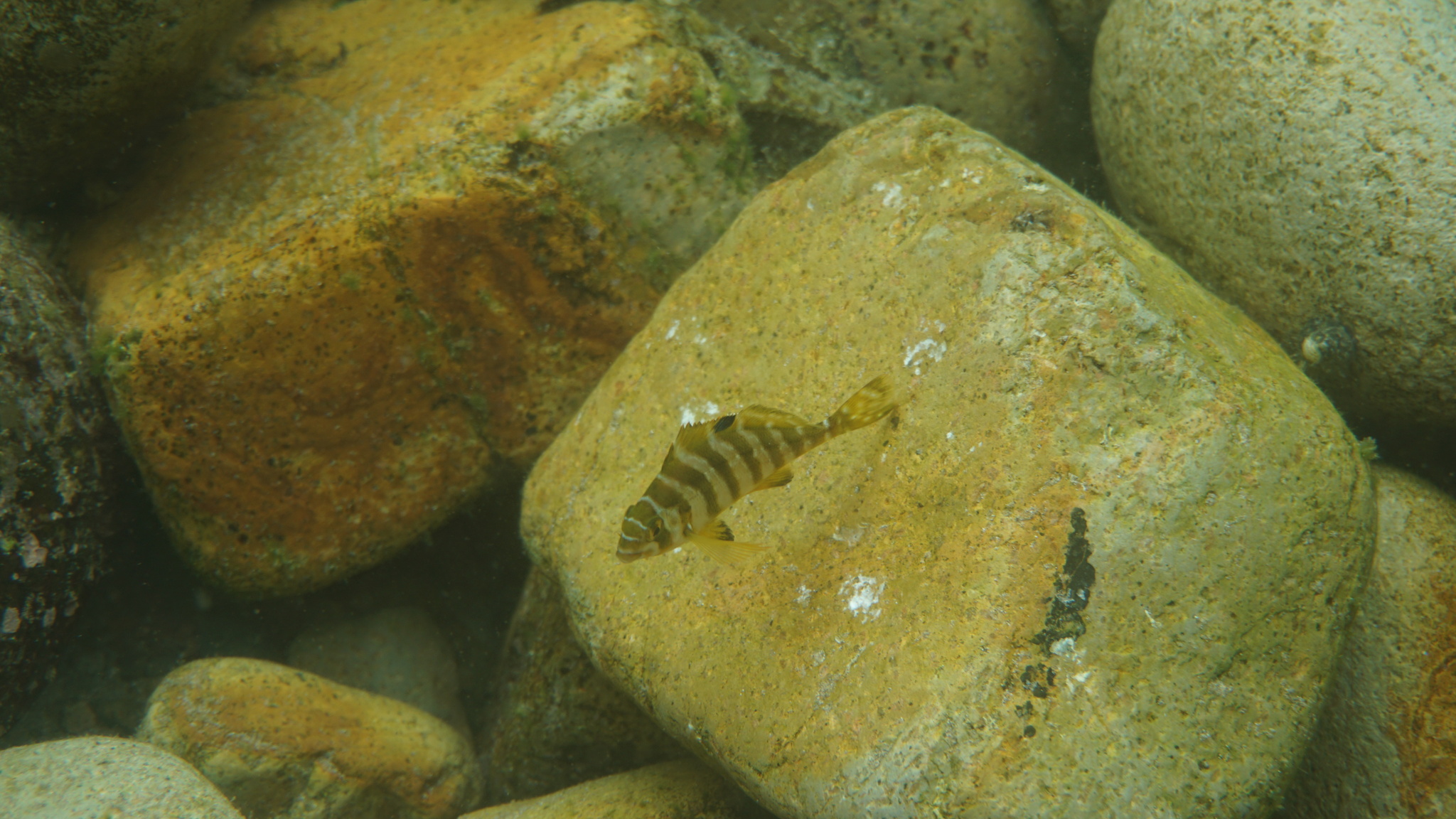
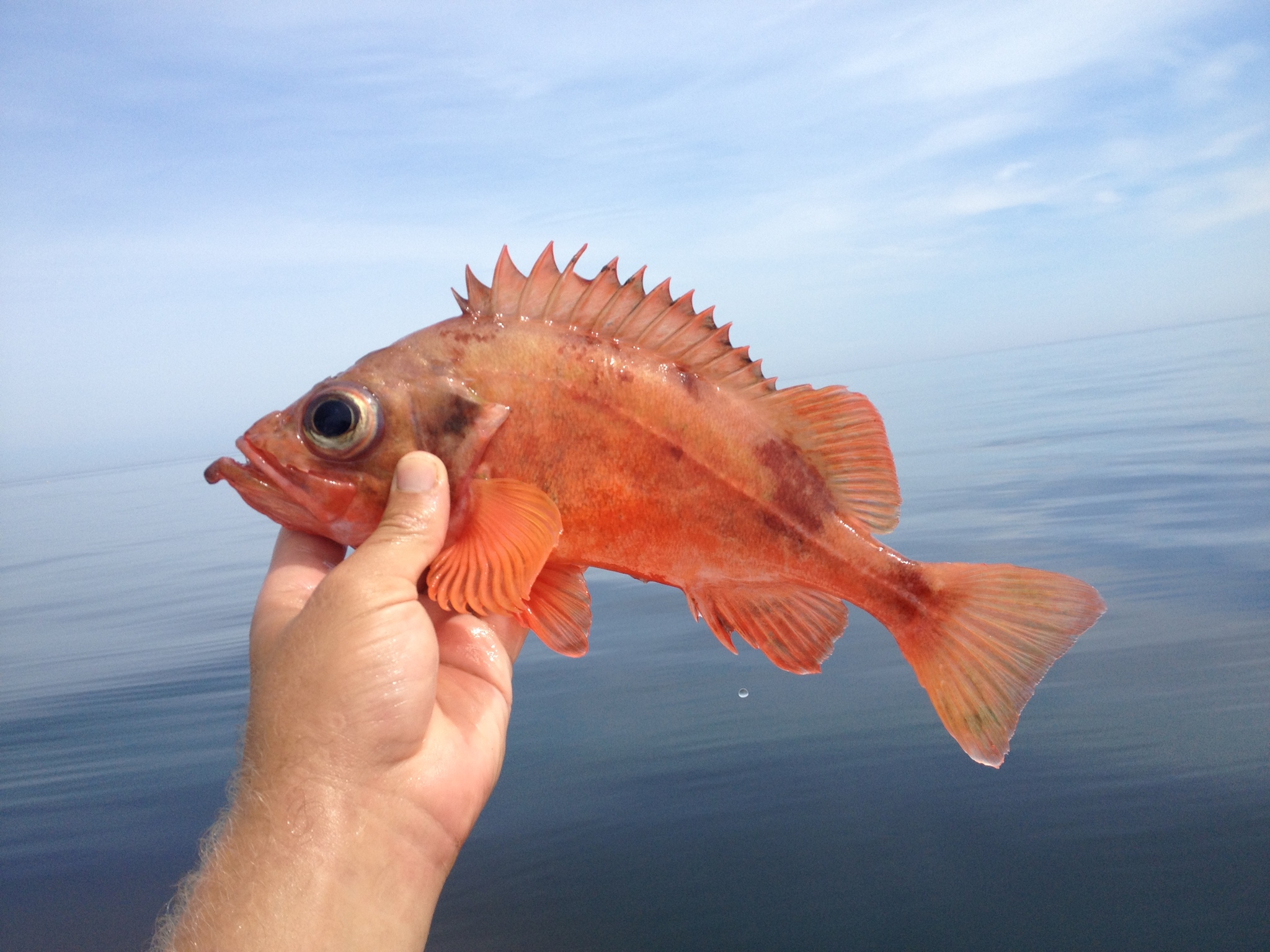
≤10 cm total length may not be taken
Japan — Tokyo · JP-13
Tokyo prohibits taking takabe (yellowstriped butterfish) of 10 cm total length or less.

A small schooling fish of Japanese coastal rock, marked by a bright yellow band along the flank. It feeds on plankton, spawns in autumn, grows slowly, and reaches the Kanto market in summer, where salt-grilling is the standard treatment. Records thin out west of Kanto and on the Japan Sea side.

A small schooling fish of Japanese coastal rock, marked by a bright yellow band along the flank. It feeds on plankton, spawns in autumn, grows slowly, and reaches the Kanto market in summer, where salt-grilling is the standard treatment. Records thin out west of Kanto and on the Japan Sea side.
Labracoglossa argenteiventris is a small, slightly elongate oval fish, compressed, with a small head and a small mouth whose lower jaw protrudes slightly. The back is blue-green, the belly silver, and a bright yellow band runs along the flank near the lateral line. The dorsal, caudal and anal fins carry yellow as well, and the base of the caudal peduncle is covered in fine scales. A notch in the dorsal fin separates it from similarly coloured juvenile sea basses and snappers. FishBase gives 20 cm total length and a common length of 15 cm; the Japanese fishing encyclopedia says usually about 25 cm. The two do not agree, and this entry uses 20 cm as the ceiling and rigs for fish of 15 to 20 cm.
FishBase gives the northwest Pacific, from central Honshu to Kyushu. The Japanese account is finer: Hachijojima and the Ogasawara Islands, the Pacific coast from Ibaraki to southern Kyushu, Wakasa Bay, Kasumi, Oki and Hamada, Tottori, and the Japan Sea side of Yamaguchi to northern Kyushu. It adds the south coast of Korea and Jeju. The fishing encyclopedia calls the species endemic to Japan, which conflicts with that Korean record; both statements are kept here and neither is resolved. The fish schools in midwater over coastal rock, and around the Izu Islands it concentrates shallower than 50 m, with the Niijima-to-Kozushima stretch as the centre. The place to fish is a reef head or a breakwater tip with enough current to carry plankton, not a stagnant bay floor.
Spawning is autumnal. The encyclopedia gives August to October; the fishing encyclopedia notes the gonad index rising from late September and staying high into November. Eggs are spherical, about 1 mm across, and hatch in roughly 60 hours at 16 to 17°C, with larvae about 2.3 mm at hatching; the following spring, juveniles around 5 cm appear in schools in rocky tide pools. Growth is slow: about 10 cm in the first year, 20 cm in the second, and seven years to pass 30 cm, with both sexes mature at two. Feeding becomes inactive below 16°C, so winter is not its season. The market peak is June to August; April and May are called the hashiri, but Kanto buyers generally consider them early.
From shore, use a 4.2 to 5.3 m stream rod, or a 0.6 to 1 iso rod with a small spinning reel. A leg float is enough; experienced anglers use a more sensitive lower float. The bait is set within a metre of the surface — three or four larger krill bunched on the hook. The method is to scatter diluted krill slurry upcurrent first, then let the rig sink with that flow rather than against it. From a boat the approach is chum-and-jerk, usually with a 60 basket, or 30 to 40 for light tackle. A three-hook streaming rig with beads on the shanks draws fish, and the retrieve works upward from the bottom of the indicated depth.
Shore line runs the length of the rod, 1 to 1.5 nylon on an iso rod, with a 0.6 to 0.8 leader and hooks in sizes 1 to 3. Boat tackle is a 2 m rod with a 7:3 action rated 20 to 30, PE 1 to 2 main line and a 2 to 3 leader. The mouth is thin, and a 30 cm cushion tube on the boat rig visibly reduces tearing. From shore, lift the fish in one continuous motion instead of playing it around the rocks. Basket size and hook count are limited by some boat operators, so confirm before boarding rather than assuming a standard.
Fat rises as the summer water warms. Salt-grilling is the Kanto standard, taken far enough that the skin oils and picks up a little char; drying, frying and simmering also work, and a very fresh fish can be seared lightly. Small individuals concentrate fat and flavour, and even an 11 cm fish is worth keeping. The flesh itself is strongly flavoured, and sashimi is a poor showcase because the colour darkens quickly. Japan has no nationwide recreational size or closed season; sea fishing follows prefectural fishery adjustment rules and cooperative angling rules. No published species-level limit was found, but the rules of Chiba, Tokyo for the Izu Islands and Shizuoka still need checking. That check was not completed and is marked deferred.
Taxonomy, distribution and length come from FishBase. The Japanese distribution detail, spawning, early life history, growth and fishing method come from the fishing encyclopedia; market season, cooking and processing from the market encyclopedia. The 20 cm maximum and the 25 cm figure are listed side by side rather than averaged, and the endemic-to-Japan claim and the Korean record are likewise left in disagreement.
Fished with the listed approach, matched to the recorded depth and size.
Fished with the listed approach, matched to the recorded depth and size.
Fished with the listed approach, matched to the recorded depth and size.
These are the published regulations for this fish. Read the number first. The notice below it is the actual regulation.
Tokyo prohibits taking takabe (yellowstriped butterfish) of 10 cm total length or less.
Every record above names its source and the date it was retrieved. See the regulation register for the full list, or how to read these regulations.
Check these pages before you rely on a size, range or protection status.
These fish live in the same place.
Technique, gear and safety guides that fit Yellowstriped butterfish.