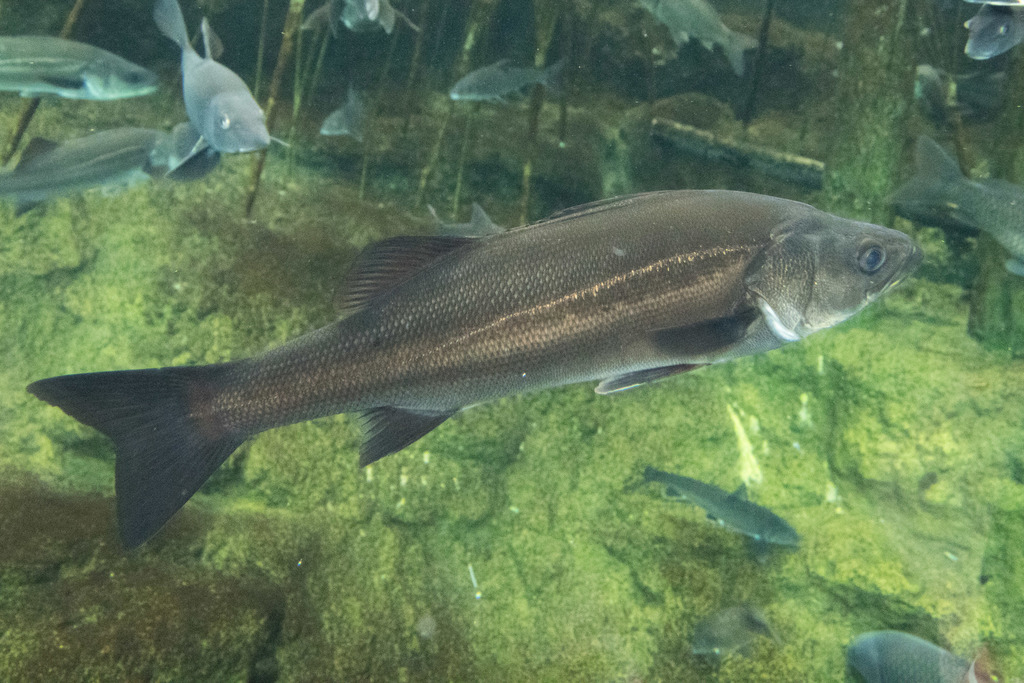
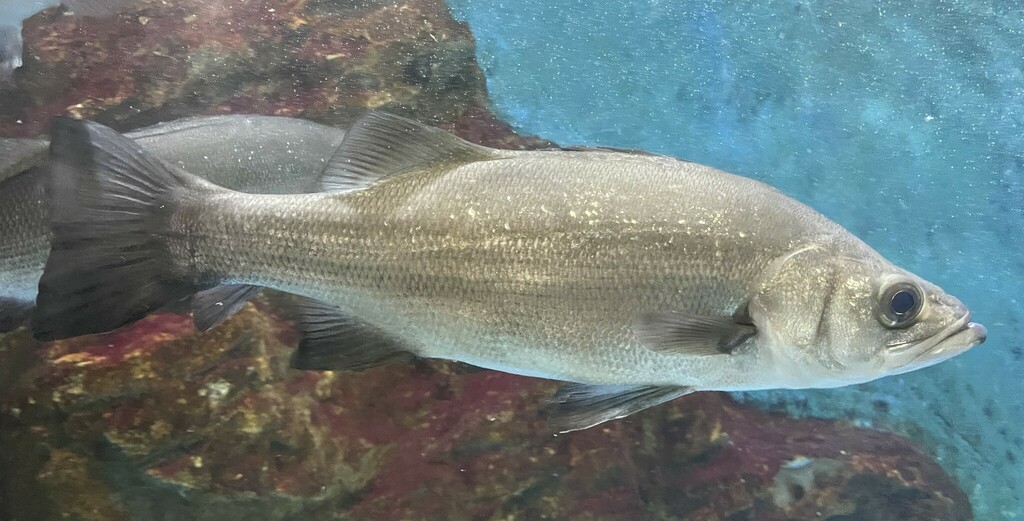
The Japanese seabass is recorded as marine, freshwater and brackish at the same time. All three labels are true, because the fish is not a single habitat but a route between them. FishBase also calls it catadromous and reef-associated, and gives a temperature-and-space envelope from 44°N to 15°N and 106°E to 143°E. The first thing is the movement; the second is a size contradiction no angler should paper over.
Three waters, one fish
Marine, freshwater and brackish are all ticked, and the habitat keywords are rocky and coastal. Catadromous is the label that ties them together: it describes a life cycle that crosses the salinity line, not a fish that can be found in all three at once. The checked page does not spell out the route or the timing, so this article will not invent a migration map. What it does say is that a river mouth, a harbour and a rock wall can all be legitimate water.
Wikipedia's lead gives the same catadromous label and sets the Western Pacific as the range. Those two together put the crossings on a western Pacific coastline rather than in open ocean, which is why a river mouth or a harbour wall is the place to wait.
That is the practical geography. Instead of choosing between the sea and the river, fish the place where they meet: the estuary mouth on a moving tide, the harbour wall with fresh water leaking out, the rock ledge just outside the brackish lens. A catadromous fish is a fish on the move, and the edge is where the move is easiest to intercept.
The 16.1 cm common length that cannot be common
Length tops out at 102 cm TL, weight at 8.7 kg. The page also carries a common length of 16.1 cm standard length, and a maturity entry of "Lm ?, range 50 - ? cm". A 16.1 cm common length and a 50 cm maturity threshold cannot describe the same population. Those two numbers trace to separate references, and the page leaves them unreconciled. This article keeps both and refuses to average them: one of them is a stock- or sample-specific figure, but which one is not stated.
For a fishing plan, the maturity range is the more conservative number. If 50 cm is the lower bound for mature fish, then a 16.1 cm fish is a juvenile by that standard, however "common" the other reference calls it. Use 50 cm as the release guide and treat the 16.1 cm figure as a warning that length statistics in this record are not internally consistent.
Depth starts at five and never ends
The depth range is written as 5 m to an unspecified maximum. That is not a band; it is a floor with no ceiling. The habitat keywords add rocky and coastal, and the mode is reef-associated, but the source does not say how deep the fish goes. Inventing a maximum would turn a blank into a false precision.
Five metres is within a shore lure's range, or a float-rigged live bait's, where shallow rock and harbour structure sit. Beyond that, a boat can follow the slope, but the page gives no target depth. The honest approach is to fish the structure you can see and let the depth finder tell you where the rock ends, rather than quote a maximum the source never recorded.
Names that travel
The English names are Japanese seabass, Japanese seaperch, Japan sea bass, common sea bass and spotted sea bass. In Chinese the approved list gives ; FishBase's Mandarin vernacular includes , , , and . The Japanese name is suzuki. These are not interchangeable in ordinary speech: "seabass" is also a market category, and is a generic word that can cover more than one species.
Only the Latin binomial stays put. If you are comparing a record from Japan with one from Hong Kong SAR, China, check the scientific name before comparing the size or the season. The alias list is evidence that the fish has been traded and eaten under many names, not evidence that every "seabass" is this species.
Spawning records with blanks
The spawning table is unusually noisy. Korea (South) is listed for every month, from a Goheung survey that ran from December 1996 to November 1997. Japan is listed for January, November and December. China is listed for January, November and December, with the locality marked "to be filled". Hong Kong SAR, China is listed for December, also with the locality unfilled.
Two things follow, and neither should be smoothed away. First, an all-year Korean record and a winter-only Japanese and Chinese record disagree about the season; the page does not decide between them. Second, "to be filled" is a data gap, not a locality, and this article will not fill it. The usable reading is that winter is the recurring window in the northern part of the range, while at least one southern Korean survey found spawning across the year.
Commercial, farmed, and a 2023 assessment
The use record covers commercial capture, commercial farming and angling. Red List status: Least Concern, as of 9 January 2023. The 2023 date makes this a fresher assessment, but a category is still a snapshot, not a licence. The page also shows a commercial farmed supply, which means the fish in a market tank and the fish on a rock wall are different products.
No regulation text appears in the record. Size and bag rules for this species are set nationally and locally, and they are not reproduced here. The biological number that travels is the 50 cm maturity threshold: a fish below it is not yet a spawning fish by the source's own standard.
GBIF: a Pacific range with stray dots
GBIF holds 4,422 preserved records. Japan accounts for 2,488, Korea for 666, China for 408, Taiwan region for 86 and Hong Kong SAR for nine. Then the list changes character: Australia six, Canada three, Great Britain two, Macao SAR two, Russia two, Indonesia one, North Korea one, Mauritius one, Namibia one, United States one. The distribution text says Western Pacific, from Japan to the South China Sea, so the Australian, Canadian, British, American, Namibian and Mauritian dots sit outside the stated range. They may be aquarium specimens, mislabels or released fish; the record picks none of those explanations.
The Asian core is the only part dense enough to plan around. The stray dots are a reminder that a GBIF record is a specimen label, not a verified population. For a trip, let the Japanese, Korean, Chinese and Taiwan region counts narrow the coastline, then let habitat keywords choose between rock and river mouth.
Where to start
iNaturalist has 406 observations for the taxon, a much smaller photographic footprint than the GBIF specimen count. The approved methods are shore lure casting, boat fishing and live bait, all mainstream. Put them together with the three-water habitat and the 5 m floor, and the plan is a salinity-edge plan: a river mouth on the tide, a harbour wall, a rock ledge at the shallow end. Carry two numbers — the 50 cm maturity threshold and the unresolved 16.1 cm common length — and treat everything else here as background.
How to catch it
Shore casting lure
Cast lures from shore and retrieve across likely holding water.
Boat fishing
Fished from a boat, with the approach adjusted to the recorded depth.
Live bait
Live bait presented where the fish is likely to feed.
Regulations before you keep it
These are the published regulations for this fish. Read the number first. The notice below it is the actual regulation.
Minimum size3
Fork length ≥18 cm
China — Hainan · CN-HI
Hainan commercial catch standard: the minimum catch size for seabass is fork length ≥ 18 cm. This is a standard for commercial catches set by a provincial regulation, not a rule for recreational angling; whether an angler must release an undersized fish should be confirmed with the local fisheries authority.
The notice uses the general name “sea bass” without splitting species; recorded here as Japanese seabass. Local interpretation governs.
Fork length ≥40 cm
China — Shandong · CN-SD
Shandong commercial catch standard: the minimum catch size for Japanese seabass is fork length ≥ 40 cm. This is a standard for commercial catches set by a provincial regulation, not a rule for recreational angling; whether an angler must release an undersized fish should be confirmed with the local fisheries authority.
≤10 cm body length may not be taken
Japan — Hiroshima · JP-34
Hiroshima Prefecture prohibits taking Japanese seabass (suzuki) of 10 cm body length or less.
Based on 35 ・ 36 ・ 40 ; the restrictions apply to everyone, not only fishers.
Season / closure1
Closed 1 March – 31 July
Japan — Hiroshima · JP-34
Hiroshima Prefecture closes fishing for Japanese seabass (suzuki) from 1 March through 31 July.
Based on 35 ・ 36 ・ 40 ; the restrictions apply to everyone, not only fishers.
Every record above names its source and the date it was retrieved. See the regulation register for the full list, or how to read these regulations.
Where these facts come from
Check these pages before you rely on a size, range or protection status.
-
FishBase — Lateolabrax japonicus
— FishBase · T2
-
GBIF — Lateolabrax japonicus occurrence records
— GBIF · T2
-
IUCN Red List — Lateolabrax japonicus
— IUCN · T1
-
Photo record — iNaturalist
— iNaturalist · T3