
Estuary perch in Australia — Victoria: ≥27 cm — Victorian waters.
Minimum legal size: 27cm
Quoted from VFA — Estuary perch (including Australian bass and hybrids)
Estuary perch is a freshwater and estuarine species. Macquarie perch (Macquaria australasica) is a different species and is fully protected in Victoria, with a bag limit of 0.
Regulation guide
Official sourcesHow estuary perch is managed in Victoria
Estuary perch (Macquaria colonorum) is a native Victorian species managed by the Victorian Fisheries Authority. The VFA publishes the recreational rules in its annual fishing guide and keeps a species page setting out the current size and bag limits alongside the fish's biology and distribution.
Victoria controls the take with a minimum legal size and a combined bag and possession limit shared with Australian bass. The combined structure exists because the two species overlap in range and are regularly confused by anglers.
The VFA describes estuary perch as native to Victoria and notes that adults live in brackish water, while Australian bass move into fresh water. That difference in where the fish is caught is one of the simplest ways to separate the two.
Source: Victorian Fisheries Authority: Estuary Perch · Victorian Fisheries Authority: Victorian Recreational Fishing Guide 2026 (PDF)
The 27 cm minimum
The minimum legal size for estuary perch is 27 cm. The VFA species page states the figure and the 2026 recreational fishing guide repeats it for estuary perch, including Australian bass and hybrids.
The size limit is the only length control on the species. A fish below 27 cm must be returned, and an angler working near the line should measure before the fish goes on ice rather than after.
The VFA notes that estuary perch can be confused with Australian bass, and a fish that cannot be identified with confidence should be released. The minimum size applies either way, but the bag rules differ within the combined limit.
Source: Victorian Fisheries Authority: Estuary Perch · Victorian Fisheries Authority: Victorian Recreational Fishing Guide 2026 (PDF)
Five fish, combined with Australian bass
The bag and possession limit is five fish. The VFA describes it as a combined bag of five that can include a maximum of two Australian bass, because the species are caught in the same waters.
The VFA species page states the figure as a bag and possession limit of five, so the same number applies to fish held at home as to fish taken on the day.
The combined structure catches anglers who count species separately. A catch of three estuary perch and two Australian bass reaches the limit, and five estuary perch also reaches it, while five Australian bass exceeds the two-bass allowance.
Source: Victorian Fisheries Authority: Estuary Perch · Victorian Fisheries Authority: Victorian Recreational Fishing Guide 2026 (PDF)
Lake Bullen Merri has its own entry
Lake Bullen Merri is listed separately in the guide. In that water the limit is a combined total of five for one or more species of estuary perch, Australian bass and hybrid species.
The difference from the rest of the state is the two-bass sub-limit. Elsewhere, the five-fish combined bag can include no more than two Australian bass; at Lake Bullen Merri the five is a straight combined total across the three categories.
An angler fishing the lake should therefore count the bag against the lake's combined total rather than against the statewide bass allowance.
Source: Victorian Fisheries Authority: Victorian Recreational Fishing Guide 2026 (PDF)
Where estuary perch live
Estuary perch occur in coastal stream systems along the entire Victorian coast. They are less common in Western Port and Port Phillip Bay than they were historically, but abundant in most streams and estuaries where they occur.
The species is most common in estuaries and the lower freshwater reaches of coastal streams and seems to prefer deeper, more saline water than Australian bass, though it is regularly found in areas with less than 1,000 p.p.m. salinity.
The VFA lists good populations in Mallacoota Inlet, the Brodribb River, Little River at Mallacoota, the Snowy River, the Bemm River, Wingan Inlet, Swan Lake, Tamboon Inlet, the Cann River, the Betka River and the Mueller River.
Growth, spawning and the fishing itself
Estuary perch can reach about 10 kg, though the usual weight range is 400 g to 2 kg. Fish of eight to nine years reach roughly 45 cm and 1.8 kg.
Spawning takes place in the mouths of estuaries in salt water during July and August, when water temperatures sit between 14 and 19 degrees Celsius. Adults spend their lives in brackish water and move into more saline water to spawn.
The VFA notes that the species is not heavily exploited in parts of its range and that it takes lures and baits such as worms and prawns. The same page observes that few anglers are adept at catching estuary perch, and that stocks in parts of the state are greatly under-exploited.
Licence and the checks before keeping a fish
A Recreational Fishing Licence is required to take fish from public waters in Victoria, and the licence covers all forms of recreational fishing in marine, estuarine and inland waters unless an exemption applies. Licences are sold by the VFA and through Service Victoria.
Because estuary perch are taken from estuaries and from the lower freshwater reaches of coastal streams, one licence covers both settings. The VFA page lists the exemptions for anglers who believe they do not need to pay.
The checks are short: identify the fish against Australian bass, measure 27 cm, count the catch against the combined five with no more than two bass outside Lake Bullen Merri, and carry a current licence.
Source: Victorian Fisheries Authority: Fishing licence · Victorian Fisheries Authority: Estuary Perch
Official pages: Victorian Fisheries Authority: Estuary Perch · Victorian Fisheries Authority: Fishing licence · Victorian Fisheries Authority: Victorian Recreational Fishing Guide 2026 (PDF)
Estuary perch regulations at a glance
1 jurisdictions| Jurisdiction | Area | Size | Bag | Season / closure | Closed area | Other |
|---|---|---|---|---|---|---|
| Australia — Victoria | Victorian waters | ≥27 cm | — | — | — | — |
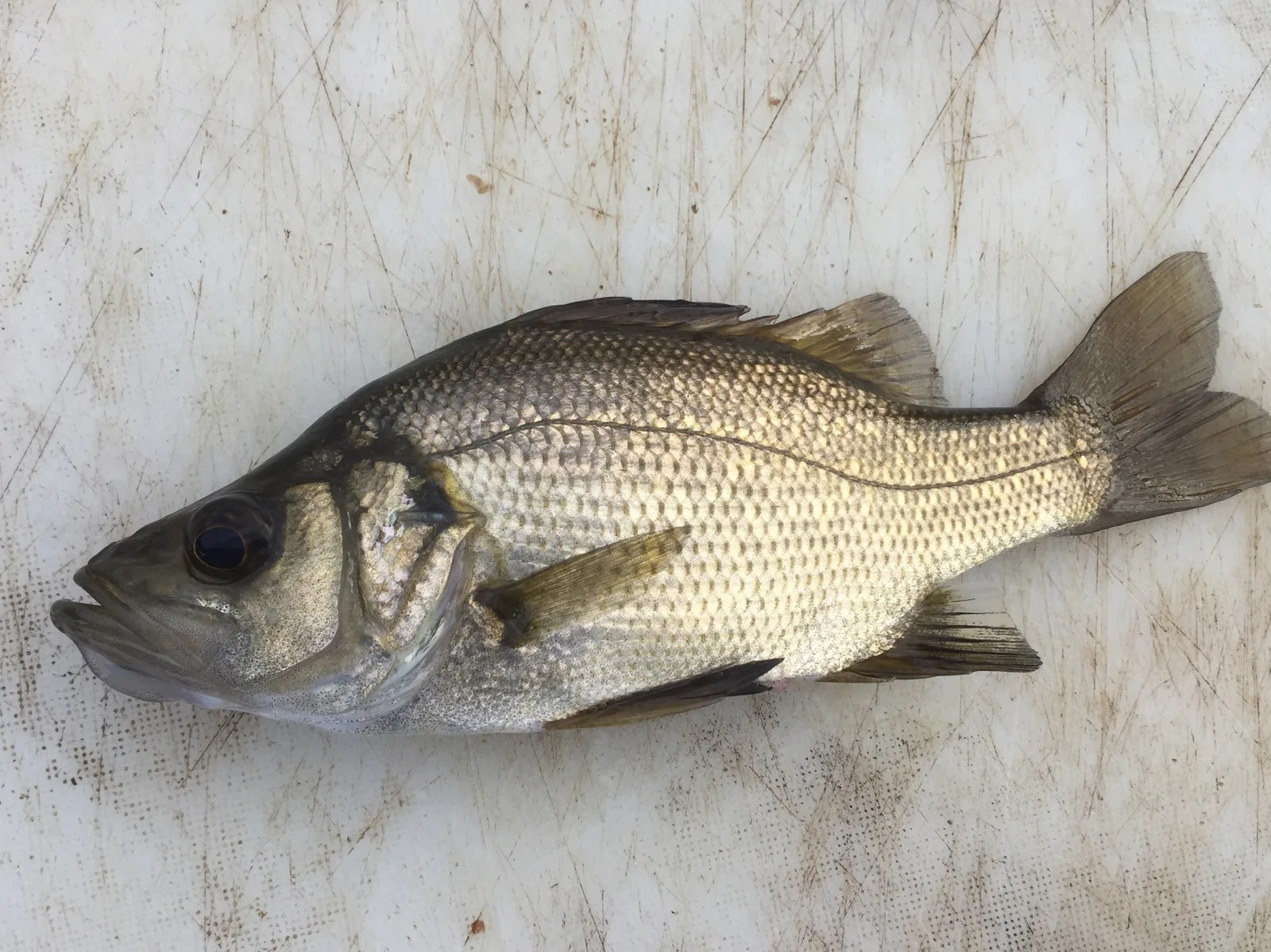
Estuary perch
Macquaria colonorum · Percalatidae
Estuary perch is a robust, fusiform fish of the family Percalatidae, native to eastern and southern Australia and largely confined to the brackish tidal reaches of coastal rivers and lakes. It is catadromous, spends part of its life in estuaries, reaches 75 cm SL and 10 kg, and can live 40 years. It is marked as both a commercial catch and a gamefish.
- Family
- Percalatidae
- Max length
- 75 cm SL
- Max weight
- 10 kg
- Max age
- 40 years
- IUCN
- LC
- Climate
- Temperate
- Diet
- crustaceans, fishes, molluscs, worms
The estuary perch is a robust, fusiform fish of the family Percalatidae, native to eastern and southern Australia and largely confined to the brackish tidal reaches of coastal rivers and lakes. It is catadromous, spending part of its life in estuaries, and no numeric depth range is available in the sources. FishBase marks it as both a commercial catch and a gamefish, with a maximum standard length of 75 cm and a weight of 10 kg. Growth is slow — the maximum reported age is 40 years — and IUCN assessed it as Least Concern in 2019. Spawning has been recorded in July–August in New South Wales and November–December in Victoria.
Seasonality
Other AU-VIC regulations
Same jurisdictionBefore you keep a fish
- Read the recorded value. It is copied from the notice; if the number and the notice disagree, the notice wins.
- Check the area. Federal, state and local waters can set different limits for the same fish.
- Check the date. Seasons, quotas and closures change; confirm the current notice before you go.
Common questions
- What is the minimum size for Estuary perch in Australia — Victoria?
- ≥27 cm
- Where does this regulation apply?
- Victorian waters
- When was it checked?
- 2026-11-18, against VFA — Estuary perch (including Australian bass and hybrids).