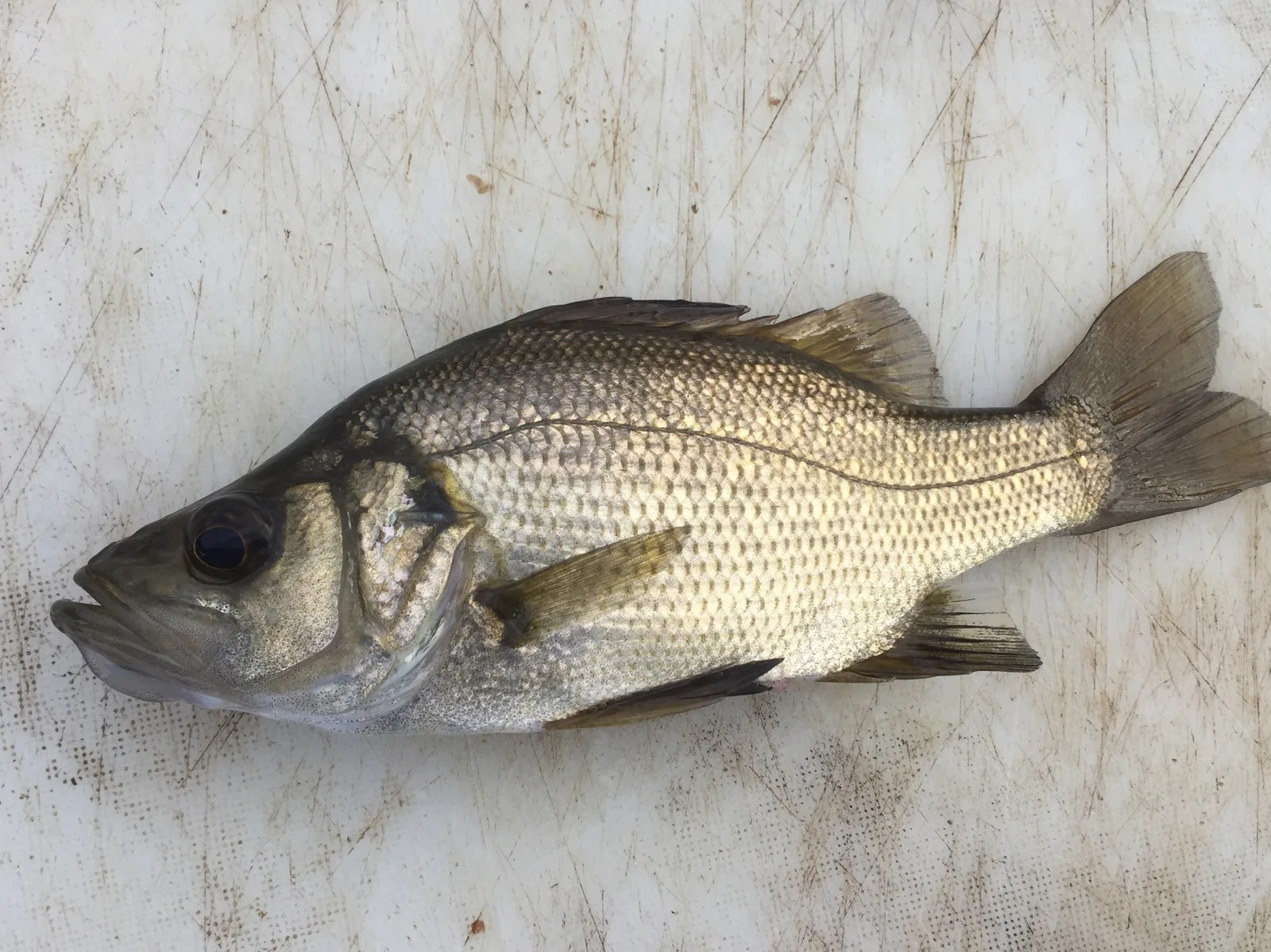
The estuary perch is a robust, fusiform fish of the family Percalatidae, native to eastern and southern Australia and largely confined to the brackish tidal reaches of coastal rivers and lakes. It is catadromous, spending part of its life in estuaries, and no numeric depth range is available in the sources. FishBase marks it as both a commercial catch and a gamefish, with a maximum standard length of 75 cm and a weight of 10 kg. Growth is slow — the maximum reported age is 40 years — and IUCN assessed it as Least Concern in 2019. Spawning has been recorded in July–August in New South Wales and November–December in Victoria.
Identification
The English names describe an estuary fish: Estuary perch is the FishBase principal and the AFS name, with Estuarine perch, Brackish water perch, Gippsland perch and the short form Perch as the Australian variants. Chinese is , with and / as alternatives. FishBase's comnames list also carries Australian bass, but that vernacular belongs to the sister species Macquaria novemaculeata, so the page excludes it and follows the native-range name Estuary perch.
The counts are dorsal spines 9–10, dorsal soft rays 8–11, anal spines 3, anal soft rays 7–9, vertebrae 25, body fusiform. Cross-section and body outline are blank. The size line gives 75.0 cm SL maximum, 40.0 cm SL common, 10.0 kg maximum weight and 40 years maximum age, with no maturity figure. A 40-year life for a 75 cm perch is the most striking number in the table.
The classification is worth naming because the sources disagree. FishBase places the species in Percalatidae, order Centrarchiformes; GBIF still files it under Percichthyidae, order Perciformes. Neither is wrong as a historical record, but a reader should know which source is speaking.
Habitat and distribution
The species tolerates both fresh and brackish water, lives over the bottom and is catadromous, across a temperate 10°S–40°S range. No depth figure appears in FishBase, GBIF or Wikipedia, so the page gives none. Habitat keywords are estuary, coastal and open-water, and the diet is crustaceans, fishes, molluscs and worms.
FishBase's distribution text says the species is endemic to eastern and southern Australia, but the country table adds Fiji. GBIF returns only four rows: two without a country code and two for Fiji, both marked introduced, with no Australian row at all. The country table and the GBIF dump therefore disagree with each other and with the text. Wikipedia keeps the picture simple: endemic to south-eastern Australia, in brackish waters such as the tidal reaches of coastal lakes, rivers and streams. iNaturalist has no exact match for the current genus, so the page carries no observation count.
Season and fishing approach
Two spawning rows are carried. New South Wales runs July and August; Victoria runs November and December. The two states fall in different seasons, mid-winter in the north and late spring to early summer in the south. No temperature threshold and no spawning depth are recorded.
The species is catadromous, and Wikipedia places it in brackish tidal reaches. That is a salinity statement, not a depth statement, and the page should keep the two apart. The use line is commercial with gamefish yes, but the capture gives no method, bait or regulation. Without a depth range, there is also no basis for a depth-based approach.
Edibility and regulations
IUCN lists the species as Least Concern, assessed 15 February 2019. The record contains no culinary, market-size or handling field. Commercial fishing and a gamefish flag are both recorded, and Wikipedia adds only the habitat description; it carries no culinary or regulatory material.
No size, season or bag limit is recorded. The species spans New South Wales and Victoria, so the applicable rule is a state rule rather than a single national one, and the page cannot name it. A reader should also treat the Fiji rows as unresolved data, not as part of the native range, before using any country-level rule.
Regulations before you keep it
These are the published regulations for this fish. Read the number first. The notice below it is the actual regulation.
Minimum size1
≥27 cm
Australia — Victoria · AU-VIC
Victoria sets a 27 cm minimum legal length for estuary perch.
Estuary perch is a freshwater and estuarine species. Macquarie perch (Macquaria australasica) is a different species and is fully protected in Victoria, with a bag limit of 0.
Minimum legal size: 27cm
Every record above names its source and the date it was retrieved. See the regulation register for the full list, or how to read these regulations.
Where these facts come from
Check these pages before you rely on a size, range or protection status.
-
FishBase — Macquaria colonorum
— FishBase · T2
-
GBIF — Macquaria colonorum occurrence records
— GBIF · T2
-
IUCN Red List — Macquaria colonorum
— IUCN · T1
-
Photo record — iNaturalist
— iNaturalist · T3