
Coho salmon in United States — Oregon: 16 in minimum length — Oregon ocean waters.
Minimum lengths: Chinook (north of Cape Falcon) = 22 inches, Chinook (south of Cape Falcon) = 24 inches: coho = 16 inches: steelhead = 20 inches: no minimum length for pink, chum or sockeye salmon in the ocean fishery.
Quoted from Oregon Department of Fish and Wildlife — Oregon ocean salmon sport regulations
Regulation guide
Official sourcesWho sets the ocean season
Ocean coho salmon off Oregon are managed under the Pacific Salmon Treaty process and the Pacific Fishery Management Council, with seasons adopted each spring and adjusted in season by NOAA Fisheries in consultation with ODFW.
The season is therefore not a fixed date in statute. ODFW publishes the current ocean salmon seasons, quotas and in-season actions, and anglers are expected to check them before each trip.
Freshwater salmon rules are published separately; the ODFW ocean salmon pages deal with the marine fishery and its quota-driven openings and closures.
Source: ODFW: Ocean Salmon Management Program - recreational ocean salmon regulations and in-season actions
Sixteen inches
ODFW's 2026 ocean salmon rules set statewide minimum lengths: coho 16 inches, Chinook 22 inches north of Cape Falcon and 24 inches south of it, and steelhead 20 inches. Pink, chum and sockeye have no minimum length in the ocean fishery.
Sixteen inches is the floor for every coho kept in the ocean, hatchery or wild, mark-selective season or not. A fish below it goes back regardless of which season is open.
The minimum applies to the ocean fishery; freshwater salmon seasons and limits are set in the Oregon Sport Fishing Regulations, which are published separately from the ocean season table.
Source: ODFW: 2026 Oregon ocean recreational salmon seasons (map view) · ODFW: Ocean Salmon Management Program - recreational ocean salmon regulations and in-season actions
Mark-selective coho
From Cape Falcon to the Oregon-California border, the main coho season is mark-selective. In 2026 it opened on 6 June and was to run until 23 August or until the 47,600 marked-coho quota was reached, whichever came first.
In a mark-selective season every coho kept must have a healed adipose fin clip, the mark of a hatchery fish. The bag is two salmon per day. An unclipped coho is released even when it is legal size, because the mark and not the length decides.
The 47,600 marked-coho quota is the ceiling for the Cape Falcon to border season, and the season ends when the quota is reached even if the calendar has not run out.
Source: ODFW: Preliminary 2026 Oregon ocean recreational salmon season update · ODFW: 2026 Oregon ocean recreational salmon seasons (map view)
Non-mark-selective days and the north coast
Later in the year ODFW opens non-mark-selective coho days, when fin clips are not required. In 2026 the Cape Falcon to Humbug Mountain fishery opened on 1 September with a 25,700 coho quota and no fin-clip requirement.
North of Cape Falcon the structure is different again: all salmon may be kept, two per day with no more than one Chinook, and there is no fin-clip restriction on coho. Cape Falcon changes the rule, not just the address.
Humbug Mountain is the southern boundary for the non-mark-selective fishery, so the same coho can be legal north of it and closed south of it on the same day.
Source: ODFW: Ocean Salmon Management Program - recreational ocean salmon regulations and in-season actions · ODFW: 2026 Oregon ocean recreational salmon seasons (map view)
Quotas close fisheries mid-season
The non-mark-selective fishery shows how quickly the rules move. The 2026 season closed at the end of 12 September when the quota was forecast to be met, then reopened for single days on 20 and 26 September.
From 27 September the fishery stayed open through 31 October for all salmon except coho, with two salmon per day and a 24-inch minimum for Chinook. An angler who read the season table in June would have been wrong by September.
Catch estimates are published through the season, and the 2026 non-mark-selective fishery had taken about 87 percent of its quota by 20 September, which is why the extra days were limited to single openings.
Source: ODFW: Ocean Salmon Management Program - recreational ocean salmon regulations and in-season actions
Tags and licences
Oregon requires a fishing licence and a Combined Angling Tag for salmon. On taking an adult salmon, the angler must immediately record the species, the location code and the month and day, and must also record whether the fish is hatchery or wild.
Jack salmon are not tagged. The tag is the state's catch record, so it has to be filled in at the water rather than at the ramp or at home.
The tag requirement applies to adult salmon, which is why the size of the fish matters for the paperwork as well as for the bag.
Source: ODFW: Combined Angling Tag instructions and location codes
Before you keep a coho
Check four things: the area boundary you are fishing, whether the day is mark-selective, the 16-inch minimum, and the current action notices. Then check the adipose fin if the season requires it.
Ocean salmon rules change by emergency action during the season, and a closure can take effect overnight. The ODFW action notices are the controlling document, not the printed summary or the season table.
A coho with an intact adipose fin is not a legal fish in a mark-selective season, however close to 16 inches it is, and a clipped fish below 16 inches is still short.
Source: ODFW: Ocean Salmon Management Program - recreational ocean salmon regulations and in-season actions · ODFW: 2026 Oregon ocean recreational salmon seasons (map view)
Official pages: ODFW: Ocean Salmon Management Program - recreational ocean salmon regulations and in-season actions · ODFW: 2026 Oregon ocean recreational salmon seasons (map view) · ODFW: Combined Angling Tag instructions and location codes · ODFW: Preliminary 2026 Oregon ocean recreational salmon season update
Coho salmon regulations at a glance
1 jurisdictions| Jurisdiction | Area | Size | Bag | Season / closure | Closed area | Other |
|---|---|---|---|---|---|---|
| United States — Oregon | Oregon ocean waters | 16 in minimum length | — | — | — | — |
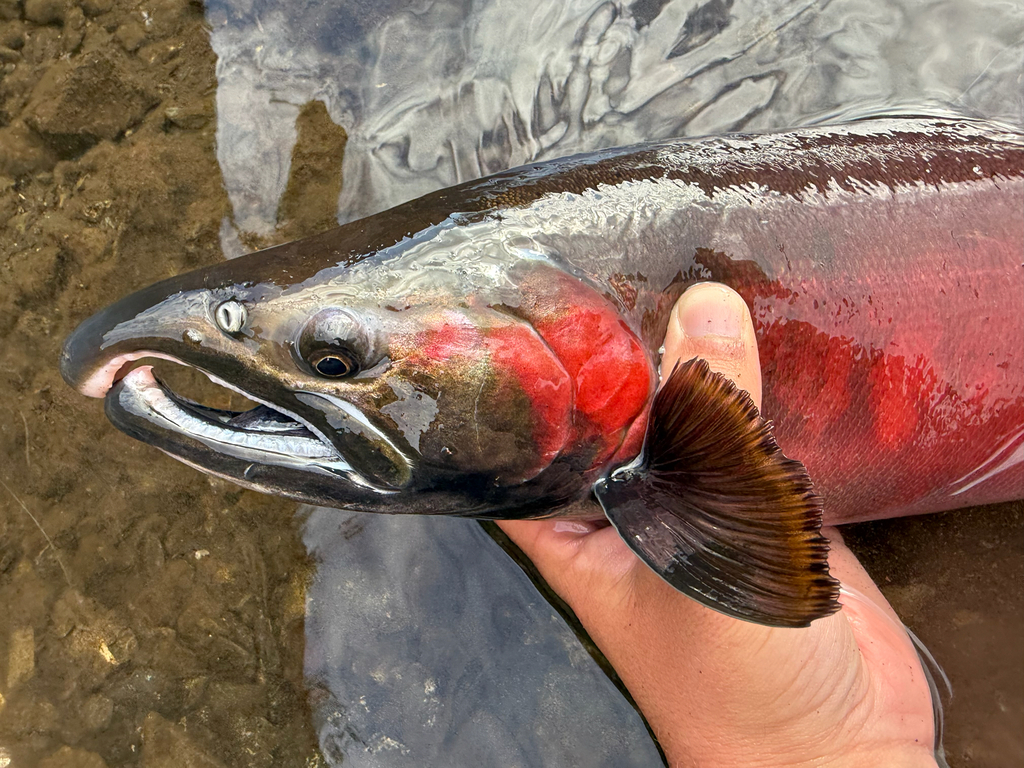
Coho salmon
Oncorhynchus kisutch · Salmonidae
Coho salmon is a salmonid of the North Pacific, from the Anadyr River in Russia and Hokkaido to Point Hope in Alaska and Baja California. It lives from the surface to 250 m in water of 0 to 25 °C, reaches 108 cm and 15.2 kg, and feeds on crustaceans, fish and zooplankton. Trolling or fly fishing is the usual approach, with the season running October to November.
- Family
- Salmonidae
- Max length
- 108 cm TL
- Max weight
- 15.2 kg
- Max age
- 5 years
- Depth
- 0–250 m
- IUCN
- LC
- Climate
- Subtropical · 0–25 °C
- Diet
- crustaceans, fishes, zooplankton
Coho salmon (Oncorhynchus kisutch) is a fish of the family Salmonidae. FishBase gives its range as: North Pacific: distributed from the Anadyr River in Russia south towards Hokkaido, Japan, and from Point Hope in Alaska southwards to Chamalu Bay in Baja California, Mexico. It is recorded from 0 to 250 m, in subtropical water at 0–25 °C. The recorded maxima are 108 cm TL, 15.2 kg, 5 years. Common length is recorded at 71 cm. Diet includes crustaceans, fishes and zooplankton. IUCN status: Least Concern (LC). Chinese name: .
Techniques
- Trolling —
- Fly fishing —
Seasonality
Other US-OR regulations
Same jurisdictionBefore you keep a fish
- Read the recorded value. It is copied from the notice; if the number and the notice disagree, the notice wins.
- Check the area. Federal, state and local waters can set different limits for the same fish.
- Check the date. Seasons, quotas and closures change; confirm the current notice before you go.
Common questions
- What is the minimum size for Coho salmon in United States — Oregon?
- 16 in minimum length
- Where does this regulation apply?
- Oregon ocean waters
- When was it checked?
- 2026-11-18, against Oregon Department of Fish and Wildlife — Oregon ocean salmon sport regulations.