
Canary rockfish in United States — Oregon: 2 fish per person per day sub-bag limit — Oregon ocean waters.
Out of the 4-fish daily bag limit, no more than 1 may be cabezon (when open) and no more than 2 may be canary rockfish
Quoted from Oregon Department of Fish and Wildlife — 2026 Sport Groundfish: What can I keep and how many?
The offshore long-leader row repeats the same two-fish canary sub-bag.
Regulation guide
Official sourcesHow canary rockfish is managed
Canary rockfish (Sebastes pinniger) is a shelf rockfish managed under the Pacific Coast Groundfish Fishery Management Plan. The plan sets coastwide harvest levels, and the recreational measures appear in 50 CFR 660.360, with California and Oregon publishing the versions their anglers actually read.
Canary is not a fish with a free-standing bag limit. In both states it is a sub-bag limit inside a larger rockfish or marine bag, which means the number of canary an angler may keep depends on how many other fish are already in the box.
The species is also one of the rockfish most often confused with yelloweye and vermilion, both of which carry very different rules. The identification problem is part of the regulation, not a separate issue.
Source: 50 CFR 660.360: Recreational fishery, management measures · CDFW: Summary of Recreational Groundfish Fishing Regulations · ODFW: Sport bottomfish seasons
California: two fish inside the ten-fish RCG bag
California allows ten fish in the rockfish, cabezon and greenling complex in combination per person, and the state table sets a canary rockfish sub-bag limit of two fish per person. The two count towards the ten rather than being additional to it.
The federal rule for waters seaward of California carries the same structure: a ten-fish RCG bag coastwide, with sub-bag limits of two canary rockfish, one copper rockfish, and four vermilion and sunset rockfish combined north of 40°10' N and two south of that line.
California sets no minimum size for canary rockfish or for rockfish generally, so the limit is entirely a count. Fillets of any RCG species kept aboard must have the entire skin attached.
Source: CDFW: Summary of Recreational Groundfish Fishing Regulations · 50 CFR 660.360: Recreational fishery, management measures
California seasons and depth by management area
The California coast is divided into five groundfish management areas. In the Northern, Mendocino, San Francisco and Central areas the RCG complex is closed from January 1 through March 31 and open at all depths from April 1 through December 31.
The Southern Management Area, from Point Conception to the Mexican border, runs on a different calendar. It is open at all depths from April 1 through June 30, restricted from July 1 through September 30 to waters inshore of the 50-fathom Rockfish Conservation Area line, and from October 1 through December 31 the shelf and slope rockfish, canary included, may be taken only seaward of that line while the nearshore group is closed.
Shore-based anglers and spearfishers are exempt from the season and depth restrictions, provided no vessel assists them and, for divers, no gear other than spearfishing gear is aboard.
Source: CDFW: Summary of Recreational Groundfish Fishing Regulations · 50 CFR 660.360: Recreational fishery, management measures
Oregon: two canary inside a four-fish bag
Oregon allows four general marine species per day, a group that includes rockfish, cabezon, greenling, skates, spiny dogfish, leopard shark and other marine fish not given a separate limit. Within that four, no more than two may be canary rockfish.
The state's 2026 summary applies the two-fish canary sub-bag from January 1, 2026, and keeps Oregon waters open at all depths year round with no seasonal depth restriction.
The federal rule for Oregon sets a ten marine fish limit with a two-canary sub-bag for the long-leader gear fishery, and states that federal rules do not supersede a more restrictive state rule. Oregon's four-fish figure is the one to plan around.
Source: ODFW: Sport bottomfish seasons · ODFW: 2026 Sport Groundfish, what can I keep · 50 CFR 660.360: Recreational fishery, management measures
Oregon's long-leader option
Oregon runs a second, deeper fishery for a short list of rockfish taken on long-leader gear outside the 40-fathom regulatory line. The bag limit is ten fish, with a canary sub-bag limit of two per angler.
The allowable species are yellowtail, widow, canary, redstripe, greenstriped, silvergray, chilipepper, blue, deacon and bocaccio rockfish. No other rockfish and no lingcod may be retained on that trip, and natural bait is prohibited.
A long-leader trip cannot be combined with a traditional bottomfish trip, though an angler may keep a general marine limit on one trip and a long-leader limit on a separate trip the same day if the fish are offloaded in between.
Source: ODFW: Sport bottomfish seasons · ODFW: 2026 Sport Groundfish, what can I keep
A rebuilt stock that is still capped
The U.S. West Coast population of canary rockfish was declared overfished in 2000, and a recovery plan followed in 2001. NOAA Fisheries declared the stock rebuilt in 2015.
The caps survived the rebuilding declaration. A rebuilt stock still carries a sub-bag limit because the management plan controls catch rather than celebrating status, and because canary is taken alongside species that remain more fragile.
That history explains why a fish that is no longer overfished still has a number attached to it, and why the number is smaller than the rockfish bag that contains it.
Source: NOAA Fisheries: Canary Rockfish · CDFW: Summary of Recreational Groundfish Fishing Regulations
What to check before you keep one
Identify the fish first. Canary, yelloweye and vermilion share an orange-to-red colour scheme, and yelloweye is a zero-retention species in both states. CDFW publishes a combined identification guide for the three, and the guide is worth carrying on the boat.
Then count. Two canary is a ceiling, not an allowance: a third canary must go back even if the RCG bag is not full, and in Oregon a canary counts against the four-fish marine limit as well as against its own sub-bag.
Finally, confirm the licence and the device. California requires a sport fishing license for ocean fishing; Oregon requires a license and, from January 1, 2026, an Ocean Endorsement for most ocean anglers. Both states require a functional descending device aboard groundfish vessels, and Oregon requires its use on rockfish released outside the 30-fathom line.
Source: CDFW: Groundfish species of concern and rockfish ID guides · CDFW: Sport Fishing Licenses and Report Cards · ODFW: Ocean Endorsement · ODFW: Sport bottomfish seasons
Official pages: CDFW: Summary of Recreational Groundfish Fishing Regulations · 50 CFR 660.360: Recreational fishery, management measures · ODFW: Sport bottomfish seasons · NOAA Fisheries: Canary Rockfish · CDFW: Groundfish species of concern and rockfish ID guides
Canary rockfish regulations at a glance
2 jurisdictions| Jurisdiction | Area | Size | Bag | Season / closure | Closed area | Other |
|---|---|---|---|---|---|---|
| United States — California | California state waters | — | 2 fish per person per day | — | — | — |
| United States — Oregon | Oregon ocean waters | — | 2 fish per person per day sub-bag limit | — | — | — |
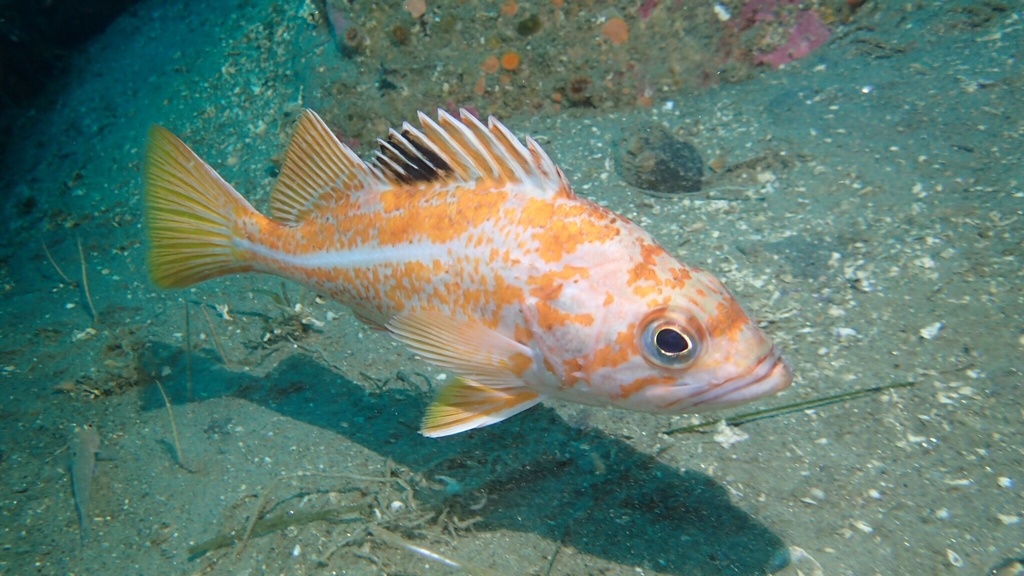
Canary rockfish
Sebastes pinniger · Sebastidae
Canary rockfish is a member of the family Sebastidae and ranges across the Eastern Pacific, from south of the Shelikof Strait in the Gulf of Alaska to Cape Colnett, Baja California, Mexico. Fish reach 76 cm FL and 4.5 kg, feeding on fishes and zooplankton. The usual approach is boat bottom fishing or slow pitch jigging. The season runs January to December, in water of 5 to 26 °C.
- Family
- Sebastidae
- Max length
- 76 cm FL
- Max weight
- 4.5 kg
- Max age
- 84 years
- Depth
- 0–838 m
- IUCN
- NE
- Climate
- Subtropical · 5–26 °C
- Diet
- fishes, zooplankton
Canary rockfish (Sebastes pinniger) is a fish of the family Sebastidae. FishBase gives its range as: Eastern Pacific: south of the Shelikof Strait in the Gulf of Alaska to Cape Colnett, Baja California, Mexico. It is recorded from 0 to 838 m, in subtropical water at 5–26 °C. The recorded maxima are 76 cm FL, 4.5 kg, 84 years. Diet includes fishes and zooplankton. IUCN status: Not Evaluated (NE). Chinese name: .
Techniques
- Boat bottom fishing —
- Slow pitch jigging —
Seasonality
Other US-OR regulations
Same jurisdictionBefore you keep a fish
- Read the recorded value. It is copied from the notice; if the number and the notice disagree, the notice wins.
- Check the area. Federal, state and local waters can set different limits for the same fish.
- Check the date. Seasons, quotas and closures change; confirm the current notice before you go.
Common questions
- What is the bag limit for Canary rockfish in United States — Oregon?
- 2 fish per person per day sub-bag limit
- Where does this regulation apply?
- Oregon ocean waters
- When was it checked?
- 2026-11-18, against Oregon Department of Fish and Wildlife — 2026 Sport Groundfish: What can I keep and how many?.
- Do other jurisdictions set different limits?
- Yes. This register lists 2 jurisdictions for Canary rockfish; compare them in the table above.