
Blue shark in New Zealand — South East: 1 fish per fisher per day — New Zealand — South-East fishing area.
Blue shark | 1 | — | 100
Quoted from MPI — South-East area fishing rules
No minimum length. Blue shark counts inside the 30-finfish combined bag and must be landed with fins naturally or artificially attached.
Regulation guide
Official sourcesHow blue shark is managed in New Zealand
Blue shark (Prionace glauca) is a recreational finfish species in New Zealand, managed by Fisheries New Zealand within the Ministry for Primary Industries. Recreational rules are published area by area, and the blue shark limit in this dossier is the one set for the South-East fishing area.
New Zealand's recreational rules cover all fishing methods, including potting and netting, and selling any fish or shellfish caught recreationally is illegal. The rules are published as summaries on the MPI website, in area brochures, in the free NZ Fishing Rules app and on signs at many fishing spots.
Sharks sit inside the finfish rules rather than in a separate category. The South-East page defines finfish to include the class Chondrichthyes, which is the cartilaginous fishes, so a shark is counted as finfish for bag purposes.
Source: Ministry for Primary Industries: South-East area fishing rules
The South-East area
The South-East area covers the east coast of the South Island, from Clarence Point near Kaikoura south to Slope Point in Southland. The limits described here apply in that area.
A small area around Kaikoura has different rules, and MPI publishes them on a separate Kaikoura area page. A fisher working near that boundary should check which area the boat is in before counting a shark against a limit.
Each area page carries its own size limits, catch limits, closed areas and special restrictions. The blue shark limit is not a national figure, so a fish taken outside the South-East area falls under whichever area rule applies at that location.
Source: Ministry for Primary Industries: South-East area fishing rules
One blue shark per fisher per day
The South-East table sets a maximum daily limit of one blue shark per active fisher. The minimum fish length column shows a dash, so there is no minimum size for blue shark in this area.
The third column of the same table is a minimum set net mesh size of 100 mm. That is a gear specification for set netting and not a fish size rule, and it should not be read as a length limit.
The daily limit applies to the individual fisher. Two active fishers on one boat hold two separate allowances, and a shark taken by one person cannot be carried against another person's limit.
Source: Ministry for Primary Industries: South-East area fishing rules
The 30-finfish bag that contains it
The South-East area has a combined daily bag limit of 30 finfish per fisher, excluding specified baitfish and freshwater eels. The blue shark limit of one sits inside that combined total rather than on top of it.
MPI's example is a mixed bag of kahawai, blue moki and red cod counted together against the 30. A blue shark occupies one of those 30 places, so a boat holding 30 other finfish and a blue shark is over the combined limit.
Individual species limits within the table still apply. The combined figure is a ceiling, not a permission to take 30 of any one species, and the blue shark row restricts that species to one irrespective of how much room remains under the 30.
Source: Ministry for Primary Industries: South-East area fishing rules
Fins must stay with the body
Since 2014 it has been illegal in New Zealand for fishers to remove fins from sharks and then discard the bodies into the sea. Sharks cannot be thrown into the sea even if they are dead, and it was already illegal before the ban to remove fins from a live shark and return the body to the water.
Blue shark is a quota management species with a specific landing requirement. Fishers must land blue sharks with the fins naturally or artificially attached to the body, which means the fins may be removed but must be tied, sewn or otherwise fastened back on for landing.
The requirement is designed to stop the waste that finning produces and to keep blue shark fishing lawful. A recreationally caught blue shark should therefore reach the boat or shore with its body and fins accounted for together.
Source: Ministry for Primary Industries: Shark finning ban · Ministry for Primary Industries: Shark conservation and management
Other sharks in the same table
Blue shark shares the table with bronze shark, hammerhead shark, mako shark, porbeagle shark, seven gilled shark and thresher shark, each with a daily limit of one. School shark and rig carry a limit of five, and spiny dogfish fifteen.
White pointer shark appears in a separate table headed further size limits, with no take allowed. A protected shark must go back, and the no-take entry is the one to check before bringing any large shark alongside.
The pattern is useful for identification. A one-fish allowance applies to most large sharks in the area, so the practical question is which species is on the line rather than how many may be kept.
Source: Ministry for Primary Industries: South-East area fishing rules
Before you keep a blue shark
Blue shark is not a protected species in New Zealand, but white pointer is, and several other sharks carry no-take or one-fish rules. The identification check comes before any decision to keep the fish.
The MPI guidance also notes that the National Plan of Action for the Conservation and Management of Sharks aims to reduce waste by promoting full use of shark bodies or live release. That sits alongside the landing rules rather than replacing them.
The checks for a South-East trip are: identify the shark, confirm the one-fish daily limit for blue shark, count it within the 30-finfish combined bag, and land it with its fins attached to the body.
Source: Ministry for Primary Industries: Shark conservation and management · Ministry for Primary Industries: South-East area fishing rules
Official pages: MPI: South-East area fishing rules · MPI: Shark finning ban · MPI: Shark conservation and management
Blue shark regulations at a glance
1 jurisdictions| Jurisdiction | Area | Size | Bag | Season / closure | Closed area | Other |
|---|---|---|---|---|---|---|
| New Zealand — South East | New Zealand — South-East fishing area | — | 1 fish per fisher per day | — | — | — |
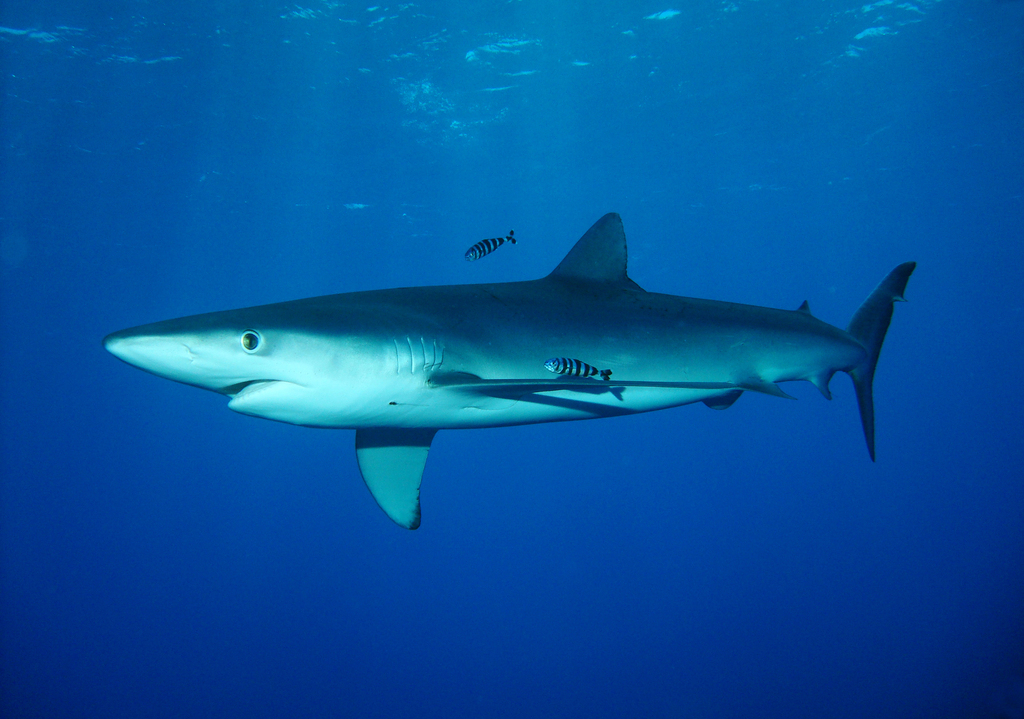
Blue shark
Prionace glauca · Carcharhinidae
Five numbers describe the species on one page, and four of them are not lengths: 205.9 kg, 199.1 cm, 20 years, a common length of 335 cm, and a maximum of 400 cm. Read together they suggest a giant. Read separately they describe a fish whose ordinary size, first breeding size and heaviest published weight are three different pieces of evidence that the record never joins.
- Family
- Carcharhinidae
- Max length
- 400 cm TL
- Max weight
- 205.9 kg
- Max age
- 20 years
- Depth
- 0–1082 m
- IUCN
- NT
- Climate
- Subtropical · 7–21 °C
- Diet
- fishes
Five numbers describe the species on one page, and four of them are not lengths: 205.9 kg, 199.1 cm, 20 years, a common length of 335 cm, and a maximum of 400 cm. Read together they suggest a giant. Read separately they describe a fish whose ordinary size, first breeding size and heaviest published weight are three different pieces of evidence that the record never joins. This page keeps them apart, because a reader who merges them will rig for the wrong animal.
Seasonality
Other NZ-SE regulations
Same jurisdictionBefore you keep a fish
- Read the recorded value. It is copied from the notice; if the number and the notice disagree, the notice wins.
- Check the area. Federal, state and local waters can set different limits for the same fish.
- Check the date. Seasons, quotas and closures change; confirm the current notice before you go.
Common questions
- What is the bag limit for Blue shark in New Zealand — South East?
- 1 fish per fisher per day
- Where does this regulation apply?
- New Zealand — South-East fishing area
- When was it checked?
- 2026-11-18, against MPI — South-East area fishing rules.