
Red drum in United States — New York: No minimum size · no limit for fish under 27 in · fish 27 in and over may not be possessed — New York Marine and Coastal District.
Red drum No size limit No limit for fish less than 27" TL Fish greater than 27" TL shall not be possessed All year
Quoted from Recreational Saltwater Fishing Regulations
Regulation guide
Official sourcesHow red drum is managed
Red drum on the U.S. Atlantic coast are managed by the Atlantic States Marine Fisheries Commission under Amendment 2 to the Interstate Fishery Management Plan, with Addendum I and Addendum II. The commission treats the coast as two stocks: a northern stock from New Jersey through North Carolina and a southern stock from South Carolina through the east coast of Florida.
Amendment 2 requires states to set recreational creel and size limits that include a maximum size of 27 inches, while commercial rules stay at existing levels. The 2024 benchmark assessment found the northern stock not overfished and not experiencing overfishing, but classified the southern stock as overfished and experiencing overfishing. Florida has prohibited commercial harvest since January 1988, and South Carolina and Georgia have designated red drum as a gamefish.
Addendum II, approved in October 2025, responds to the 2024 assessment by modifying fishing mortality for the southern stock and aligning recreational rules in Virginia, Maryland and the Potomac River Fisheries Commission.
Source: ASMFC: Red Drum
Federal waters are closed to retention
Federal waters are not an open recreational fishery for red drum. NOAA Fisheries' recreational regulations for the Northeast and Mid-Atlantic list red drum as no recreational fishing allowed. In the Gulf, NOAA's history of the red drum plan records that Amendment 2, implemented in 1988, prohibited retention and possession of red drum from the exclusive economic zone.
ASMFC also describes a federal harvest moratorium and executive order that bar harvest or sale from federal waters. The closure applies to the exclusive economic zone, generally 3 to 200 nautical miles offshore, while waters closer to shore remain under state control. An angler fishing beyond the state line therefore cannot keep a red drum, even when the same fish would be legal inshore.
Source: NOAA Fisheries: Recreational Fishing Regulations by Species (Northeast and Mid-Atlantic) · NOAA Fisheries: Gulf of Mexico Red Drum Historical Amendments and Rulemaking · ASMFC: Red Drum
Florida: a narrow slot and regional limits
Florida applies a statewide slot limit: a red drum must be at least 18 inches and no more than 27 inches in total length. The recreational bag is one fish per person per day in most waters. In Tampa Bay the bag is one fish per person, and the Indian River Lagoon is catch-and-release only, so no red drum may be retained there.
The slot and the regional limits apply in Florida state waters. Anglers should check the current FWC rules for the region they are fishing, because the vessel and regional limits are not uniform across the state.
Source: Florida Fish and Wildlife Conservation Commission: Red Drum · Florida Administrative Code 68B-22.003: Size Limits
North Carolina: slot, gear and reporting
North Carolina allows red drum from 18 to 27 inches total length, with a bag limit of one fish per person per day in coastal and joint waters. It is unlawful to possess a red drum longer than 27 inches, and the state prohibits taking red drum by gig, spear or gaff. A Coastal Recreational Fishing License is required under state law.
Since December 1, 2025, anglers must report harvested red drum to the Division of Marine Fisheries, along with spotted seatrout, striped bass, weakfish and flounder. The report is made electronically at the end of the trip, and the angler receives a confirmation number to show Marine Patrol; a paper report card is available for anglers who cannot report electronically. In parts of Pamlico Sound, a summer nighttime rule also restricts hook size or requires a circle hook with a fixed sinker when using natural bait. That rule runs from July 1 through September 30, from 7 p.m. to 7 a.m., and bars hooks larger than 4/0 unless the terminal tackle is a circle hook with a fixed sinker of at least two ounces within six inches.
Source: NC DEQ Division of Marine Fisheries: Recreational Size and Bag Limits · NC DEQ Division of Marine Fisheries: Electronic Mandatory Harvest Reporting · NC DEQ Division of Marine Fisheries: Circle Hook Rig for Red Drum
How to measure a red drum
Red drum limits are written in total length, the straight-line distance from the tip of the snout to the tip of the tail. Lay the fish flat on a ruler rather than measuring over the curve of its body.
Because the limit is a slot, both ends matter: a fish below 18 inches and a fish above 27 inches must go back. North Carolina's measuring guide uses the same total-length definition for its finfish limits, so an angler who measures correctly in one state will measure correctly in the other.
Source: NC DEQ Division of Marine Fisheries: How to Measure a Fish · Florida Fish and Wildlife Conservation Commission: Red Drum
What to check before keeping one
Before keeping a red drum, establish whether you are in state or federal water, because the federal answer is no retention. In state waters, check the current state rule or proclamation rather than relying on a remembered number; North Carolina and Florida both adjust measures by region. State rules can change between seasons, so a printed summary from an earlier year is not a safe substitute for the current rule.
Carry the required state license and report the harvest where required. If the fish is outside the slot, it cannot be kept, regardless of how it was hooked.
Source: NC DEQ Division of Marine Fisheries: Recreational Size and Bag Limits · Florida Fish and Wildlife Conservation Commission: Red Drum · ASMFC: Red Drum
Official pages: ASMFC: Red Drum · NOAA Fisheries: Recreational Fishing Regulations by Species (Northeast and Mid-Atlantic) · NOAA Fisheries: Gulf of Mexico Red Drum Historical Amendments and Rulemaking · Florida Fish and Wildlife Conservation Commission: Red Drum · NC DEQ Division of Marine Fisheries: Recreational Size and Bag Limits · NC DEQ Division of Marine Fisheries: Electronic Mandatory Harvest Reporting
Red drum regulations at a glance
6 jurisdictions| Jurisdiction | Area | Size | Bag | Season / closure | Closed area | Other |
|---|---|---|---|---|---|---|
| United States — Florida | 18–27 in total length (slot limit) | Tampa Bay: 1 fish per person · Indian River Lagoon: no retention | — | — | — | |
| United States — New York | New York Marine and Coastal District | — | No minimum size · no limit for fish under 27 in · fish 27 in and over may not be possessed | — | — | — |
| United States — North Carolina | North Carolina coastal and joint waters | — | 18–27 in total length · 1 fish per person per day | — | — | — |
| United States — South Carolina | South Carolina coastal waters | — | 15–23 in total length · 2 fish per person per day · 6 per boat per day | — | — | — |
| United States — Virginia | Virginia marine waters | — | 18–26 in total length · 3 fish per person per day | — | — | — |
| United States — federal (Atlantic) | US federal waters (Atlantic and Gulf) | — | — | — | No recreational fishing in federal waters | — |
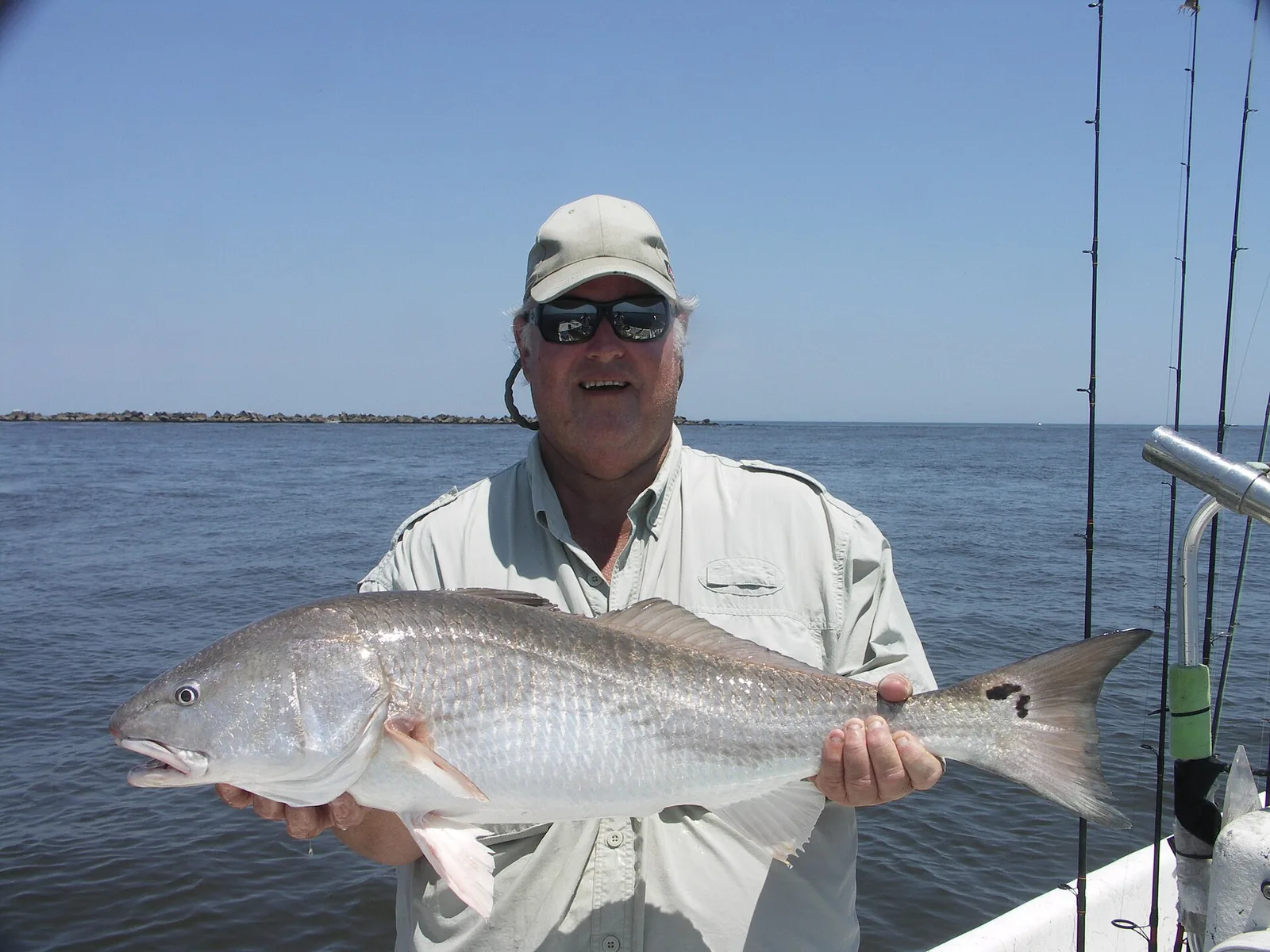
Red drum
Sciaenops ocellatus · Sciaenidae
Red drum is decided by a tape measure as much as by a fight: 155 cm total length, 100 cm common length, 45 kg, maturity at 82.7 cm, and slot limits on both coasts. A legal fish is defined by two numbers, so measuring the wrong way — or the wrong length type — keeps or releases the wrong fish. Check the local slot before you lift a fish aboard.
- Family
- Sciaenidae
- Max length
- 155 cm TL
- Max weight
- 45 kg
- Max age
- 50 years
- Depth
- ≥ 10 m
- IUCN
- LC
- Climate
- Subtropical · 15–26 °C
- Diet
- crustaceans, fishes
Red drum is the species on this site most often decided by a tape measure rather than by a fight. The catalogue gives 155 cm total length, 100 cm common length, 45 kg, a 50-year maximum age and a length at first maturity of 82.7 cm. Fisheries on both its coasts use a slot limit, which means a legal fish is defined by two numbers: not shorter than the lower bound, not longer than the upper. Anglers who measure incorrectly, or who measure a different way from the regulation, release or keep the wrong fish even when they intend to follow the rule.
Techniques
- Shore casting —
- Boat fishing —
Baits
- Fresh shrimp
- Cut mullet
- Gold spoon
- Soft plastic jerkbait
Seasonality
Peak Apr–SepFlood tide for flats; ebb for channel edges and passes.
Warm, stable weather is best. A falling barometer ahead of a summer storm can produce a short window.
Other US-NY regulations
Same jurisdictionBefore you keep a fish
- Read the recorded value. It is copied from the notice; if the number and the notice disagree, the notice wins.
- Check the area. Federal, state and local waters can set different limits for the same fish.
- Check the date. Seasons, quotas and closures change; confirm the current notice before you go.
Common questions
- What is the bag limit for Red drum in United States — New York?
- No minimum size · no limit for fish under 27 in · fish 27 in and over may not be possessed
- Where does this regulation apply?
- New York Marine and Coastal District
- When was it checked?
- 2026-11-18, against Recreational Saltwater Fishing Regulations.
- Do other jurisdictions set different limits?
- Yes. This register lists 6 jurisdictions for Red drum; compare them in the table above.