Red drum is the species on this site most often decided by a tape measure rather than by a fight. The catalogue gives 155 cm total length, 100 cm common length, 45 kg, a 50-year maximum age and a length at first maturity of 82.7 cm. Fisheries on both its coasts use a slot limit, which means a legal fish is defined by two numbers: not shorter than the lower bound, not longer than the upper. Anglers who measure incorrectly, or who measure a different way from the regulation, release or keep the wrong fish even when they intend to follow the rule.
A fish measured by a rule, not by a record
The 155 cm maximum belongs to a small number of very old fish. The 100 cm common length describes what a mature adult looks like, and a 45 kg ceiling is as exceptional as the maximum length. What an angler actually meets is a fish of 40–90 cm, and what the regulation actually controls is a band inside that range.
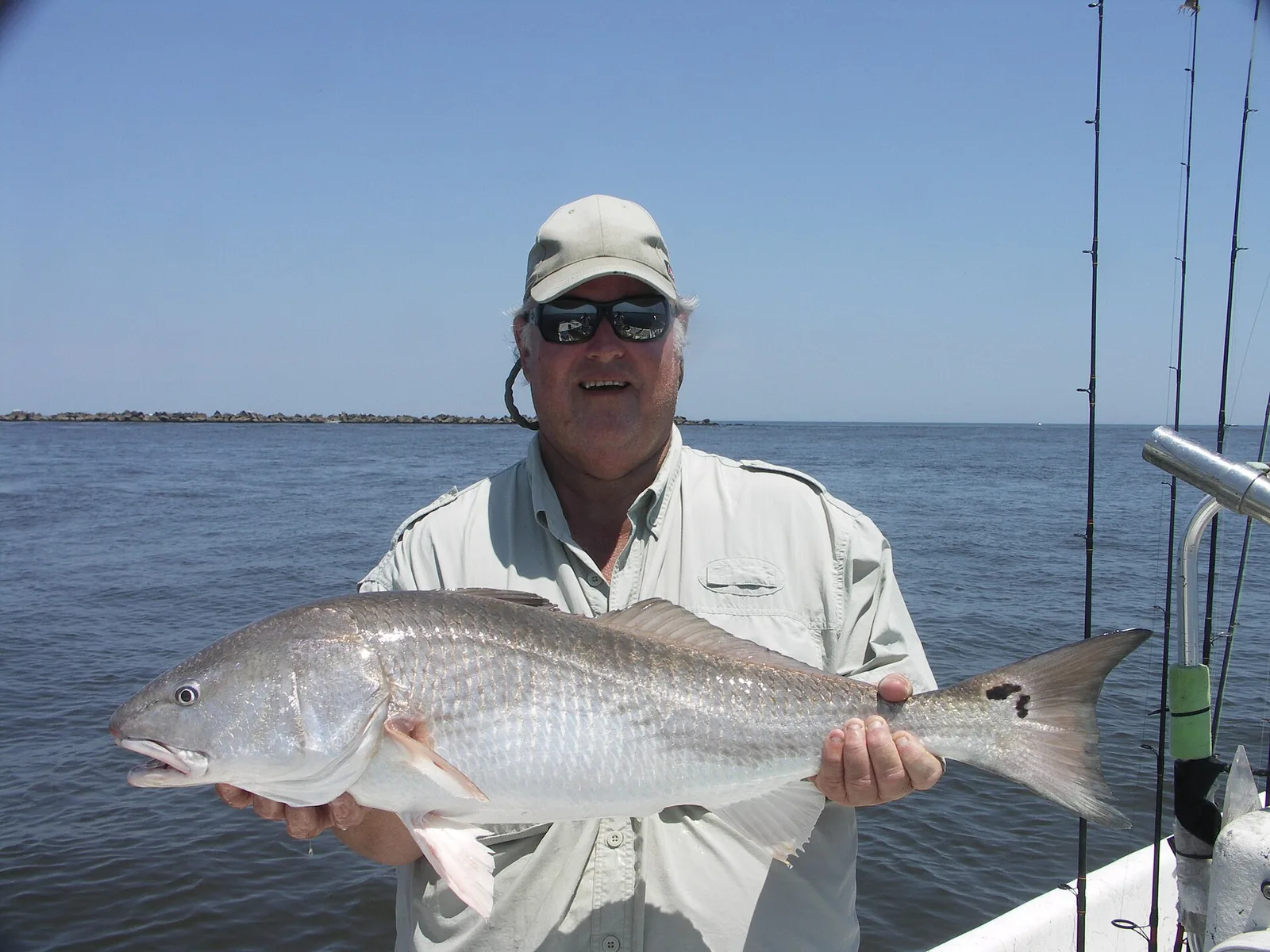
That is the practical difference between red drum and, say, cod. Cod is managed mostly by minimum size and bag limit; the big fish are rare but legal. Red drum is managed by a window, and the biggest fish in the population are protected by the upper bound. A 120 cm "bull red" is a fish you are usually required to release, even though it is the fish in the photograph.
Why the slot is measured total length
The standard measurement for red drum is total length, from the tip of the snout to the tip of the tail, with the tail squeezed. Fork length, which is standard for tunas and many mackerels, measures to the notch in the tail and gives a smaller number for the same fish.
The difference is not academic. On a 70 cm red drum the two measurements can differ by several centimetres, which is enough to move a fish from legal to illegal at either end of the slot. If the rule is written as total length and the angler measures to the fork, a fish that is inside the slot will look short and be released; if the rule is fork length and the angler measures total, a fish that is over the upper bound will look legal and be kept.
The safe routine is to know which measurement the local rule uses before the trip, to carry a marked measuring board rather than a soft tape, and to measure the fish flat, on its side, with the tail pinched. A fish held up by the jaw and measured with a slack tape is not measured.
82.7 cm maturity inside a 100 cm common length
The catalogue gives length at first maturity as 82.7 cm, with a reported range of 55–80.3 cm. The two numbers do not agree, and that disagreement is itself a fact about the species: red drum maturity varies by stock, by latitude and by year class, and different studies put it in different places.
The consequence for management is that a slot limit set below the maturity length protects juveniles poorly, and a slot set above it protects spawners but removes the fish that have already reproduced once. Most current slots sit somewhere in the 45–70 cm band, which is below the 82.7 cm figure — a policy choice, not a biological constant.
For an angler the useful takeaway is that a 70 cm fish in the slot is likely immature in the northern part of the range. Keeping the top of the slot is not the same as keeping a spawner.
The 10 m depth floor and what it says about flats
The recorded depth range begins at 10 m and has no stated maximum. That lower bound separates red drum from the shallowest flatfish and puts it in the zone where a boat is useful: channel edges, oyster bars, the outside of a grass flat, and the surf line where a bar drops off.
Habitat keywords in the record are sandy, muddy, estuary and coastal, and the species is classed as brackish and demersal as well as marine. In practice that means the fish uses turbid, structured water and does not need clear water to feed. A muddy creek mouth with current is a better mark than a clean sand flat without structure, and the difference is visible from the boat ramp.
Temperature is the other filter. The record gives 15–26 °C, which is warm for a temperate species and explains why the range runs from Massachusetts to northern Mexico rather than further north. In cold winters fish move to deeper water and offshore; in summer they spread onto the flats.
August to November: one spawn, two coasts
The spawning table gives August to November for the Gulf and Atlantic coasts of Florida, and August to October for the northern Gulf from Mobile Bay west to Galveston Bay. Both entries describe the same late-summer pattern: spawning follows the warmest water of the year.
That timing is why the autumn fishery is built around schools of sub-adults rather than around spawners. The spawn happens offshore and in passes; the fish that fill the flats in October are juveniles and young adults feeding before winter.
Bait, lure, and the tail spot
The record's diet keywords are crustaceans and fishes, which covers almost everything a red drum eats. The practical version is shrimp and crab on the bottom, small fish and cut bait in the current, and lures that imitate a shrimp or a mullet near structure.
The tail spot, the ocellated mark that gives the species its scientific name, is not a reliable identification character on its own: some fish have several spots, some have none, and hatchery fish often differ from wild ones. Identification should rest on body shape, the sloping forehead, and the lack of barbels, not on the spot.
Tackle for a 45–70 cm fish is a 2.1–2.4 m spinning rod rated 10–30 g with 0.13–0.16 mm braid and a 0.30 mm leader. For the bull reds that must be released, the same tackle is underpowered; a heavier rod and a landing net with a rubberised bag make the release faster and safer for the fish.
Aquaculture, stocking and the stocking question
The catalogue marks it as a minor commercial species, a commercial aquaculture species and a gamefish. Red drum aquaculture is established in the United States, China and several other countries, and stocking programmes have been used to supplement wild stocks.
That creates an identification problem rather than a fishing problem. A stocked fish and a wild fish are the same species, and in some waters a large fraction of the young fish are hatchery origin. It also creates a rule problem: a state that stocks red drum may have different limits from a state that does not, and the rules can change with the stocking programme.
34,635 records in one country
The GBIF index holds 34,635 red drum records, with the United States at 33,264, an unassigned category at 380, China at 37, Mexico at 31 and Hong Kong at 11. The American concentration reflects both the species' range and the density of recording in the Gulf and South Atlantic states; the Chinese and Mexican records are edge cases and aquaculture-related.
iNaturalist's 4,059 observations are concentrated in Florida and the Gulf coast, which is where the recreational fishery is largest. Neither dataset tells you where a slot fish is on a given tide. They do confirm that the species is a coastal, estuarine animal with a strong southern centre, which is the right frame before you read a local regulation and pick a measurement method.
Where and when it feeds
Tide. Flood tide for flats; ebb for channel edges and passes.
Weather. Warm, stable weather is best. A falling barometer ahead of a summer storm can produce a short window.
How to catch it
Shore casting
Cast from shore or a breakwater, within reach of the recorded inshore range.
Boat fishing
Fished from a boat, with the approach adjusted to the recorded depth.
Bait and lures
Fresh shrimpCut mulletGold spoonSoft plastic jerkbait
Regulations before you keep it
These are the published regulations for this fish. Read the number first. The notice below it is the actual regulation.
Minimum size1
18–27 in total length (slot limit)
United States — Florida · US-FL
Florida recreational rule: redfish may be kept only at total length from 18 inches to 27 inches inclusive; fish shorter than 18 inches or longer than 27 inches must be released. This is a slot limit, not a single minimum size.
Rule 68B-22.003, effective 1989-01-01; the flrules site uses a human check, so the rule text was checked against FAC search results.
No person shall harvest in or from the waters of the State of Florida at any time, or unnecessarily destroy, any redfish of total length less than 18 inches, nor greater than 27 inches.
Bag limit5
Tampa Bay: 1 fish per person · Indian River Lagoon: no retention
United States — Florida · US-FL
Florida sets the recreational redfish bag limit by region: one fish per person in the Tampa Bay region, and no harvest, landing or possession at all in the Indian River Lagoon region; other regions carry their own limits in the same rule.
Rule 68B-22.005, effective 2022-09-01; limits differ by area and cannot be summarised as a statewide 1-fish limit.
(c) Tampa Bay Region – One (1) redfish. / (h) Indian River Lagoon Region – A person may not harvest, land, or possess a redfish within the Indian River Lagoon Region.
18–27 in total length · 1 fish per person per day
United States — North Carolina · US-NC
North Carolina allows one red drum per person per day, and fish must measure between 18 and 27 inches total length.
A footnote on the same page adds: "Unlawful to possess red drum greater than 27” TL."
Red Drum (Channel Bass, Puppy Drum) | 18" Min - 27" Max TL | 1/Day
No minimum size · no limit for fish under 27 in · fish 27 in and over may not be possessed
United States — New York · US-NY
New York allows unlimited red drum under 27 inches but prohibits possession of larger fish.
Red drum No size limit No limit for fish less than 27" TL
Fish greater than 27" TL
shall not be possessed All year
15–23 in total length · 2 fish per person per day · 6 per boat per day
United States — South Carolina · US-SC
South Carolina allows 2 red drum per person and 6 per boat per day within a 15–23-inch slot.
Slot Limit:
15-23 inches (total length)
Bag Limit:
2 per person per day, and no more than 6 per boat per day
18–26 in total length · 3 fish per person per day
United States — Virginia · US-VA
Virginia allows 3 red drum per person per day in an 18-to-26-inch slot.
RED DRUM (CHANNEL BASS, REDFISH)
Minimum Size Limit: Min 18 IN. to Max 26 IN.
Possession Limit: 3 per person
Closed area1
No recreational fishing in federal waters
United States — federal (Atlantic) · US-FED-ATL
Recreational fishing for red drum is closed in federal waters; state rules govern fishing inside three miles.
Red drum is a state-managed fish; the federal closure applies outside state waters.
No recreational fishing allowed.
Every record above names its source and the date it was retrieved. See the regulation register for the full list, or how to read these regulations.
Where these facts come from
Check these pages before you rely on a size, range or protection status.
-
FishBase — Sciaenops ocellatus
— FishBase · T2
-
GBIF — Sciaenops ocellatus occurrence records
— GBIF · T2
-
IUCN Red List — Sciaenops ocellatus
— IUCN · T1
-
Photo record — iNaturalist
— iNaturalist · T3