
Cabezon in United States — California: No minimum size limit — California state waters.
Cabezon and Greenlings : No minimum size limit
Quoted from California Department of Fish and Wildlife — Summary of Recreational Groundfish Fishing Regulations
Regulation guide
Official sourcesHow cabezon is managed
Cabezon (Scorpaenichthys marmoratus) is a groundfish in the Pacific Coast Groundfish Fishery Management Plan, but its recreational rules are set separately in each state. California treats it as a member of the rockfish, cabezon and greenling complex; Oregon treats it as one of the general marine species with its own sub-bag limit.
The federal rule at 50 CFR 660.360 sets a floor for vessels seaward of each state and repeats the state-specific measures. It also states that federal rules do not supersede a more restrictive state rule, which is the reason a single fish can carry different limits on either side of the California and Oregon lines.
The practical consequence is that cabezon has no single west coast answer. A California angler works inside a ten-fish complex limit with no minimum size, while an Oregon angler works inside a four-fish marine limit, one cabezon, with a sixteen-inch minimum and a mid-year opening.
Source: 50 CFR 660.360: Recreational fishery, management measures · CDFW: Summary of Recreational Groundfish Fishing Regulations · ODFW: Sport bottomfish seasons
California: ten fish in combination, no minimum size
The California table lists the RCG complex as ten fish in combination per person, and cabezon is counted inside that ten rather than on top of it. The only species carved out with their own numbers are copper rockfish, canary rockfish and the vermilion and sunset rockfish group.
There is no minimum size limit for cabezon in California. The state table states no minimum size for cabezon and greenlings, and no minimum size for rockfish, so a legal cabezon is measured against the bag count rather than a tape.
Cabezon fillets kept aboard must have the entire skin attached. When angling for cabezon the gear is restricted to two hooks and one line, and the state rule allows the department to change cabezon rules in season.
Source: CDFW: Summary of Recreational Groundfish Fishing Regulations · 50 CFR 660.360: Recreational fishery, management measures
California seasons and depth limits
In the Northern, Mendocino, San Francisco and Central management areas the RCG complex, cabezon included, is closed from January 1 through March 31 and open at all depths from April 1 through December 31. The same dates apply to lingcod.
The Southern Management Area is different. Fishing is open at all depths from April 1 through June 30, restricted to waters inshore of the 50-fathom Rockfish Conservation Area line from July 1 through September 30, and then closed for nearshore species from October 1 through December 31. Cabezon sits on the nearshore side of that table, so its southern California season ends with September.
Two groups are exempt from the season and depth restrictions: shore-based anglers, meaning people fishing from beaches, banks, piers, jetties, breakwaters, docks and similar structures, and divers or spearfishers. Vessels may not assist them, and boat-based fishing remains subject to the closures.
Source: CDFW: Summary of Recreational Groundfish Fishing Regulations · 50 CFR 660.360: Recreational fishery, management measures
Oregon: one cabezon, and not before July 1
Oregon's 2026 bottomfish rules put cabezon inside the general marine species bag limit of four fish per day, with a sub-bag limit of one cabezon. The state summary states that no more than one of the four may be cabezon, and only when the cabezon fishery is open.
The cabezon season is the key detail. Retention is prohibited from January 1 through June 30, and the fishery opens on July 1. Oregon also applies a minimum length of 16 inches to cabezon, a size rule that California does not have.
Oregon's marine waters are open at all depths year round, with no seasonal depth restriction, so a cabezon taken in summer or autumn is not tied to a depth contour in the way a California fish can be.
Source: ODFW: Sport bottomfish seasons · ODFW: 2026 Sport Groundfish, what can I keep
Oregon's four-fish bag and the federal ten
The federal rule for Oregon sets a bag limit of ten marine fish per day, including rockfish, kelp greenling, cabezon and other groundfish, and a cabezon minimum size of 16 inches total length. Read alone, that looks far more generous than the state summary.
The same federal section opens by saying that federal recreational groundfish regulations are not intended to supersede any more restrictive state regulation and that bag limits include fish taken in both state and federal waters. Oregon's published four-fish limit is the more restrictive rule, and it is the figure anglers fishing off Oregon are expected to work to.
The federal text also notes that boat limits apply off Washington, Oregon and California, so a licensed angler may keep fishing until the combined daily limits of everyone aboard are reached, subject to additional state restrictions.
Source: 50 CFR 660.360: Recreational fishery, management measures · ODFW: Sport bottomfish seasons
Measuring cabezon
Oregon measures cabezon against a 16-inch total length minimum, and the federal text expresses the same figure as 16 inches or 41 centimetres total length. Total length is the straight-line measurement from the tip of the head, with the mouth closed, to the end of the longest lobe of the tail.
California has no minimum size for cabezon, so there is no legal measurement to take before keeping one. The state still defines total length in the same way for the species that do carry a size limit, and the definition is used across the groundfish tables.
Because California's limit is a count and Oregon's is a count plus a length, a fish that is legal in one state can be short in the other. The state where the fish is taken, not where the boat is registered, decides which rule applies.
Source: ODFW: Sport bottomfish seasons · CDFW: General Provisions and Definitions (14 CCR) · CDFW: Summary of Recreational Groundfish Fishing Regulations
License, gear and what to check
California requires a sport fishing license for anyone attempting to take fish from ocean waters. Oregon requires a fishing license and, from January 1, 2026, an Ocean Endorsement for most anglers fishing from beaches, jetties, boats or by spearfishing, sold as a nine-dollar annual or four-dollar daily add-on.
Both states require a functional descending device on vessels fishing for groundfish. Oregon states that the device must be aboard any vessel fishing for or possessing bottomfish, halibut or flatfish in the ocean, regardless of depth, and used to release rockfish outside the 30-fathom regulatory line.
Before keeping a cabezon, confirm the state, the date, the depth band and the current in-season rule. California rules can change during the year, and Oregon's opening date and sub-bag limit are set annually rather than fixed permanently.
Source: CDFW: Sport Fishing Licenses and Report Cards · ODFW: Ocean Endorsement · ODFW: Sport bottomfish seasons · CDFW: Summary of Recreational Groundfish Fishing Regulations
Official pages: CDFW: Summary of Recreational Groundfish Fishing Regulations · 50 CFR 660.360: Recreational fishery, management measures · ODFW: Sport bottomfish seasons · ODFW: 2026 Sport Groundfish, what can I keep · CDFW: Sport Fishing Licenses and Report Cards
Cabezon regulations at a glance
2 jurisdictions| Jurisdiction | Area | Size | Bag | Season / closure | Closed area | Other |
|---|---|---|---|---|---|---|
| United States — California | California state waters | No minimum size limit | — | — | — | — |
| United States — Oregon | Oregon ocean waters | — | 1 fish per person per day sub-bag limit · ≥16 in total length · closed Jan 1 – Jun 30 | — | — | — |
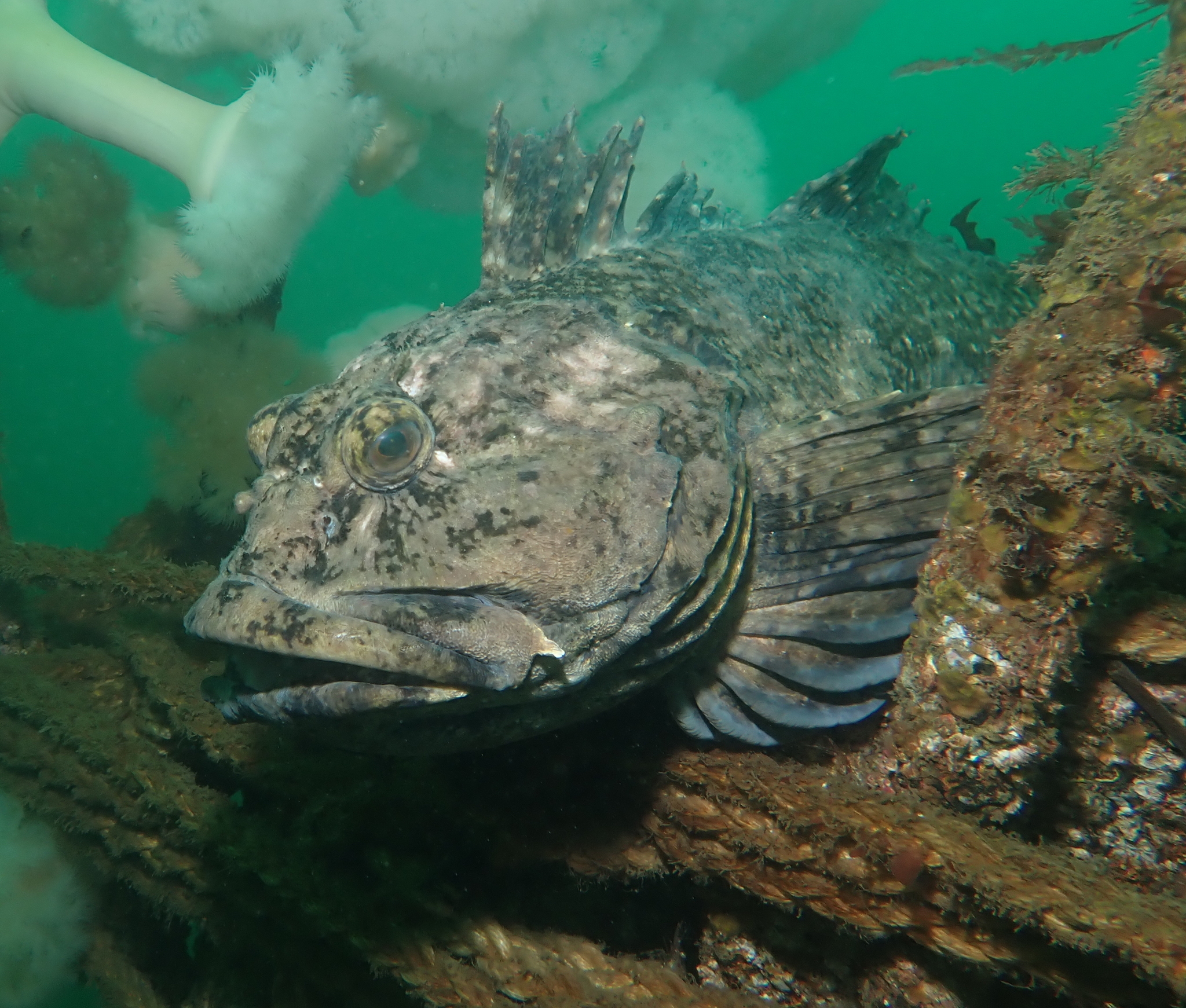
Cabezon
Scorpaenichthys marmoratus · Jordaniidae
Cabezon is a large cottid of the eastern Pacific, the only species in its genus, found from Sitka in southeastern Alaska to Punta Abrejos in central Baja California. It works the top 200 m of subtropical water on crustaceans and fish. Adults reach 99 cm TL and 14 kg and can live 13 years. January to March is the season.
- Family
- Jordaniidae
- Max length
- 99 cm TL
- Max weight
- 14 kg
- Max age
- 13 years
- Depth
- 0–200 m
- IUCN
- NE
- Climate
- Subtropical
- Diet
- crustaceans, fishes
Cabezon (Scorpaenichthys marmoratus) is a fish of the family Jordaniidae. FishBase gives its range as: Eastern Pacific: Sitka, southeastern Alaska to Punta Abrejos, central Baja California, Mexico. Its fin formula is worth recording because it does not match the scorpionfish sharing its rocky ground: 8–12 dorsal spines, 15–18 dorsal soft rays, 11–13 anal soft rays, no anal spines and 35 vertebrae. It is recorded from 0 to 200 m, in subtropical water. The recorded maxima are 99 cm TL, 14 kg, 13 years. Diet includes crustaceans and fishes. IUCN status: Not Evaluated (NE). Chinese name: .
Seasonality
Other US-CA regulations
Same jurisdictionBefore you keep a fish
- Read the recorded value. It is copied from the notice; if the number and the notice disagree, the notice wins.
- Check the area. Federal, state and local waters can set different limits for the same fish.
- Check the date. Seasons, quotas and closures change; confirm the current notice before you go.
Common questions
- What is the minimum size for Cabezon in United States — California?
- No minimum size limit
- Where does this regulation apply?
- California state waters
- When was it checked?
- 2026-11-18, against California Department of Fish and Wildlife — Summary of Recreational Groundfish Fishing Regulations.
- Do other jurisdictions set different limits?
- Yes. This register lists 2 jurisdictions for Cabezon; compare them in the table above.