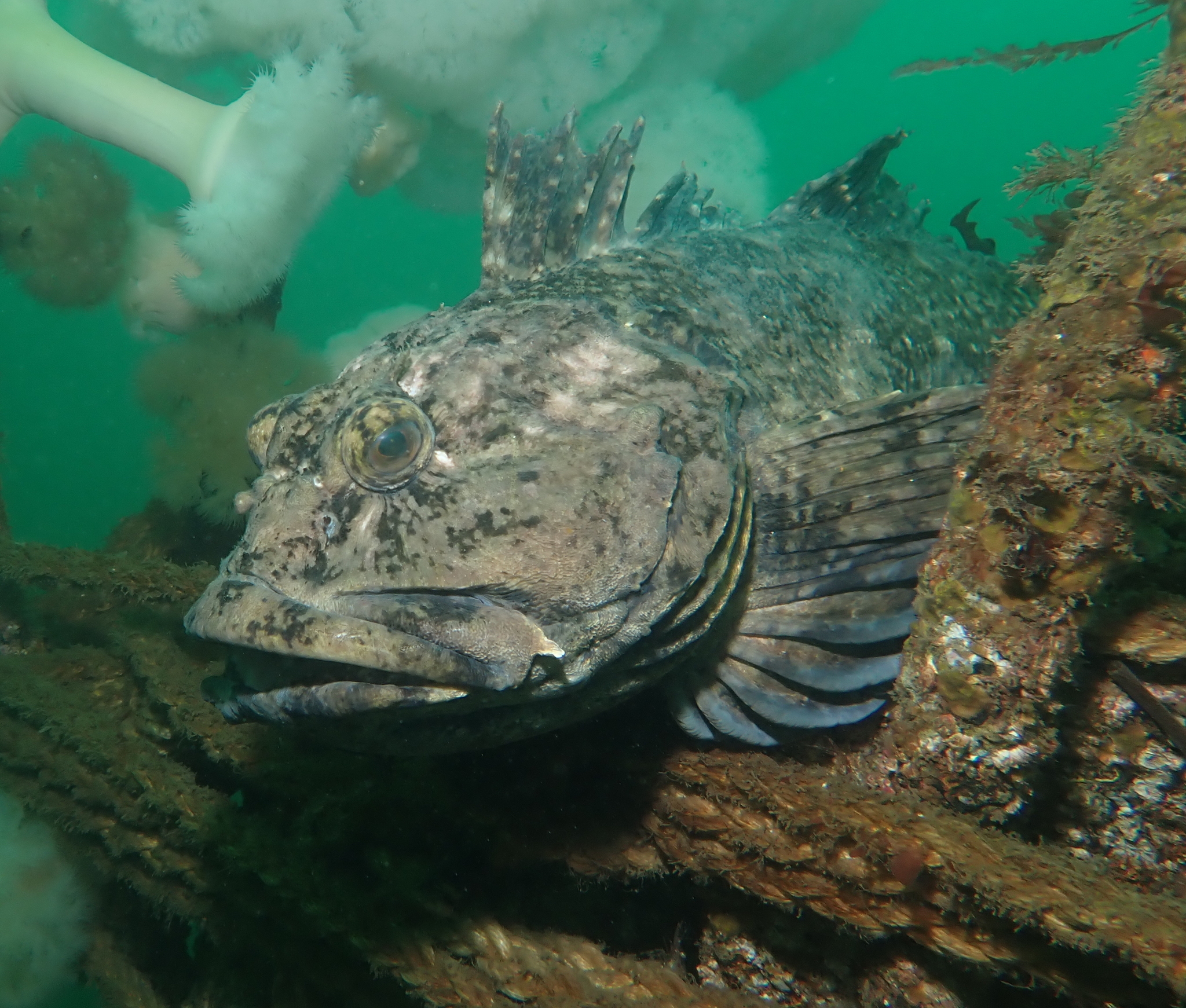
Cabezon (Scorpaenichthys marmoratus) is a fish of the family Jordaniidae. FishBase gives its range as: Eastern Pacific: Sitka, southeastern Alaska to Punta Abrejos, central Baja California, Mexico. Its fin formula is worth recording because it does not match the scorpionfish sharing its rocky ground: 8–12 dorsal spines, 15–18 dorsal soft rays, 11–13 anal soft rays, no anal spines and 35 vertebrae. It is recorded from 0 to 200 m, in subtropical water. The recorded maxima are 99 cm TL, 14 kg, 13 years. Diet includes crustaceans and fishes. IUCN status: Not Evaluated (NE). Chinese name: .
Identification
Cabezon is a large sculpin and the only species in its genus. Its fin formula is worth recording because it does not match the scorpionfish sharing its rocky ground: 8–12 dorsal spines, 15–18 dorsal soft rays, 11–13 anal soft rays, no anal spines and 35 vertebrae. The size card reads 99 cm total length, 14 kg and an age of 13 years. All three are ceiling figures, and the first one is the one that starts arguments. Total length is taken from the tip of the snout to the end of the tail, with the tail straightened; a fish measured to the fork, or to the base of the tail, records shorter than the same animal measured for a record.
Habitat and distribution
Eastern Pacific from Sitka in southeastern Alaska to Punta Abrejos in central Baja California, Mexico. Alaska, Canada, Mexico and the contiguous United States all appear as range states. The depth span is 0–200 m in subtropical water between 58°N and 26°N. Bottom type is the useful part of the card: rock, sand, mud and kelp. That means a cabezon can sit on a kelp-covered reef, on sand between boulders, or on mud at the head of a bay, and the common thread is structure with weed. Crustaceans and fishes are the recorded prey.
Season and fishing approach
Spawning is recorded from January to March in British Columbia. Measurement matters more than the calendar here. Treat 99 cm and 14 kg as ceilings, not as a target class, and measure every fish the same way before any decision is made: snout to tail tip, tail squeezed straight. If a rule is written in fork length, the same cabezon reads shorter, and a fish that passes on one board fails on another. Fish rock and kelp edges with a bait tight to the bottom, because a cabezon picks crabs and fish out of cover and the take often feels like a snag. Heavy leader is not a luxury around that structure, and a fast-tipped rod helps lift a fish away from the rocks.
Edibility and regulations
Fisheries use is commercial, it is also a gamefish, and public aquariums display it. IUCN classifies the species as Not Evaluated. Both the CITES and CMS fields are marked Not Evaluated. Retention is fixed by a minimum length, while access is fixed by the season; the two are separate settings. The 99 cm record and the 14 kg weight are the numbers people quote, and neither is a legal threshold.
Regulations before you keep it
These are the published regulations for this fish. Read the number first. The notice below it is the actual regulation.
Minimum size1
No minimum size limit
United States — California · US-CA
California has no minimum size limit for cabezon.
Cabezon and Greenlings : No minimum size limit
Bag limit1
1 fish per person per day sub-bag limit · ≥16 in total length · closed Jan 1 – Jun 30
United States — Oregon · US-OR
Oregon allows one cabezon per day inside the general marine bag, with a 16-inch total-length minimum. Retention is closed from 1 January to 30 June and opens on 1 July.
The general marine bag is 4 fish per day from 1 January 2026; cabezon is a 1-fish sub-limit inside it.
Out of the 4-fish daily bag limit, no more than 1 may be cabezon (when open) and no more than 2 may be canary rockfish
Every record above names its source and the date it was retrieved. See the regulation register for the full list, or how to read these regulations.
Where these facts come from
Check these pages before you rely on a size, range or protection status.
-
FishBase — Scorpaenichthys marmoratus
— FishBase · T2
-
GBIF — Scorpaenichthys marmoratus occurrence records
— GBIF · T2
-
IUCN Red List — Scorpaenichthys marmoratus
— IUCN · T1
-
Photo record — iNaturalist
— iNaturalist · T3