
California yellowtail in United States — California: 10 fish per person per day — California ocean waters.
(a) Limit: Ten
Quoted from California Code of Regulations Title 14 § 28.37 — Yellowtail
Regulation guide
Official sourcesHow California yellowtail is managed
California yellowtail (Seriola dorsalis) is managed by the State of California. Its recreational bag and size limits sit in section 28.37 of Title 14 of the California Code of Regulations, adopted by the Fish and Game Commission and enforced by the California Department of Fish and Wildlife.
The species does not appear in the state's rockfish, cabezon and greenling tables, and it is not one of the groundfish species listed in the federal table for California at 50 CFR 660.360. An angler fishing for yellowtail is working from the state's ocean finfish rules rather than the groundfish rules.
CDFW lists yellowtail among the species covered by its southern California ocean fishing summary, which covers the coast from Point Conception to the Mexican border. That is the region where the fish is most consistently available to recreational boats.
Source: 14 CCR § 28.37: Yellowtail (California Code of Regulations) · CDFW: Current California Ocean Recreational Fishing Regulations, Southern Region · CDFW: Ocean Sport Fishing regulations index
Ten fish a day
The limit in section 28.37 is ten fish. That is a daily bag limit, and under the state's general provisions it is also the possession limit: no more than one daily bag limit of each kind of fish may be taken or possessed by one person.
Because the species has its own listed limit, the statewide default that fills gaps in the regulations does not set the number. CDFW applies a default of 20 finfish in combination, with no more than 10 of any one species, only where no bag limit is listed for the species.
The ten-fish figure applies to fish an angler keeps. A released fish is not part of the bag, and the general provision counts only fish taken or possessed.
Source: 14 CCR § 28.37: Yellowtail (California Code of Regulations) · CDFW: General Provisions and Definitions (14 CCR) · CDFW: Ocean Sport Fishing regulations index
Twenty-four inches fork length, with five exceptions
The minimum size is 24 inches fork length, and the regulation carries an exception: five fish less than 24 inches fork length may be taken or possessed.
The exception is a ceiling inside the bag, not a separate bag. An angler may keep up to five short fish and fill the rest of the ten-fish limit with legal-sized fish, but the sixth fish under 24 inches is over the line.
The measurement basis matters as much as the number. Yellowtail is measured to the fork, not to the tip of the tail, which is the measurement used for species such as leopard shark and lingcod.
The size rule and the bag limit are written in the same section, so they are read together. An angler who keeps five short fish has used the whole undersize allowance and must fill the remaining five places with fish of at least 24 inches fork length.
Source: 14 CCR § 28.37: Yellowtail (California Code of Regulations) · CDFW: General Provisions and Definitions (14 CCR)
How to measure fork length
Fork length is defined in the state's general provisions as the straight-line distance from the tip of the head to the centre of the tail fin. The tip of the head is the most anterior point on the fish with the mouth closed and the fish lying flat on its side.
That definition is the one an enforcement officer will use, so a measurement taken along the curve of the body, or with the mouth open, can differ from the legal number. A flat board and a closed mouth give the reading that counts.
Total length, by contrast, runs to the end of the longest lobe of the tail. For a yellowtail the difference between the two measurements is not trivial, and a fish that measures 24 inches to the fork is longer than 24 inches overall.
Source: CDFW: General Provisions and Definitions (14 CCR) · 14 CCR § 28.37: Yellowtail (California Code of Regulations)
Fillets aboard a vessel
The fillet rule for yellowtail is specific. Fillets must be a minimum of 17 inches in length, except that not more than 10 fillets may be less than 17 inches, and each fillet must bear intact a one-inch square patch of skin.
The skin patch is the identification mark. Without it an officer cannot tell a yellowtail fillet from the fillet of another species, and the fillet rule exists to keep the bag limit enforceable after the head and backbone are gone.
The fillet rule also tracks the size exception. A boat carrying only short fish can still be legal on the water, but the fillets it brings ashore have to fall inside the allowance the regulation gives.
Source: CDFW: General Provisions and Definitions (14 CCR) · 14 CCR § 28.37: Yellowtail (California Code of Regulations)
License, possession and what to check
A California sport fishing license is required for any person attempting to take fish from ocean waters. The department sells 365-day licenses, which run from the date of purchase rather than the calendar year.
Possession is limited to one daily bag, whether the fish are fresh, frozen or otherwise preserved. Two limits in the cooler, or a limit at home and a limit on the boat, is the kind of possession the general provision is written to prevent.
Before keeping a yellowtail, confirm the licence, measure to the fork with the mouth closed, and check the marine protected area map for the spot. The bag and size rule is statewide, but closed areas remove water independently of the limit.
Source: CDFW: Sport Fishing Licenses and Report Cards · CDFW: General Provisions and Definitions (14 CCR) · CDFW: Current California Ocean Recreational Fishing Regulations, Southern Region
Official pages: 14 CCR § 28.37: Yellowtail (California Code of Regulations) · CDFW: General Provisions and Definitions (14 CCR) · CDFW: Current California Ocean Recreational Fishing Regulations, Southern Region · CDFW: Ocean Sport Fishing regulations index · CDFW: Sport Fishing Licenses and Report Cards
California yellowtail regulations at a glance
1 jurisdictions| Jurisdiction | Area | Size | Bag | Season / closure | Closed area | Other |
|---|---|---|---|---|---|---|
| United States — California | California ocean waters | ≥24 in fork length · up to 5 fish under 24 in may be kept | 10 fish per person per day | — | — | — |
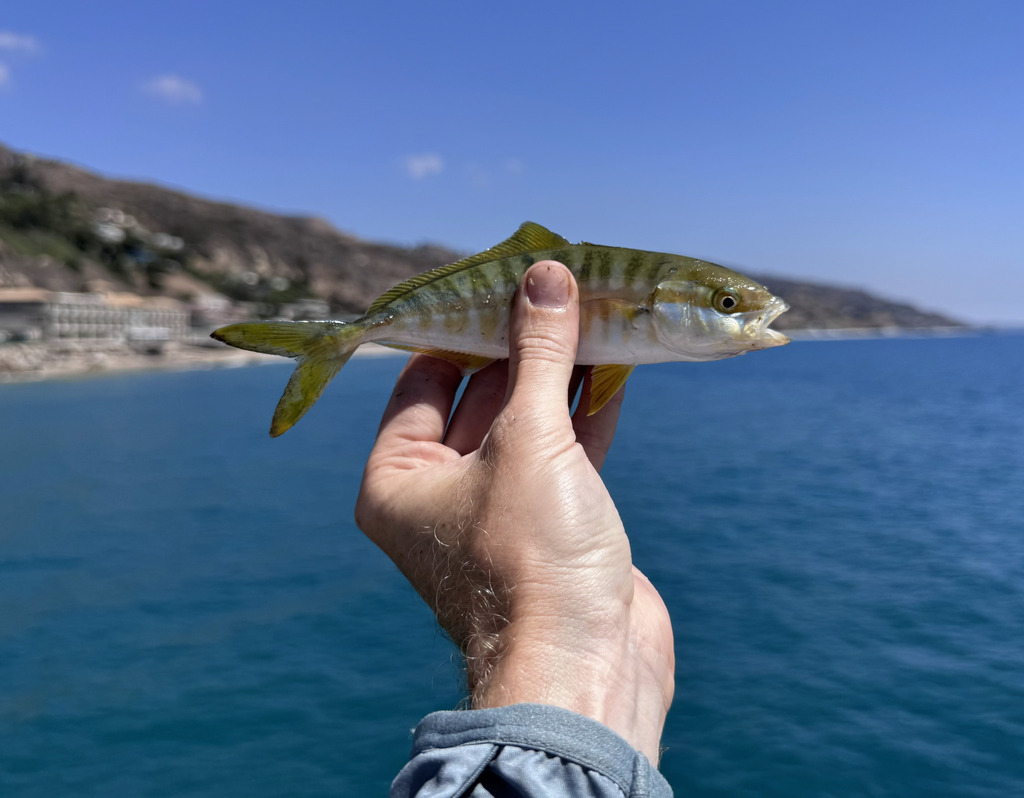
California yellowtail
Seriola dorsalis · Carangidae
The California yellowtail's rule fits in one line and holds two numbers: ten fish a day, a 24-inch fork-length minimum, and no more than five of those ten may be shorter than 24 inches. Most arguments at the rail are not about tackle. They are about measuring to the fork instead of the tip, and about reading the five-fish exception as a guarantee rather than a ceiling.
- Family
- Carangidae
- Max length
- 250 cm
- Depth
- 3–825 m
- IUCN
- LC
- Climate
- Subtropical
The California yellowtail's rule fits in one line and holds two numbers: ten fish a day, a 24-inch fork-length minimum, and no more than five of those ten may be shorter than 24 inches. Most arguments at the rail are not about tackle. They are about measuring to the fork instead of the tip, and about reading the five-fish exception as a guarantee rather than a ceiling.
Techniques
- Trolling —
- Surf fishing —
- Jigging —
Seasonality
Other US-CA regulations
Same jurisdictionBefore you keep a fish
- Read the recorded value. It is copied from the notice; if the number and the notice disagree, the notice wins.
- Check the area. Federal, state and local waters can set different limits for the same fish.
- Check the date. Seasons, quotas and closures change; confirm the current notice before you go.
Common questions
- What is the bag limit for California yellowtail in United States — California?
- 10 fish per person per day
- Where does this regulation apply?
- California ocean waters
- When was it checked?
- 2026-11-18, against California Code of Regulations Title 14 § 28.37 — Yellowtail.