
Silver sillago in Australia — Queensland: ≥23 cm — Queensland tidal waters.
Northern whiting | Min: 23cm | Combined limit: 30 in total of sand, goldenline and northern whiting
Quoted from Queensland Government — Size and possession limits in tidal waters
Queensland also applies a combined possession limit of 30 across sand, goldenline and northern whiting.
Regulation guide
Official sourcesThe name on the Queensland list
Sillago sihama appears in Queensland's fish species guide as northern whiting, with sand whiting listed as another name. The guide gives a common length of 20 cm and a maximum length of 30 cm.
The guide describes the species as occurring along the Queensland coast, near the shore in shallow water along beaches, sandbars, mangrove creeks and estuaries.
The species is a small inshore whiting, and the recreational rules for it sit in the general tidal water table rather than in a separate fishery.
Sillago sihama is one of several whiting species in the Queensland guide, and its entry carries both a size limit and a possession limit.
Queensland applies the limits in tidal waters, defined as waters subject to tidal influence. That includes waters with marine plants such as mangroves, seagrasses, marine algae or salt marsh, and waters with salt or brackish water.
It also includes waters with a tidal ebb and flow regardless of salinity, which matters for whiting because they are caught in estuaries and mangrove creeks.
Freshwater limits are published separately, so an angler fishing above the tidal reach works from a different table.
Source: Queensland Government: Northern whiting · Queensland Government: Size and possession limits in tidal waters
The 23 cm minimum
Queensland's tidal water table gives northern whiting a minimum size of 23 cm.
Fish are measured from the tip of the snout to the end of the tail, and the fish must not be manipulated to increase or decrease its length.
Fish below the minimum must be returned to the water immediately.
The minimum of 23 cm is above the species' common length of 20 cm and below its maximum of 30 cm.
The whiting entries carry no boat limit in the tidal table; the control is the combined possession limit.
Because the limit is combined across three species, a mixed bag of whiting is counted as one total rather than three separate bags.
Source: Queensland Government: Size and possession limits in tidal waters · Queensland Government: Measure your catch
A combined possession limit of 30
Northern whiting shares a combined possession limit of 30 with sand whiting and goldenline whiting.
The figure is a possession limit, not a daily bag limit. It covers fish held at any one time, including fish at home and in the freezer.
Because the species has its own entry, the general possession limit of 20 for unlisted tidal species does not apply to it.
The combined figure is stated for the three whiting species as a group, so a bag of one species is counted the same way as a mixed bag.
Source: Queensland Government: Size and possession limits in tidal waters · Queensland Government: Northern whiting
Telling the whiting apart
The Queensland guide flags other whiting species as a frequent source of misidentification for northern whiting.
The same table gives goldenline whiting and sand (summer) whiting a 23 cm minimum inside the same combined limit of 30, while trumpeter (winter) whiting has no minimum and a separate limit of 50.
The species guide lists northern whiting alongside sand, goldenline, stout and trumpeter whiting, so identification should be settled before a fish is kept.
Source: Queensland Government: Northern whiting · Queensland Government: Size and possession limits in tidal waters
Gear in Queensland tidal waters
Anglers may use up to three fishing lines with no more than six hooks in total, in any configuration. An artificial fly, lure, bait jig or gang hook counts as one hook.
A line may be handheld or attached to a rod and reel, but cross lines, drum lines, free-floating lines and set lines are prohibited, and anglers must stay with their lines.
Jagging or foul hooking is prohibited, as is using underwater breathing apparatus other than a snorkel to catch fish.
A gaff or landing net may be used to secure a line-caught fish, and the state publishes the current rules through its Qld Fishing 2.0 app.
Closed seasons and closed waters
Queensland's tidal closed seasons cover Australian bass, barramundi, black jewfish, coral reef fin fish, snapper and pearl perch, Spanish mackerel, spanner crab and tropical rocklobster. Whiting is not among the species listed.
Closed waters are a separate restriction and can apply regardless of species, for example around spawning gatherings, barriers or areas set aside for other uses.
The whiting entries also carry no boat limit, so the possession limit of 30 is the figure to watch.
Source: Queensland DPI: Closed seasons in tidal waters · Queensland Government: Closed seasons and waters
What to check before keeping a whiting
Check 23 cm on the measure, and count northern, sand and goldenline whiting together against the combined possession limit of 30.
Confirm the identification, because the whiting entries carry different limits and the state guide warns that northern whiting is easily confused with other species.
Remember that the count includes fish held at home and not just the fish on the boat.
Source: Queensland Government: Northern whiting · Queensland Government: Size and possession limits in tidal waters
Official pages: Queensland Government: Northern whiting · Queensland Government: Size and possession limits in tidal waters · Queensland Government: Measure your catch · Queensland Government: Fishing gear
Silver sillago regulations at a glance
1 jurisdictions| Jurisdiction | Area | Size | Bag | Season / closure | Closed area | Other |
|---|---|---|---|---|---|---|
| Australia — Queensland | Queensland tidal waters | ≥23 cm | — | — | — | — |
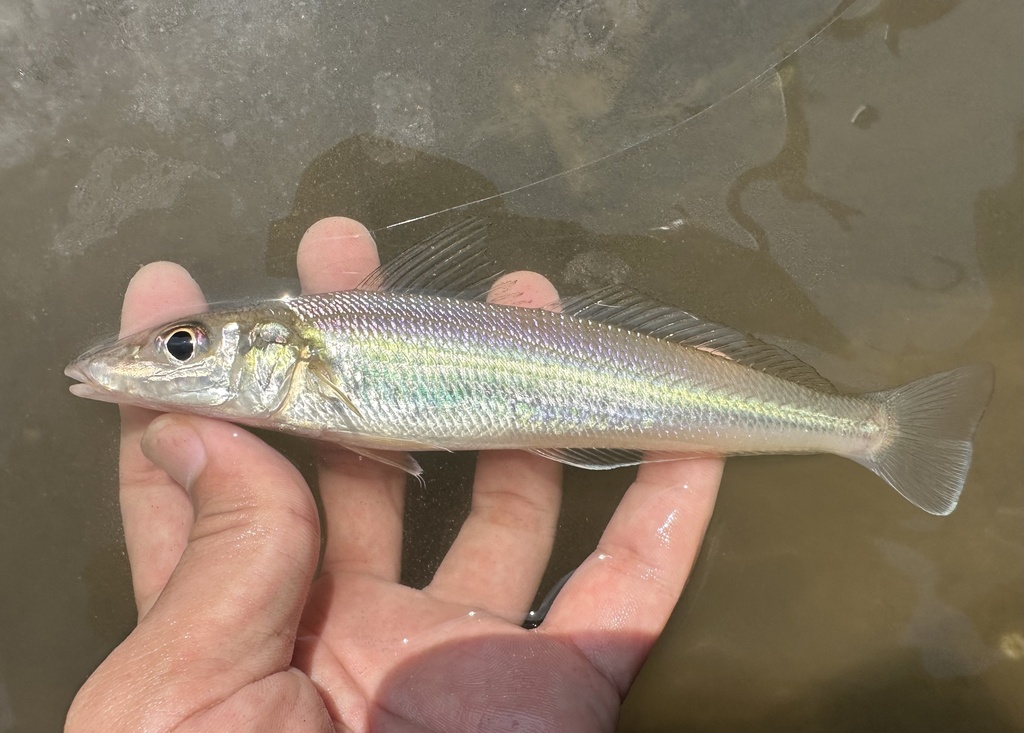
Silver sillago
Sillago sihama · Sillaginidae
FishBase gives this species two depth figures, and the distance between them is the article. The recorded range runs from 0 to 60 m; the usual depth runs from 0 to 2 m. One number describes what the fish can survive, the other describes where the records actually put it. For anyone fishing from a beach, only the second number comes with a casting range attached.
- Family
- Sillaginidae
- Max length
- 31 cm SL
- Max age
- 7 years
- Depth
- 0–60 m
- IUCN
- LC
- Climate
- Tropical · 26–29 °C
- Diet
- zooplankton, worms
FishBase gives this species two depth figures, and the distance between them is the article. The recorded range runs from 0 to 60 m; the usual depth runs from 0 to 2 m. One number describes what the fish can survive, the other describes where the records actually put it. For anyone fishing from a beach, only the second number comes with a casting range attached.
Techniques
- Shore casting —
- Boat fishing —
Seasonality
Other AU-QLD regulations
Same jurisdictionBefore you keep a fish
- Read the recorded value. It is copied from the notice; if the number and the notice disagree, the notice wins.
- Check the area. Federal, state and local waters can set different limits for the same fish.
- Check the date. Seasons, quotas and closures change; confirm the current notice before you go.
Common questions
- What is the minimum size for Silver sillago in Australia — Queensland?
- ≥23 cm
- Where does this regulation apply?
- Queensland tidal waters
- When was it checked?
- 2026-11-18, against Queensland Government — Size and possession limits in tidal waters.