
Atlantic Spanish mackerel in United States — New York: 14 in · 15 fish per person per day · all year — New York Marine and Coastal District.
Spanish mackerel 14" 15 All year
Quoted from Recreational Saltwater Fishing Regulations
Regulation guide
Official sourcesHow Atlantic Spanish mackerel is managed
Atlantic Spanish mackerel (Scomberomorus maculatus) is managed as a coastal migratory pelagic species under a joint fishery management plan of the South Atlantic Fishery Management Council and the Gulf of Mexico Fishery Management Council. NOAA Fisheries implements the federal measures in federal waters.
For anglers from New York to Florida the relevant stock is the Atlantic migratory group. Its northern boundary is the intersection point of New York, Connecticut and Rhode Island, its southern boundary is off Miami-Dade and Monroe counties in Florida, and it is split into a northern and a southern zone at the North Carolina/South Carolina border. The zone boundaries stay the same all year.
State agencies set their own rules inside state waters, and the four states in this guide differ on size but not on the 15-fish count. The SAFMC summary also warns that a federally permitted vessel may not retain a species that is closed in federal waters even where state waters allow it, so a for-hire trip should be checked against both sets of rules.
Source: NOAA Fisheries: Spanish Mackerel · eCFR: 50 CFR 622.369, Description of zones
Federal waters: 15 fish per person and 12 inches fork length
In the Atlantic EEZ the recreational bag limit is 15 Spanish mackerel per person per day. The minimum size is 12 inches fork length, and a fish below that size must be released immediately with a minimum of harm.
The SAFMC regulation summary currently lists the fishery as open, with the 15-fish bag limit and the 12-inch fork length minimum.
Anglers may keep cut-off or damaged Atlantic Spanish mackerel taken under the recreational bag limit, provided the fish comply with the minimum size.
The 15-fish figure is a daily bag limit, not a possession limit. On a charter or headboat trip that spans more than 24 hours, a passenger may possess no more than two daily bag limits, but only where the vessel has two licensed operators aboard and every passenger holds a receipt that verifies the length of the trip. That is a possession allowance for a longer trip, not a second daily bag.
Source: eCFR: 50 CFR 622.382, Bag and possession limits · eCFR: 50 CFR 622.380, Size limits · South Atlantic Fishery Management Council: Mackerel, Spanish
North Carolina: 12 inches fork length and 15 fish
The North Carolina Division of Marine Fisheries lists Spanish mackerel at 12 inches fork length with a daily bag limit of 15 fish per person in coastal and joint waters. Those figures line up with the federal rule, so crossing from state waters into the EEZ does not change the number an angler may keep.
Recreational fishing in North Carolina coastal waters requires a Coastal Recreational Fishing License under G.S. 113-174.2.
The state's general finfish rule makes it unlawful to possess a fish that is subject to a size or harvest restriction without the head and tail attached, apart from listed bait exceptions. A Spanish mackerel kept on board should therefore stay whole.
Source: North Carolina DEQ, Division of Marine Fisheries: Recreational Size and Bag Limits · North Carolina OAH: 15A NCAC 03M, Finfish rules
Rhode Island, New York and Virginia: 14 inches and 15 fish
Rhode Island sets a 14-inch minimum, a possession limit of 15 fish per person per day and a season running 1 January through 31 December. Spanish mackerel taken there must be landed with head and fins intact.
New York's recreational table lists Spanish mackerel at 14 inches total length and 15 fish per day, all year, in the Marine and Coastal District.
Virginia sets 14 inches total length and a possession limit of 15 Spanish mackerel per person. Where the catch is held in a common hold or container, the limit applies to the boat and equals 15 times the number of persons on board who are legally eligible to fish, with the captain responsible for compliance.
The 14-inch state minimum is the more restrictive size rule, and in New York and Virginia it is a total-length measurement rather than the federal fork length.
Source: Rhode Island Department of State: 250-RICR-90-00-3 Finfish · New York State DEC: Recreational Saltwater Fishing Regulations · Virginia Administrative Code: 4VAC20-540-30, Recreational possession limits
Fork length and total length are not the same measurement
Fork length runs from the tip of the snout to the fork of the tail. Total length runs to the tip of the longest lobe of the tail, so it is always the larger of the two figures for the same fish.
That is why a 12-inch fork length federal minimum and a 14-inch total length state minimum cannot be compared directly. An angler in Virginia or New York state waters should measure to the tail tip and use 14 inches; in the EEZ the fork of the tail is the reference point and the figure is 12 inches.
Filleting at sea can make a fish unmeasurable. Rhode Island requires head and fins intact, and North Carolina's general rule requires head and tail attached, so a filleted Spanish mackerel may not be defensible even when the fish was legal when caught.
Source: eCFR: 50 CFR 622.380, Size limits · Rhode Island Department of State: 250-RICR-90-00-3 Finfish
What to check before keeping a Spanish mackerel
Confirm the water first: state waters, the EEZ, or a federally permitted vessel fishing in state waters. Then apply the matching size and bag rule, remembering that the 15-fish figure is a daily per-person limit in the states covered here, with Virginia converting it to a boat limit when the catch is held in a common container.
Check the current state proclamation or regulation table before a trip. Rhode Island states that seasons and possession limits can change during the year, and North Carolina publishes its limits through proclamations as well as the size and bag table.
Finally, check the measurement and handling rules: head and fins intact in Rhode Island, head and tail attached in North Carolina, and total length rather than fork length in New York and Virginia.
Source: Rhode Island Department of State: 250-RICR-90-00-3 Finfish · North Carolina DEQ, Division of Marine Fisheries: Recreational Size and Bag Limits
Official pages: NOAA Fisheries: Spanish Mackerel · South Atlantic Fishery Management Council: Spanish mackerel regulations · eCFR: 50 CFR 622.382, Bag and possession limits · North Carolina DMF: Recreational Size and Bag Limits · Rhode Island: 250-RICR-90-00-3 Finfish · New York DEC: Recreational Saltwater Fishing Regulations · Virginia Administrative Code: 4VAC20-540, Spanish and King Mackerel
Atlantic Spanish mackerel regulations at a glance
4 jurisdictions| Jurisdiction | Area | Size | Bag | Season / closure | Closed area | Other |
|---|---|---|---|---|---|---|
| United States — New York | New York Marine and Coastal District | — | 14 in · 15 fish per person per day · all year | — | — | — |
| United States — North Carolina | North Carolina coastal and joint waters | — | 12 in fork length · 15 fish per person per day | — | — | — |
| United States — Rhode Island | Rhode Island state waters | — | 14 in · 15 fish per person per day · year round | — | — | — |
| United States — Virginia | Virginia marine waters | — | 14 in · 15 fish per person per day | — | — | — |
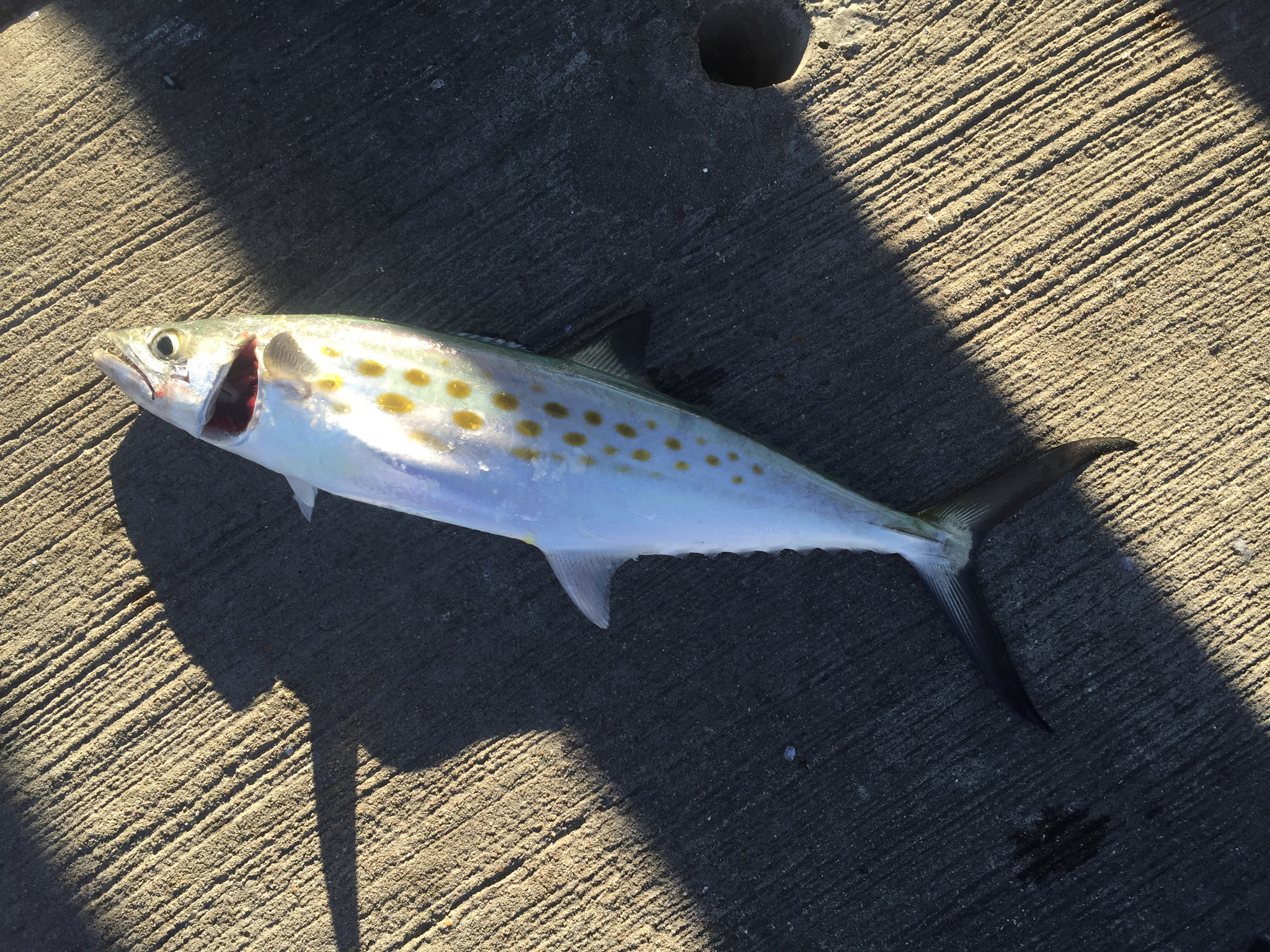
Atlantic Spanish mackerel
Scomberomorus maculatus · Scombridae
Spanish mackerel is four species under one market name: Scomberomorus maculatus in the western Atlantic, tritor in the east, sierra in the eastern Pacific and brasiliensis in the Caribbean and Brazil. The western Atlantic fish reaches 91 cm fork length, 5.9 kg and about five years, over 10–35 m at 20–30 °C. Settle the species before the tackle.
- Family
- Scombridae
- Max length
- 91 cm FL
- Max weight
- 5.9 kg
- Max age
- 5 years
- Depth
- 10–35 m
- IUCN
- LC
- Climate
- Subtropical · 20–30 °C
- Diet
- fishes, molluscs
"Spanish mackerel" is a name that means a different fish in three different oceans, and that is the first thing to settle before discussing tackle. In the western Atlantic the approved species is *Scomberomorus maculatus*: 91 cm fork length, 5.9 kg, a five-year lifespan, a maturity length of 40.5 cm, and a recorded depth range of 10–35 m in water of 20–30 °C. In the eastern Atlantic the same common name is applied to *Scomberomorus tritor*; in the eastern Pacific it is *Scomberomorus sierra*; in the Caribbean and Brazil it is *Scomberomorus brasiliensis*. Four species, one market name, four sets of rules.
Techniques
- Trolling —
- Shore casting —
Baits
- Metal spoon
- Live shrimp
- Small live baitfish
- Gotcha plug
Seasonality
Peak Jun–SepFish the moving tide around a pass or inlet. A ripping current concentrates bait.
Warm, clear water and light wind. Rough, dirty water pushes them offshore.
Other US-NY regulations
Same jurisdictionBefore you keep a fish
- Read the recorded value. It is copied from the notice; if the number and the notice disagree, the notice wins.
- Check the area. Federal, state and local waters can set different limits for the same fish.
- Check the date. Seasons, quotas and closures change; confirm the current notice before you go.
Common questions
- What is the bag limit for Atlantic Spanish mackerel in United States — New York?
- 14 in · 15 fish per person per day · all year
- Where does this regulation apply?
- New York Marine and Coastal District
- When was it checked?
- 2026-11-18, against Recreational Saltwater Fishing Regulations.
- Do other jurisdictions set different limits?
- Yes. This register lists 4 jurisdictions for Atlantic Spanish mackerel; compare them in the table above.