
Chinamanfish in Australia — Queensland: No take — Queensland tidal waters.
Chinaman fish | No take | No take
Quoted from Queensland Government — Size and possession limits in tidal waters
Regulation guide
Official sourcesHow chinaman fish is managed in Queensland
Chinaman fish is a Queensland tidal-water species, and the state's recreational rules place it among the fish that may not be taken at all. Queensland publishes the size and possession limits for tidal waters in a single table, and the no-take species are listed separately in the same rule set.
The fish appears in the tropical snappers and sea perch group of the limit table, under the exception list that overrides the group's general 25 cm minimum and five-per-species limit. Its row reads no take in both the size column and the possession column.
The rules apply to tidal waters, defined as waters subject to tidal influence, including waters with mangroves, seagrass, marine algae or salt marsh, salt or brackish water, or a tidal ebb and flow regardless of salinity.
Source: Queensland Government: Size and possession limits in tidal waters · Queensland Government: Protected and no-take species
No take, and no possession
Chinaman fish is on Queensland's no-take list for tidal waters. The list states that if a no-take species is accidentally caught it must be immediately and carefully returned to the water unharmed.
The absence of a possession limit is deliberate. There is no bag to fill and no size at which the fish becomes legal, so a chinaman fish on ice, in a bucket or in a freezer is not covered by any allowance.
The tropical snapper table groups better-known no-take fish in the same exception list, including paddletail and red bass. All three sit outside the normal reef limits rather than at the top of them.
Source: Queensland Government: Protected and no-take species · Queensland Government: Size and possession limits in tidal waters
Why the species is no take: ciguatera
Queensland Health identifies chinamanfish, red bass and paddletail as presenting a particularly high risk of ciguatera poisoning, and notes that these fish are no-take species. Ciguatera is a food poisoning caused by eating warm-water reef fish carrying a toxin produced by a dinoflagellate that grows on algae in reef areas.
The toxin moves up the food chain as small plant-eating fish are eaten by larger predatory fish and then by people. It does not change the appearance, odour or taste of a fish, and cooking and freezing do not destroy it. Queensland Health states there is no known method of removing it from a fish.
Symptoms usually begin between one and 24 hours after eating a toxic fish and can include tingling and numbness around the mouth and limbs, a burning sensation on contact with cold water, joint and muscle pain, nausea and diarrhoea. The health advice is to seek medical attention promptly if symptoms appear.
Source: Queensland Government: Naturally occurring seafood toxins
Identifying a chinaman fish
Queensland's tables use the name chinaman fish, set in the tropical snappers and sea perch section alongside crimson, saddletail, flame, goldband, rosy, ruby and sharptooth snapper.
Because the no-take rule turns on identity, a fish that cannot be identified with confidence should not be kept. The Qld Fishing 2.0 app and the state's fish species identification guide are the department's recommended references for checking an unfamiliar reef fish.
The cost of a mistaken identification is one-directional. A wrongly released snapper costs an angler a fish, while a wrongly kept chinaman fish is a possession offence and a health risk.
Source: Queensland Government: Size and possession limits in tidal waters · Queensland Government: Protected and no-take species
If you catch one
The requirement is immediate release, handled carefully. Queensland's no-take page makes no provision for retaining a damaged fish, and it does not provide for a fish that dies during capture to be kept.
Release should be quick and should keep the fish in the water where possible. The state's measuring page repeats the same principle for undersized, oversized, no-take and closed-season fish: return them immediately so they have the best chance of survival.
An angler who has already put a chinaman fish in the boat should return it without delay. Leaving the fish on deck while deciding what to do with it does not convert it into a lawful possession.
Source: Queensland Government: Protected and no-take species · Queensland Government: Measure your catch
The rest of the reef rules still apply
Catching a no-take fish does not suspend the rules for everything else in the boat. Coral reef fin fish carry a combined possession limit of 20 in total, and reef fin fish may be kept whole, gilled, gutted or filleted, with fillets at least 40 cm long and skin and scales left on.
Two five-day coral reef fin fish closures fall in October and November each year. The 2026 closures are 8 to 12 October and 6 to 10 November, and the 2027 closures are 26 to 30 October and 25 to 29 November.
Queensland's Your Catch Counts program asks recreational fishers to record catches in the Qld Fishing 2.0 app so the department has recreational data for its stock work. For a no-take species, that record is the only thing the trip can contribute to the dataset.
Source: Queensland Government: Size and possession limits in tidal waters · Queensland Department of Primary Industries: Closed seasons in tidal waters · Queensland Department of Primary Industries: Your Catch Counts
Official pages: Queensland Government: Protected and no-take species · Queensland Government: Size and possession limits in tidal waters · Queensland Government: Naturally occurring seafood toxins (ciguatera)
Chinamanfish regulations at a glance
1 jurisdictions| Jurisdiction | Area | Size | Bag | Season / closure | Closed area | Other |
|---|---|---|---|---|---|---|
| Australia — Queensland | Queensland tidal waters | — | — | — | — | Protected species: No take |
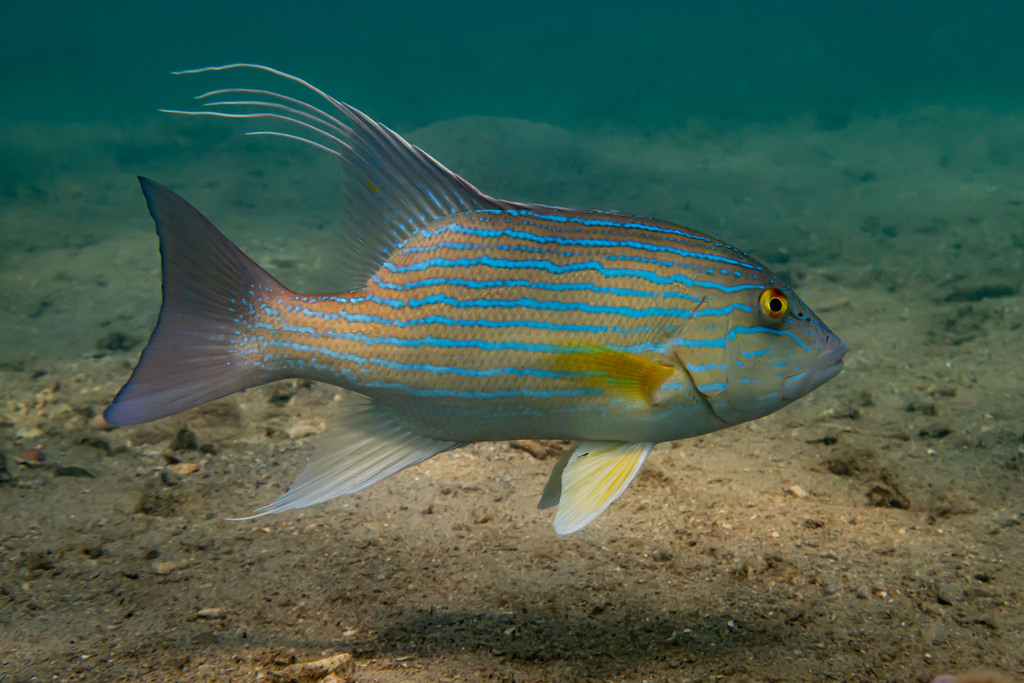
Chinamanfish
Symphorus nematophorus · Lutjanidae
Chinamanfish is a large western Pacific snapper, from the Ryukyu Islands to the Indo-Australian Archipelago. It lives on coral reefs at 20 to 100 m, with adults from shallow water to at least 50 m, usually solitary and feeding mainly on fish. It reaches 100 cm SL with a common length of 35 cm and 13.2 kg. Bottom fishing and lures are the methods listed.
- Family
- Lutjanidae
- Max length
- 100 cm SL
- Max weight
- 13.2 kg
- Depth
- 20–100 m
- IUCN
- LC
- Climate
- Tropical
Chinamanfish is a large western Pacific snapper, from the Ryukyu Islands to the Indo-Australian Archipelago (Malay Peninsula to New Guinea and northern Australia). It lives on coral reefs at 20–100 m, adults from shallow water to at least 50 m, usually solitary and feeding mainly on fishes. FishBase gives a maximum of 100 cm standard length, a common length of 35 cm and a maximum weight of 13.2 kg. IUCN lists it as Least Concern, assessed in 2015. The main issue is not tackle but ciguatera: FishBase states it is frequently ciguatoxic in certain areas and is banned for sale in Australia.
Techniques
- Bottom fishing —
- Lure fishing —
Seasonality
Other AU-QLD regulations
Same jurisdictionBefore you keep a fish
- Read the recorded value. It is copied from the notice; if the number and the notice disagree, the notice wins.
- Check the area. Federal, state and local waters can set different limits for the same fish.
- Check the date. Seasons, quotas and closures change; confirm the current notice before you go.
Common questions
- What is the protected species for Chinamanfish in Australia — Queensland?
- No take
- Where does this regulation apply?
- Queensland tidal waters
- When was it checked?
- 2026-11-18, against Queensland Government — Size and possession limits in tidal waters.