No take
Australia — Queensland · AU-QLD
Queensland prohibits taking Chinaman fish.
Chinaman fish | No take | No take

Chinamanfish is a large western Pacific snapper, from the Ryukyu Islands to the Indo-Australian Archipelago. It lives on coral reefs at 20 to 100 m, with adults from shallow water to at least 50 m, usually solitary and feeding mainly on fish. It reaches 100 cm SL with a common length of 35 cm and 13.2 kg. Bottom fishing and lures are the methods listed.
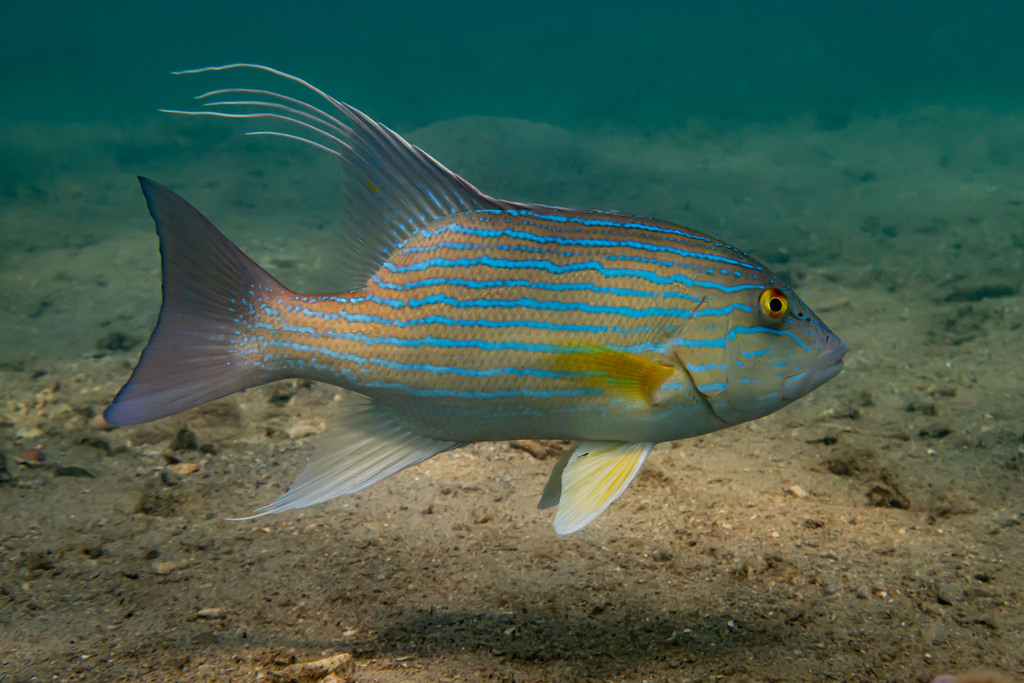
Chinamanfish is a large western Pacific snapper, from the Ryukyu Islands to the Indo-Australian Archipelago (Malay Peninsula to New Guinea and northern Australia). It lives on coral reefs at 20–100 m, adults from shallow water to at least 50 m, usually solitary and feeding mainly on fishes. FishBase gives a maximum of 100 cm standard length, a common length of 35 cm and a maximum weight of 13.2 kg. IUCN lists it as Least Concern, assessed in 2015. The main issue is not tackle but ciguatera: FishBase states it is frequently ciguatoxic in certain areas and is banned for sale in Australia.
The dorsal fin has 10 spines and 15–16 soft rays; the anal fin has 3 spines and 9 soft rays. It is placed in the snapper family Lutjanidae, subfamily Paradicichthyinae; the subfamily distinction does not show in the fish's shape, and on deck it is handled like any snapper. The body is fusiform with an oval cross-section. The colour is reddish brown to grey-red with longitudinal bands. The soft rays of the dorsal and anal fins are extended into filaments, especially in adults; the caudal fin is deeply forked; the head is large and the mouth is large. Among snappers, the filamentous fin tips are the giveaway: the dorsal and anal fin ends trail like ribbons, and the colour plus bands separate it from red and mangrove snappers. The Chinese aliases , and refer to the filaments or the toxicity and are kept as aliases.
FishBase's range is the western Pacific: the Ryukyu Islands to the Indo-Australian Archipelago (Malay Peninsula to New Guinea and northern Australia). The country table includes the Admiralty Islands, Australia, Brunei, Cambodia, China, Hong Kong SAR, Indonesia, Japan, Macao, Malaysia, New Caledonia, Papua New Guinea, the Philippines, the Ryukyu Islands, Singapore, the Solomon Islands, Taiwan region, Thailand, Timor-Leste, Vanuatu and Vietnam. GBIF's 1,933 records are led by Australia (1,776), New Caledonia (42), the Philippines (34), Japan (27) and Indonesia (14). It lives on coral reefs from shallow water to at least 50 m, adults usually solitary and feeding mainly on fishes. Fish the outer reef slope, gullies and points where baitfish gather.
FishBase publishes no spawning months and no temperature window. The species is tropical and catchable all year; in Taiwan region, Hong Kong SAR and Southeast Asia, late spring to autumn is the main window, while monsoon winters reduce offshore trips. No temperature number is published, so follow local reef temperature. It is an ambush predator; tide and slack water concentrate baitfish along the slope and edge, and dawn and dusk also work.
The GBIF pattern is overwhelmingly Australian, with New Caledonia, the Philippines and Japan secondary. Fish the outer slope and the current-swept point, not the lagoon. The source gives no coordinates; local knowledge of ledges and current lines is the real map.
Reef bottom fishing and heavy lure fishing both work: bottom fishing uses live or fresh bait, large hooks and heavy leaders; lures include large soft plastics, jigheads, heavy jigs and poppers. The fish sprints and dives for cover, so a smooth drag and a fast lift matter. Live baits such as scad, damselfish or small squid are slow-trolled along the reef edge. Use bite protection: 60–100 lb fluorocarbon or wire leader and large single or heavy treble hooks. Do not challenge large fish on light tackle.
Chinamanfish supports commercial fisheries and game fishing and is sold in Hong Kong live-fish markets; the flesh is fine, but FishBase states it is frequently ciguatoxic in some areas and banned for sale in Australia. Ciguatoxin is heat-stable, so cooking does not destroy it; large fish, heads and organs are higher risk, and the safest choice is not to eat large individuals. The two official positions sit at opposite ends of the same risk: Australia blocks sale, while Hong Kong SAR sells the fish live. Bleed, gut and ice promptly, and check local ciguatera advisories. Rules vary: Taiwan region manages inshore fishing through closed areas, seasons and gear restrictions, and recreational fishing must follow Fisheries Agency and local government notices; Hong Kong SAR's Fisheries Protection Ordinance regulates methods, with no angling or collecting in marine parks and reserves; Australia bans the sale of this species; Southeast Asian states differ widely, with Malaysia, Indonesia, the Philippines and Thailand issuing size and closed-season rules and usually prohibiting take in marine protected areas. Check the current local notice.
The page is built from FishBase taxonomy, morphology, distribution, environment, biology, use, IUCN and ciguatera entries, with the country table for range and GBIF/iNaturalist for occurrence. The Australian sales ban is quoted from FishBase's biology entry; ciguatera risk should be confirmed with local health authorities. Spawning months, water temperature and local size limits are not standardised, so the text stays conservative.
Fished with the listed approach, matched to the recorded depth and size.
Fished with the listed approach, matched to the recorded depth and size.
These are the published regulations for this fish. Read the number first. The notice below it is the actual regulation.
Queensland prohibits taking Chinaman fish.
Chinaman fish | No take | No take
Every record above names its source and the date it was retrieved. See the regulation register for the full list, or how to read these regulations.
Check these pages before you rely on a size, range or protection status.
These fish live in the same place.
Technique, gear and safety guides that fit Chinamanfish.