
Tautog in United States — New York: 16 in · Long Island Sound 2 fish Apr 1 – Apr 30 and 3 fish Oct 11 – Dec 9 · NY Bight 2 fish Apr 1 – Apr 30 and 4 fish Oct 15 – Dec 22 — New York Marine and Coastal District, by region.
Tautog (blackfish): Long Island Sound Region Marine and coastal district waters lying east of the Throgs Neck Bridge and west of a line that runs from Orient Point, NY to Watch Hill, RI 16" 2 3 April 1 - April 30 Oct 11 - Dec 9 Tautog (blackfish): NY Bight Region Marine and coastal district waters lying outside of the Long Island Sound Region 16" 2 4 April 1 - April 30 Oct 15 - Dec 22
Quoted from Recreational Saltwater Fishing Regulations
Regulation guide
Official sourcesAn interstate plan built around four regions
Tautog, known locally as blackfish, are managed by ASMFC under Amendment 1 (2017) to the interstate Fishery Management Plan. The amendment split the stock into four regions — Massachusetts–Rhode Island, Long Island Sound, New Jersey–New York Bight, and Delaware–Maryland–Virginia — because biology, fishery characteristics and limited coastwide movement differ. Each region has its own reference points, fishing mortality target and rebuilding schedule, and each must adopt measures with at least a 50 percent probability of reaching the regional target. If fishing mortality exceeds the regional threshold, the Board must begin corrective action within a year.
More than 90 percent of the harvest is recreational, and most landings occur in state waters. Most tautog are landed in spring and fall, although some Mid-Atlantic anglers fish for them year-round and Virginia has an active winter fishery. Tautog can live for more than 30 years and feed heavily on oysters, blue mussels and other shellfish.
Source: ASMFC: Tautog
The 2025 update produced four verdicts
The 2025 regional stock assessment update found different status in each region. Massachusetts–Rhode Island and Long Island Sound remained not overfished with overfishing not occurring. New Jersey–New York Bight moved from overfished but not experiencing overfishing to not overfished but experiencing overfishing. Delaware–Maryland–Virginia moved from neither to both overfished and experiencing overfishing.
All regions showed major retrospective patterns in fishing mortality and spawning stock biomass, and the subcommittee adjusted values where they fell outside the confidence interval. Since the 2021 update, recruitment has increased in Long Island Sound and New Jersey–New York Bight, and total removals have risen in every region, driven mainly by recreational harvest. In October 2025 the Board began an addendum to address the changed status in New Jersey–New York Bight and Delaware–Maryland–Virginia, and to consider whether the other two regions may adjust measures for precaution or alignment.
Source: ASMFC: Tautog · ASMFC: 2025 Tautog Regional Stock Assessment Update
New Jersey
New Jersey's 2026 rules set a 15-inch minimum and four open windows: four fish from January 1 to February 28, four fish from April 1 to April 30, one fish from August 1 to November 15, and five fish from November 16 to December 31. Size is total length.
Saltwater anglers must comply with the New Jersey Saltwater Recreational Registry Program. Fish may be taken only by angling with a hand line or rod and line unless a regulation provides otherwise, although spearfishing is allowed for state-managed species other than lobster, and a spear fisherman must ensure the fish meets the minimum before killing or injuring it.
Filleting at sea is prohibited for fish with a size limit, and fish that are purposely killed become part of the daily possession limit and may not be returned to the water.
Source: New Jersey Division of Fish and Wildlife: Attention Anglers 2026 — Recreational Size Limits, Possession Limits and Seasons · New Jersey Division of Fish and Wildlife: 2026 New Jersey Marine Digest, Marine Regulations — Finfish
Reading the New Jersey calendar
The four windows leave March and May through July outside the listed seasons, and the bag moves between one and five fish. That structure, rather than a single annual limit, is how New Jersey constrains recreational removals through the year.
ASMFC's state measures table lists the same New Jersey figures and reported no changes for 2025. Because the Commission's addendum could change regional measures, anglers should read the current digest rather than an older summary. New Jersey publishes its marine digest in May, and regulations remain in effect until changed.
Source: ASMFC: 2024 Tautog State Recreational Measures · New Jersey Division of Fish and Wildlife: Marine Seasons and Regulations
Release, discards and illegal harvest
ASMFC estimated that recreational anglers discarded 26.1 million tautog in 2024, with an assumed 2.5 percent discard mortality, equal to about 17.5 percent of recreational removals. Handling and release practice therefore affect the stock as much as the bag limit does.
The Commission also notes that high prices for live tautog and interest in undersized fish have led to significant illegal harvest, a reminder that the minimum size is the rule that protects the spawning population.
Source: ASMFC: Tautog
Before you keep a tautog
Check the date against the four windows, confirm the 15-inch minimum, and count the fish already in the box against the current possession limit. Carry the registry confirmation. Leave the fish whole until shore, because cleaning a size-limit fish at sea is prohibited.
Identify blackfish by the stout body, arched head and broad tail; juveniles are greenish and adults darker. Tautog are most abundant between Cape Cod and Chesapeake Bay, and a cold-water wreck may produce only one or two fish, so measure before deciding to keep one. In very low water temperatures adults become torpid or lethargic, which makes careful release and quick measurement even more important.
Source: ASMFC: Tautog · New Jersey Division of Fish and Wildlife: Attention Anglers 2026 — Recreational Size Limits, Possession Limits and Seasons · New Jersey Division of Fish and Wildlife: 2026 New Jersey Marine Digest, Marine Regulations — Finfish
Official pages: ASMFC: Tautog · ASMFC: 2025 Tautog Regional Stock Assessment Update · ASMFC: 2024 Tautog State Recreational Measures · New Jersey Division of Fish and Wildlife: Attention Anglers 2026 · New Jersey Division of Fish and Wildlife: 2026 Marine Digest, Finfish Regulations · New Jersey Division of Fish and Wildlife: Marine Seasons and Regulations
Tautog regulations at a glance
7 jurisdictions| Jurisdiction | Area | Size | Bag | Season / closure | Closed area | Other |
|---|---|---|---|---|---|---|
| United States — Maine | Maine territorial waters | — | No minimum size · no bag limit | — | — | — |
| United States — Massachusetts | Massachusetts state waters | — | 16 in (one fish may exceed 21 in) · 3 fish Apr 1 – May 31 · 1 fish Jun 1 – Jul 31 · 3 fish Aug 1 – Oct 14 · 5 fish Oct 15 – Dec 31 | — | — | — |
| United States — New Jersey | New Jersey marine waters | — | 15 in · 4 fish Jan 1 – Feb 28 and Apr 1 – Apr 30 · 1 fish Aug 1 – Nov 15 · 5 fish Nov 16 – Dec 31 | — | — | — |
| United States — New York | New York Marine and Coastal District, by region | — | 16 in · Long Island Sound 2 fish Apr 1 – Apr 30 and 3 fish Oct 11 – Dec 9 · NY Bight 2 fish Apr 1 – Apr 30 and 4 fish Oct 15 – Dec 22 | — | — | — |
| United States — Rhode Island | Rhode Island state waters | — | 16 in (only one fish over 21 in) · 3 fish Apr 1 – May 31 · closed Jun 1 – Jul 31 · 3 fish Aug 1 – Oct 14 · 5 fish Oct 15 – Dec 31 · 10 per vessel | — | — | — |
| United States — Virginia | Virginia marine waters | — | 16 in · 4 fish per person per day · closed May 16 – Jun 30 | — | — | — |
| United States — federal (Atlantic) | Federal Atlantic waters (Greater Atlantic) | — | No minimum size · unlimited possession · all year | — | — | — |
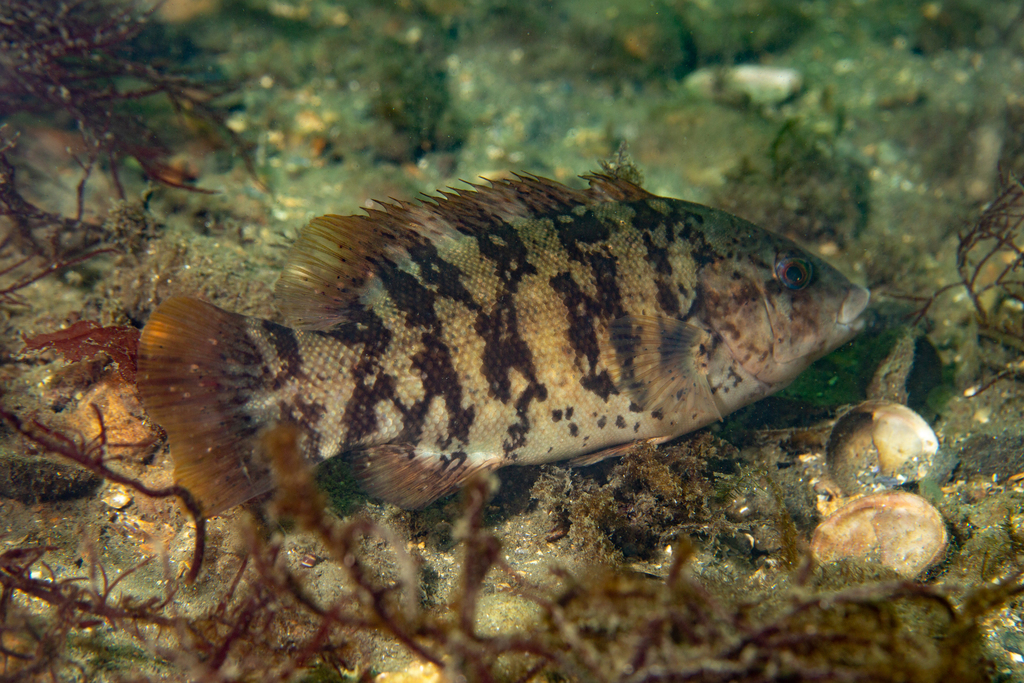
Tautog
Tautoga onitis · Labridae
The tautog is labelled marine and brackish on the same environment line. It is not a fish that crosses into fresh water; it is a fish that uses the saltier end of an estuary as well as the open coast, and the record compresses that into two words. The fishing consequence is a question of position on a gradient that runs from ocean rock to bay rock, not a question of choosing between two separate waters.
- Family
- Labridae
- Max length
- 91 cm TL
- Max weight
- 11.3 kg
- Max age
- 34 years
- Depth
- 1–75 m
- IUCN
- VU
- Climate
- Subtropical
- Diet
- crustaceans, fishes
The tautog is labelled marine and brackish on the same environment line. It is not a fish that crosses into fresh water; it is a fish that uses the saltier end of an estuary as well as the open coast, and the record compresses that into two words. The fishing consequence is a question of position on a gradient that runs from ocean rock to bay rock, not a question of choosing between two separate waters.
Seasonality
Other US-NY regulations
Same jurisdictionBefore you keep a fish
- Read the recorded value. It is copied from the notice; if the number and the notice disagree, the notice wins.
- Check the area. Federal, state and local waters can set different limits for the same fish.
- Check the date. Seasons, quotas and closures change; confirm the current notice before you go.
Common questions
- What is the bag limit for Tautog in United States — New York?
- 16 in · Long Island Sound 2 fish Apr 1 – Apr 30 and 3 fish Oct 11 – Dec 9 · NY Bight 2 fish Apr 1 – Apr 30 and 4 fish Oct 15 – Dec 22
- Where does this regulation apply?
- New York Marine and Coastal District, by region
- When was it checked?
- 2026-11-18, against Recreational Saltwater Fishing Regulations.
- Do other jurisdictions set different limits?
- Yes. This register lists 7 jurisdictions for Tautog; compare them in the table above.