
Southern bluefin tuna in New Zealand — South East: 1 fish per fisher per day — New Zealand — South-East fishing area.
Southern bluefin tuna | 1 | — | 100
Quoted from MPI — South-East area fishing rules
Regulation guide
Official sourcesWho manages southern bluefin tuna
Southern bluefin tuna (Thunnus maccoyii) is a highly migratory species managed internationally through the Commission for the Conservation of Southern Bluefin Tuna. In Australia, AFMA manages the commercial fishery while recreational fishing is managed by the state governments.
AFMA states that five per cent of Australia's CCSBT allocation is set aside for recreational fishing mortality.
In New Zealand, the Ministry for Primary Industries publishes the recreational rules for the South-East fishing area, which is the area that carries a specific tuna limit.
In 2020 AFMA amended the Southern Bluefin Tuna Management Plan 1995 to implement that commitment.
The arrangement is national. It does not replace the state bag, boat and size rules, which are the rules an angler actually applies on the water.
Source: AFMA: Southern Bluefin Tuna Fishery · PIRSA: Southern Bluefin Tuna · MPI: South-East area fishing rules
South Australia: two a day
South Australia sets no minimum legal length for southern bluefin tuna. The personal daily bag limit is 2.
The daily boat limit is 6 when three or more people are fishing on board.
South Australia does not require a recreational fishing licence, although a permit is needed to fish in certain reservoirs.
Source: PIRSA: Southern Bluefin Tuna · PIRSA: Recreational fishing rules
What the South Australian boat limit means
South Australia's boat limit is usually three times the personal bag limit, which is how the figure of 6 is reached. It applies when three or more people are fishing from the boat.
With one or two people aboard, the personal bag limit applies to each person, so two anglers can land four fish rather than six.
Two anglers fishing together are therefore limited to four fish between them, even though each has a personal limit of two.
The boat limit is a vessel cap, not a per-person allowance. Adding a fourth or fifth angler does not raise it above 6.
Bag limits are daily, counted from midnight to midnight, and a person may not keep catching the same species after reaching the personal limit.
A boat limit is defined by the fish landed onto the boat, rather than by the number of fish hooked.
Source: PIRSA: Fishing limits explained · PIRSA: Southern Bluefin Tuna
New Zealand: one a day in the South-East
The New Zealand South-East area runs along the east coast of the South Island from Clarence Point near Kaikoura to Slope Point in Southland. A small area around Kaikoura has different rules.
In that area the maximum daily limit for southern bluefin tuna is 1 per active fisher, and the table lists no minimum length.
The tuna limit sits inside the area's combined daily bag limit of 30 finfish per fisher, which excludes specified baitfish and freshwater eels.
Because the combined limit is per fisher, two anglers fishing together can take up to 60 finfish between them, subject to the individual species limits.
The South-East table also sets a minimum set net mesh of 100 mm for southern bluefin tuna, alongside the daily limit and the absence of a minimum length.
Counting fish in New Zealand
New Zealand's limits are daily limits per active fisher, and the South-East table sets individual species limits within the combined limit of 30 finfish.
An angler may take a mix of species up to 30 in total, but may not exceed the individual limit for any listed species, including the single southern bluefin tuna.
Other species in the same combined limit still carry their own minimum lengths, such as 25 cm for red cod and 33 cm for blue cod.
Selling recreationally caught fish is illegal in New Zealand, as it is in South Australia without a commercial licence.
Source: MPI: South-East area fishing rules · PIRSA: Recreational fishing rules
The two rulebooks side by side
Both jurisdictions set no minimum length for southern bluefin tuna, so the check is the count rather than the measure.
South Australia allows 2 per person per day and a boat limit of 6 with three or more people aboard. New Zealand gives a daily limit of 1 per active fisher in the South-East area.
An angler fishing in both countries has to reset the count at the border, because the limits are set independently and do not carry across.
Source: PIRSA: Southern Bluefin Tuna · MPI: South-East area fishing rules
Handling, release and what to check
AFMA publishes guidance on responsible catching, handling, releasing and tagging of southern bluefin tuna, which is useful for fish that are released rather than kept.
Because the Australian recreational share is the five per cent set aside from the national allocation, the state bag and boat limits are the rules that apply to that share.
Before the trip, check the state or national rulebook, confirm the boat limit for the number of people aboard, and keep a running count on the water so that the limit is not exceeded.
Source: AFMA: Southern Bluefin Tuna Fishery · PIRSA: Southern Bluefin Tuna · MPI: South-East area fishing rules
Official pages: PIRSA: Southern Bluefin Tuna · PIRSA: Fishing limits explained · AFMA: Southern Bluefin Tuna Fishery · MPI: South-East area fishing rules
Southern bluefin tuna regulations at a glance
2 jurisdictions| Jurisdiction | Area | Size | Bag | Season / closure | Closed area | Other |
|---|---|---|---|---|---|---|
| Australia — South Australia | South Australia — all fishing zones | — | 2 fish per person per day · boat limit 6 with 3 or more people aboard | — | — | — |
| New Zealand — South East | New Zealand — South-East fishing area | — | 1 fish per fisher per day | — | — | — |
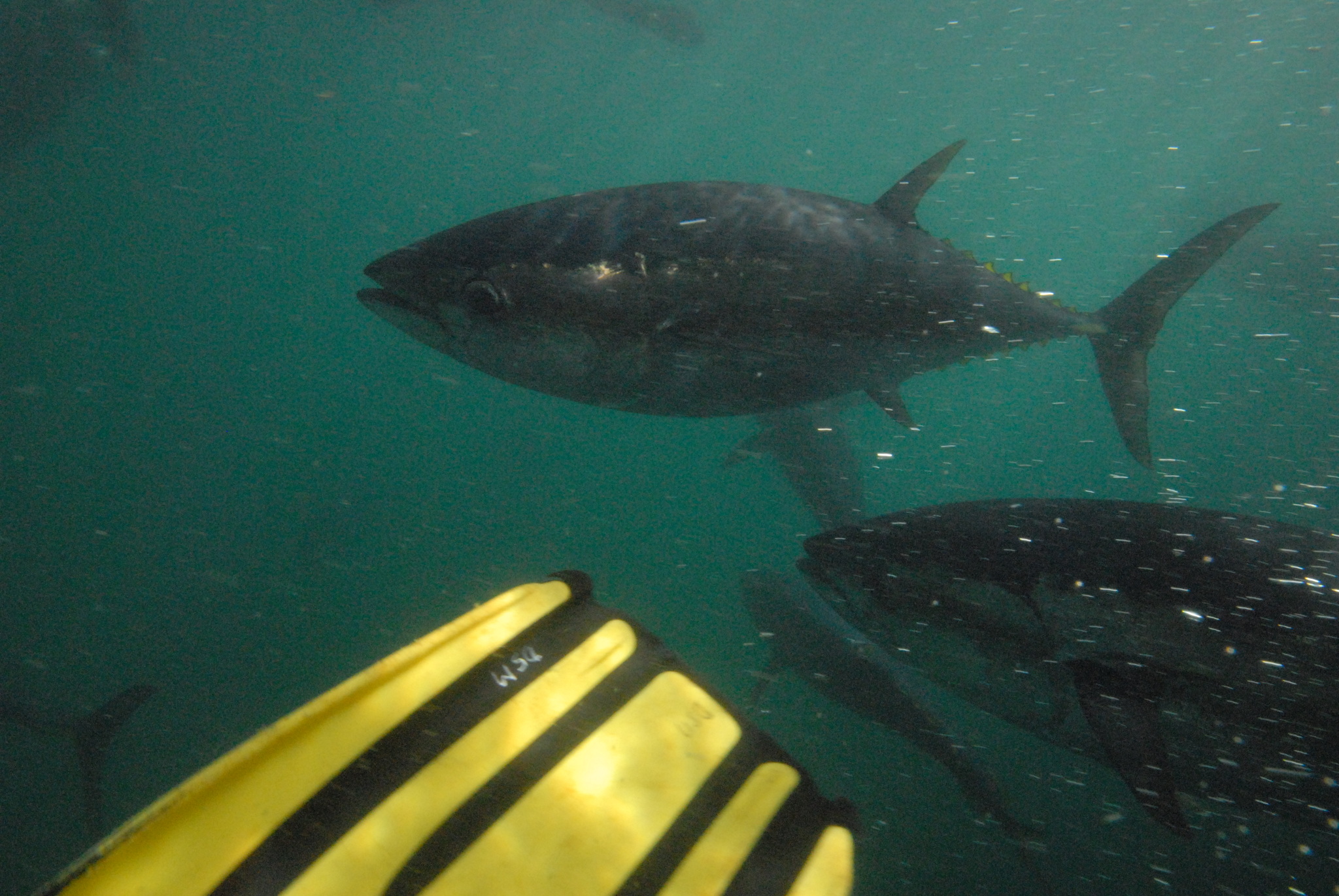
Southern bluefin tuna
Thunnus maccoyii · Scombridae
FishBase puts this species inside a temperate envelope: 5°C to 20°C, 10°S to 60°S. Two lines further down, its spawning grounds are listed between 7°S and 20°S, south of Java, and in the tropical eastern Indian Ocean. Both statements belong to the same record, and neither is a typing error. The first is a climate class applied to the whole page; the second is a list of dated observations.
- Family
- Scombridae
- Max length
- 245 cm FL
- Max weight
- 260 kg
- Max age
- 20 years
- Depth
- 0–2743 m
- IUCN
- EN
- Climate
- Temperate · 5–20 °C
- Diet
- crustaceans, fishes, molluscs
FishBase puts this species inside a temperate envelope: 5°C to 20°C, 10°S to 60°S. Two lines further down, its spawning grounds are listed between 7°S and 20°S, south of Java, and in the tropical eastern Indian Ocean. Both statements belong to the same record, and neither is a typing error. The first is a climate class applied to the whole page; the second is a list of dated observations. Read as one claim, they describe a fish that spawns below its own temperature floor. This article keeps the two apart instead of choosing a winner.
Techniques
- Trolling —
- Jigging —
Seasonality
Other NZ-SE regulations
Same jurisdictionBefore you keep a fish
- Read the recorded value. It is copied from the notice; if the number and the notice disagree, the notice wins.
- Check the area. Federal, state and local waters can set different limits for the same fish.
- Check the date. Seasons, quotas and closures change; confirm the current notice before you go.
Common questions
- What is the bag limit for Southern bluefin tuna in New Zealand — South East?
- 1 fish per fisher per day
- Where does this regulation apply?
- New Zealand — South-East fishing area
- When was it checked?
- 2026-11-18, against MPI — South-East area fishing rules.
- Do other jurisdictions set different limits?
- Yes. This register lists 2 jurisdictions for Southern bluefin tuna; compare them in the table above.