
Bigeye tuna in Spain: ≥3.2 kg — Spain — Cantabrian/Northwest, Gulf of Cadiz and Canary Islands.
| Patudo (Thunnus obesus) | 3,2 kg |
Quoted from Real Decreto 560/1995 — tallas mínimas (texto consolidado, actualizado 1 November 2025)
Recreational bigeye requires a specific Spanish authorisation. The 1999 order sets a piece allowance of 5 fish per licence per day and 20 per boat per day while the fishery is open, with a daily declaration.
Regulation guide
Official sourcesHow bigeye tuna is managed in Spain
Bigeye tuna, Thunnus obesus, is patudo in Spanish. It is one of the tunas that Spain regulates by weight rather than by length, and it appears both in the national size schedule (Real Decreto 560/1995) and in the recreational framework (Real Decreto 347/2011).
In the Atlantic the stock is managed internationally by ICCAT, and Spain implements those measures through national rules. For a recreational angler the practical consequence is that bigeye is not an ordinary licensed catch: it is listed in Annex II of Real Decreto 347/2011 as a species subject to differentiated protection measures, under the FAO code BET.
The recreational framework divides Spanish external waters into four zones: Cantabrian and Northwest, Gulf of Cadiz, Mediterranean and Canary. The size schedule uses the same division, and bigeye appears in two of the three annexes.
Source: BOE: Real Decreto 560/1995, tallas mínimas · BOE: Real Decreto 347/2011, pesca marítima de recreo (Annex II)
3.2 kg in the Atlantic and the Canary Islands
Annex I of the size decree, which covers the Cantabrian and north-west grounds and the Gulf of Cadiz, lists Patudo (Thunnus obesus) at 3.2 kg. Annex III, the Canary table, repeats the same figure and adds the local name Tuna.
Annex II, the Mediterranean table, has no patudo row at all. It lists bluefin at 80 cm or 10 kg, but bigeye is absent, so the Spanish size tables give no Mediterranean bigeye figure.
The 3.2 kg therefore applies in the Spanish Atlantic and in the Canary Islands. The current database entry names only the Cantabrian, northwest and Gulf of Cadiz area, which understates where the figure is written into Spanish law.
Source: BOE: Real Decreto 560/1995, annexes I and III · BOE: Real Decreto 560/1995, annex II (Mediterráneo)
Why the limit is a weight
The Spanish tables express the bigeye limit in kilograms, not centimetres. The check at the boat is therefore a weighing, and the figure refers to the fish as landed rather than to a length that can be read off a measuring board.
Weigh the fish whole and before gutting. Gilling, gutting or cutting a tuna changes the weight that the rule is written against, and an inspector will weigh what is on board rather than reconstruct what the fish weighed at capture.
The same logic runs through the other tuna rows in Annex I: bluefin is listed at 6.4 kg and yellowfin at 3.2 kg. The Spanish schedule treats these as weight limits, and the recreational angler needs a scale rather than a ruler.
Source: BOE: Real Decreto 560/1995, annex I · BOE: Real Decreto 560/1995, article 3 (prohibiciones)
What ICCAT says, and what it does not
ICCAT's current tropical-tuna recommendation, Rec. 24-01, replaces Rec. 22-01 and runs a 15-year rebuilding programme for bigeye tuna from 2020 through 2034. It sets an annual total allowable catch of 73,011 t for 2025 and records that the 2021 assessment found the stock overfished but no longer subject to overfishing.
That recommendation does not set a minimum weight for bigeye. ICCAT's earlier bigeye size-limit recommendation, Rec. 79-01, was replaced in 2004 by a management programme (Rec. 04-01), which dealt with catch limits, capacity and area closures rather than with a size threshold.
The 3.2 kg is therefore the figure written into Spanish law. ICCAT acts through catch limits and quotas, and Spain gives that international layer effect for recreational fishers through the authorisation and declaration system described below.
Source: ICCAT: Recommendation 24-01, tropical tunas · ICCAT: Recommendation 04-01, bigeye tuna programme
The Annex II authorisation
Article 10 of Real Decreto 347/2011 requires a specific authorisation for the capture or keeping on board of any Annex II species. The authorisation is issued by the Secretaría General de Pesca to the holder of the boat, is valid for three years and must be on board while the activity is carried out.
The ministry states that Annex II species may be taken only while the fishery is open or until the quota assigned to recreational fishing has been used up, whichever comes first. That condition applies to every Annex II species, so the state of the fishery and the remaining quota decide whether a bigeye may be kept at all.
Since 20 March 2026 the authorisation is requested through PescaREC, the ministry's mobile application, which the ministry describes as the only channel for these Annex II authorisations.
Source: BOE: Real Decreto 347/2011, article 10 · MAPA: Pesca marítima de recreo, preguntas frecuentes · MAPA: PescaREC
Catch limits: five fish, not five kilos
Bigeye is one of the species listed in Annex III of the recreational order of 26 February 1999, so the general 5 kg limit does not apply to it. For albacore, bigeye and hake together the limit is five pieces per licence per day, with a maximum of 20 pieces per boat per day.
The three species share one allowance. A bigeye kept on a trip therefore reduces the number of albacore or hake that may be kept on the same licence and day, and the boat ceiling counts the group rather than each species separately.
The individual licence and the boat licence still apply on top of the Annex II authorisation. The ministry continues to list the 1999 order among the rules in force alongside the 2011 decree.
Source: BOE: Orden de 26 de febrero de 1999, article 4 · MAPA: Pesca marítima de recreo · BOE: Real Decreto 347/2011, articles 8 and 9
Before you keep a bigeye
Weigh the fish before anything else. In the Cantabrian, northwest, Gulf of Cadiz and Canary zones the floor is 3.2 kg; a fish under that weight must go back, and the Spanish Mediterranean tables give no bigeye size at all.
Check that the Annex II authorisation is on board and in date, that the fishery is open and that recreational quota remains. Without those conditions the fish cannot be retained, whatever its weight.
Declare the capture the same day through PescaREC and keep the fish whole until it has been weighed. Recreational fishing is non-commercial, sale of the catch is prohibited, and retaining an undersized tuna is prohibited under Article 3 of the size decree.
Source: BOE: Real Decreto 560/1995, article 3 · MAPA: PescaREC · BOE: Real Decreto 347/2011, article 1
Official pages: BOE: Real Decreto 560/1995, tallas mínimas · BOE: Real Decreto 347/2011, pesca marítima de recreo · BOE: Orden de 26 de febrero de 1999, pesca marítima de recreo · MAPA: Pesca marítima de recreo · MAPA: PescaREC · ICCAT: Recommendation 24-01, tropical tunas
Bigeye tuna regulations at a glance
1 jurisdictions| Jurisdiction | Area | Size | Bag | Season / closure | Closed area | Other |
|---|---|---|---|---|---|---|
| Spain | Spain — Cantabrian/Northwest, Gulf of Cadiz and Canary Islands | ≥3.2 kg | — | — | — | — |
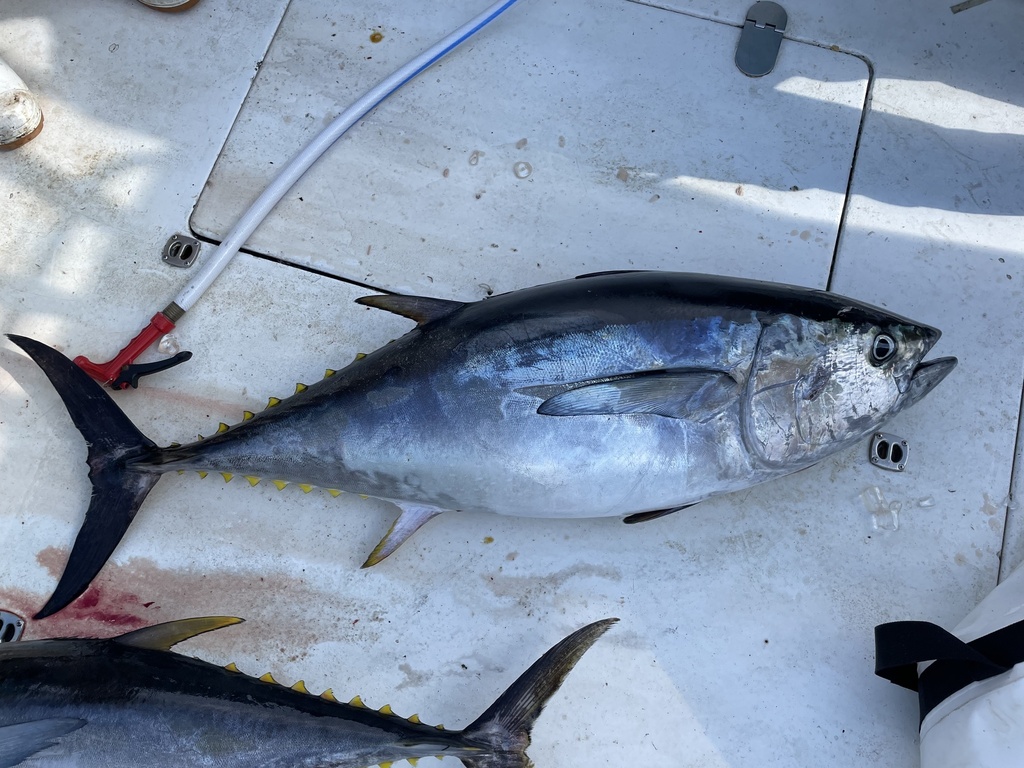
Bigeye tuna
Thunnus obesus · Scombridae
Bigeye tuna is a large scombrid of tropical and subtropical waters in the Atlantic, Indian and Pacific oceans, including the Mediterranean. It lives from the surface to 1,500 m, reaches 250 cm TL and 210 kg, can live 17 years, and feeds on crustaceans, fish and molluscs. Trolling or jigging is the usual approach, and it is present year-round.
- Family
- Scombridae
- Max length
- 250 cm TL
- Max weight
- 210 kg
- Max age
- 17 years
- Depth
- 0–1500 m
- IUCN
- VU
- Climate
- Subtropical · 13–29 °C
- Diet
- crustaceans, fishes, molluscs
Bigeye tuna (Thunnus obesus) is a fish of the family Scombridae. FishBase gives its range as: Atlantic, Indian and Pacific: in tropical and subtropical waters. Absent in the Mediterranean. It is recorded from 0 to 1500 m, in subtropical water at 13–29 °C. The recorded maxima are 250 cm TL, 210 kg, 17 years. Common length is recorded at 180 cm. Diet includes crustaceans, fishes and molluscs. IUCN status: Vulnerable (VU). Chinese name: .
Techniques
- Trolling —
- Jigging —
Seasonality
Other ES regulations
Same jurisdictionBefore you keep a fish
- Read the recorded value. It is copied from the notice; if the number and the notice disagree, the notice wins.
- Check the area. Federal, state and local waters can set different limits for the same fish.
- Check the date. Seasons, quotas and closures change; confirm the current notice before you go.
Common questions
- What is the minimum size for Bigeye tuna in Spain?
- ≥3.2 kg
- Where does this regulation apply?
- Spain — Cantabrian/Northwest, Gulf of Cadiz and Canary Islands
- When was it checked?
- 2026-11-18, against Real Decreto 560/1995 — tallas mínimas (texto consolidado, actualizado 1 November 2025).