
Pacific bluefin tuna in Japan — national: Report catch to the fishery authority within 1 day of landing, by the angler — All Japanese waters.
Reporting is done through the national web/LINE reporting site or by e-mail using the prescribed form.
Regulation guide
Official sourcesOne Pacific stock, two management systems
Pacific bluefin tuna (Thunnus orientalis) is a single Pacific-wide stock fished by many nations. Two international bodies coordinate management: the Inter-American Tropical Tuna Commission and the Western and Central Pacific Fisheries Commission. NOAA Fisheries implements their conservation and management measures for U.S. fleets under the relevant highly migratory species plans.
The stock was determined to be overfished in 2013. Domestic and international measures followed, and NOAA states that the stock was determined to be rebuilt in 2024. The 2024 stock assessment found it not overfished and not subject to overfishing.
Japan manages its recreational catch inside the national allocation set through the regional fishery management process. The Japanese rules and the U.S. West Coast rules below are separate systems; a limit that applies in one does not carry over to the other.
Source: NOAA Fisheries: Pacific Bluefin Tuna · Japan Fisheries Agency: クロマグロ遊漁の部屋
Japan: the rules cover every recreational angler
Japan's recreational bluefin rules apply to all recreational fishing for the species, whether from a charter boat, a private boat or the shore, including breakwaters. The Fisheries Agency states that the rules are not limited to commercial fishermen or to one type of boat.
From April 2026, a notification system applies. Anglers and vessels that fish for bluefin must submit a notification once a year; it is not a notification for every trip. Charters and pleasure boat operators were given a filing deadline in March 2026 for the initial round.
The notification is separate from the catch report for each landed large fish.
Source: Japan Fisheries Agency: クロマグロ遊漁の部屋 · Japan Fisheries Agency: くろまぐろ遊漁に関する規制の内容
Japan: 30 kg is the dividing line
Japanese recreational rules divide bluefin into large fish of 30 kg or more and small fish under 30 kg. Small fish may not be taken at all, and the Fisheries Agency states that this prohibition applies even when the angler intends to release the fish. There is no catch-and-release exception for fish under 30 kg.
If there is no scale on board and the fish might weigh less than 30 kg, the official guidance is to release it. Landing a fish that turns out to be under 30 kg is a violation of the regional fisheries adjustment commission instruction.
For large fish, the bag limit changed in April 2026 to one fish per person per period. The periods are April–May, June–July, August–September, October–November, December–January and February–March.
Source: Japan Fisheries Agency: クロマグロ遊漁の採捕規制に関するQ&A · Japan Fisheries Agency: クロマグロ遊漁の部屋
Japan: report the catch within one day
A recreational angler who lands a large bluefin must report the catch within one day of landing. The Fisheries Agency states that the report must be made by the person who caught the fish, not by the boat operator on the angler's behalf.
Reports can be filed through the online reporting site, including a LINE-based route and a form that does not require a login. If the online system cannot be used, a paper reporting form can be sent by email.
The report includes the weight and the length measurement required by the form (尾さ長), with a photograph showing the fish beside a tape or another object of known size. Weight is normally reported before the gills and viscera are removed; if they have been removed, the report must say so. Personal identification and vessel details are also required. Released fish do not have to be reported, but the reporting form allows them to be included.
Source: Japan Fisheries Agency: 採捕報告の方法について · Japan Fisheries Agency: クロマグロ遊漁の採捕規制に関するQ&A
Japan: period caps and closure days
Japan does not manage recreational bluefin only with a bag limit. It sets a recreational catch cap for large fish and divides that cap across the periods. For the 2026 fiscal year the overall recreational cap is 51.4 tonnes, with period caps that fall from 4.2 tonnes in April to 2.3 tonnes from September onward.
When a period cap is likely to be reached, the Fisheries Agency publishes a closure. In 2026 the published closures included 5–30 April, 24–31 May, 3–30 June, 3–31 July and 25–31 August.
During a closure, fishing that targets bluefin is prohibited even if the angler intends to release the fish. If a bluefin is hooked while fishing for another species, it must be released immediately. From July 2026, a published closure takes effect the day after it appears on the Fisheries Agency website, so the page needs to be checked before a trip.
Source: Japan Fisheries Agency: クロマグロ遊漁の部屋 · Japan Fisheries Agency: クロマグロ遊漁の採捕規制に関するQ&A
U.S. EEZ off California: two fish per trip
The U.S. federal rule is separate from Japan's system. In the U.S. Exclusive Economic Zone off California, south of a line running due west from the California–Oregon border at 42 degrees north, a recreational fisherman may take and retain, or possess on board, no more than two bluefin tuna during any part of a fishing trip.
The federal bag limits are applied on the basis of each 24-hour period at sea, regardless of how many trips are made in a day, and no person may take more than one daily bag limit in a calendar day. Boat limits apply, so anglers aboard a vessel may continue fishing until the combined daily limits for all licensed and juvenile anglers are reached, subject to any stricter state rule.
Filleting rules also apply. South of Point Conception, any tuna that has been filleted must be individually bagged, the bag must be marked with the species name, and the fish must be cut into six pieces with all skin attached: the four loins, the collar with both pectoral fins, and the belly with the vent and both pelvic fins.
Source: 50 CFR 660.721: Recreational fishing bag limits and filleting requirements
Before you keep a Pacific bluefin
In Japan, check the current period, the current closure notice and the notification requirement before leaving. Weigh the fish before deciding to keep it; if it may be under 30 kg, release it. Report a retained large fish within one day of landing, from the angler's own account, with the weight, tail measurement and photograph.
In the U.S. EEZ off California, the federal trip limit is two bluefin, applied per 24-hour period at sea, with boat limits and a one-daily-bag-limit ceiling per calendar day. California may impose stricter rules, and the federal regulation does not override a more restrictive state measure.
Do not blend the two systems. A Japanese bag limit or reporting duty does not apply to a fish landed in California, and the U.S. two-fish trip limit has no bearing on a fish taken in Japanese waters.
Source: Japan Fisheries Agency: クロマグロ遊漁の部屋 · Japan Fisheries Agency: 採捕報告の方法について · 50 CFR 660.721: Recreational fishing bag limits and filleting requirements
Official pages: Japan Fisheries Agency: クロマグロ遊漁の部屋 · Japan Fisheries Agency: くろまぐろ遊漁に関する規制の内容 · Japan Fisheries Agency: 採捕報告の方法について · Japan Fisheries Agency: クロマグロ遊漁の採捕規制に関するQ&A · NOAA Fisheries: Pacific Bluefin Tuna · 50 CFR 660.721: Recreational fishing bag limits and filleting requirements
Pacific bluefin tuna regulations at a glance
3 jurisdictions| Jurisdiction | Area | Size | Bag | Season / closure | Closed area | Other |
|---|---|---|---|---|---|---|
| Japan — national | All Japanese waters | ≥30 kg · fish under 30 kg may not be taken, even catch-and-release | — | — | — | Reporting: Report catch to the fishery authority within 1 day of landing, by the angler |
| Japan — national | All Japanese waters (Pacific, Sea of Japan/Kyushu west, Seto Inland Sea) | — | 1 large fish (≥30 kg) per person per period · Apr–May, Jun–Jul, Aug–Sep, Oct–Nov, Dec–Jan, Feb–Mar | — | — | — |
| United States — federal (Pacific) | U.S. EEZ off California | — | 2 fish per person per trip | — | — | — |
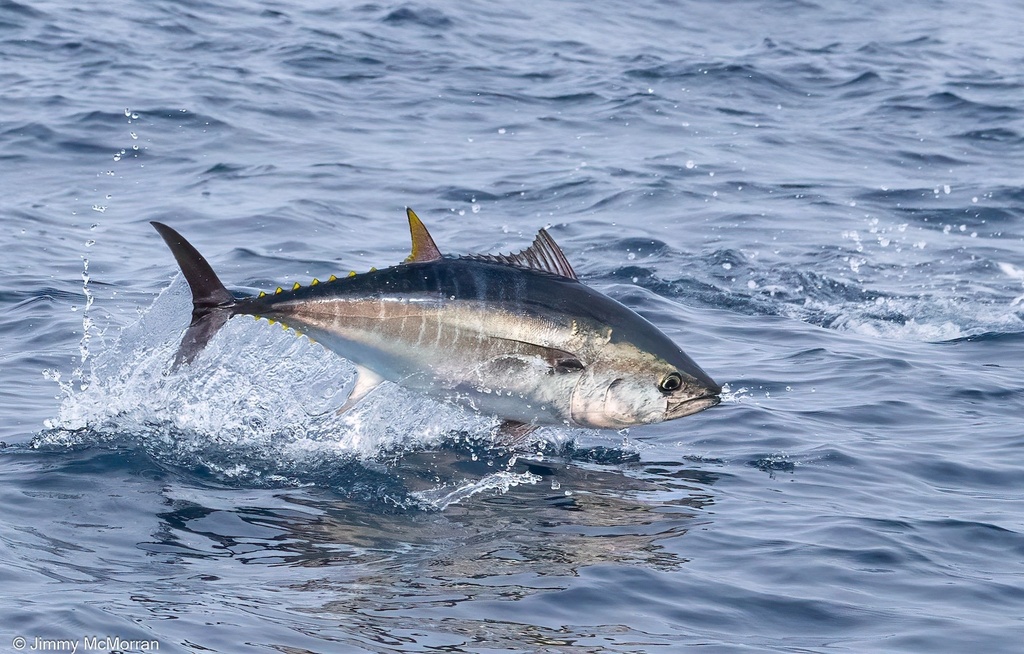
Pacific bluefin tuna
Thunnus orientalis · Scombridae
Pacific bluefin tuna, a member of the family Scombridae, is found across the North Pacific, from Gulf of Alaska to southern California and Baja California and from Sakhalin Island in the southern Sea of Okhotsk south to northern Philippines. Its depth range is from 1 to 550 m, in subtropical seas. It grows to 300 cm FL and 450 kg, with a diet of fishes. The standard approach is trolling, jigging or live bait. The season runs April to August.
- Family
- Scombridae
- Max length
- 300 cm FL
- Max weight
- 450 kg
- Max age
- 15 years
- Depth
- 1–550 m
- IUCN
- NT
- Climate
- Subtropical
- Diet
- fishes
Pacific bluefin tuna (Thunnus orientalis) is a fish of the family Scombridae. FishBase gives its range as: North Pacific: Gulf of Alaska to southern California and Baja California and from Sakhalin Island in the southern Sea of Okhotsk south to northern Philippines. There are four substantiated records of this subspecies in the southern hemisphere: off Western Australia, southeast Pacific (37°11'S, 114°41'W) and Gulf of Papua. It is recorded from 1 to 550 m, in subtropical water. The recorded maxima are 300 cm FL, 450 kg, 15 years. Diet includes fishes. IUCN status: Near Threatened (NT). Chinese name: .
Techniques
- Trolling —
- Jigging —
- Live bait —
Seasonality
Other JP-NATIONAL regulations
Same jurisdictionBefore you keep a fish
- Read the recorded value. It is copied from the notice; if the number and the notice disagree, the notice wins.
- Check the area. Federal, state and local waters can set different limits for the same fish.
- Check the date. Seasons, quotas and closures change; confirm the current notice before you go.
Common questions
- What is the reporting for Pacific bluefin tuna in Japan — national?
- Report catch to the fishery authority within 1 day of landing, by the angler
- Where does this regulation apply?
- All Japanese waters
- When was it checked?
- 2026-11-18, against www.jfa.maff.go.jp.
- Do other jurisdictions set different limits?
- Yes. This register lists 3 jurisdictions for Pacific bluefin tuna; compare them in the table above.