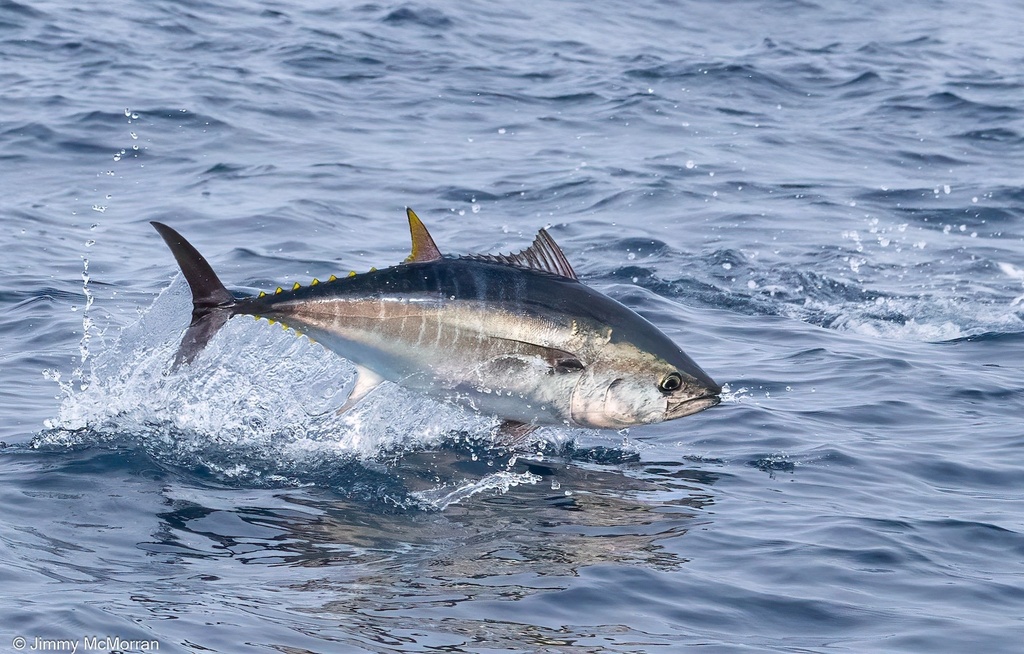
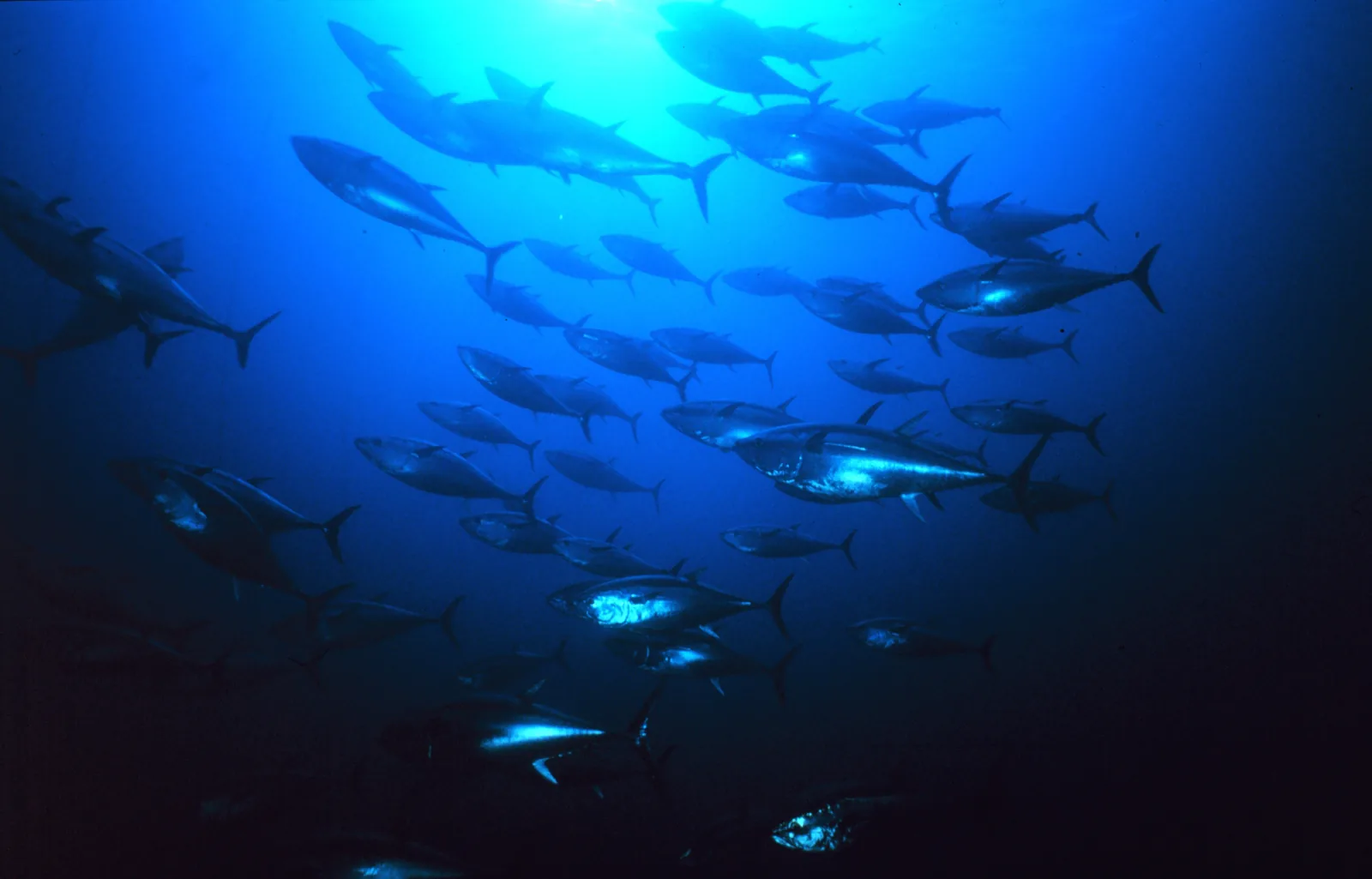
Pacific bluefin tuna (Thunnus orientalis) is a fish of the family Scombridae. FishBase gives its range as: North Pacific: Gulf of Alaska to southern California and Baja California and from Sakhalin Island in the southern Sea of Okhotsk south to northern Philippines. There are four substantiated records of this subspecies in the southern hemisphere: off Western Australia, southeast Pacific (37°11'S, 114°41'W) and Gulf of Papua. It is recorded from 1 to 550 m, in subtropical water. The recorded maxima are 300 cm FL, 450 kg, 15 years. Diet includes fishes. IUCN status: Near Threatened (NT). Chinese name: .
The two numbers at the top
FishBase also gives a maximum reported age of 15 years. There is no maturity length, no maturity range and no common weight. So the page contains a ceiling, a typical adult size and a lifespan, and nothing that divides the size range into ages. A 300 cm fish is not simply an older 200 cm fish; the record does not support that reading. What it supports is a gap: the species reaches a size well beyond the one the database uses to describe it.
What "common" means here
Common length is a database field, not a landing statistic. It is the length FishBase uses for a typical adult of the species, and it is the number to plan around when asking what a hooked fish will look like. A 200 cm bluefin is already a large animal, and the 300 cm ceiling sits 100 cm beyond it. On a boat that difference is not cosmetic: it changes the rod, the leader, the fight time and what happens at the rail.
A hundred centimetres is not a hundred centimetres
A fish grows in three dimensions, so the weight gap between 200 cm and 300 cm is far larger than the length gap suggests. That is geometry rather than a measurement, but it explains why the record fish dominates photographs while the common fish dominates encounters. The published 450 kg belongs to the top of the range. No common weight is recorded, so any "average bluefin weighs X" statement is outside this source.
What the record map shows
GBIF's 1,025 preserved occurrences are led by Japan (300), Australia (220), New Zealand (202), the United States (70) and Taiwan region (66). That is a map of specimens and observations, not a map of fish sizes. It shows where material has been collected, and it explains why the species looks abundant in some national datasets: the record reflects sampling effort as much as fish density. The 1,025 has no length column you can average.
The southern edge is a visit, not a population
The distribution text is explicit that the species occurs mainly in the northern Pacific, with four substantiated southern-hemisphere records and a seasonal presence in New Zealand for at least three months in spring and early summer. Four records are individuals, not a stock. The New Zealand figure of 202 GBIF occurrences shows how quickly a seasonal visitor can dominate a national dataset, and the two statements are compatible: a handful of fish, sampled repeatedly, can look like a range. For planning, the southern edge is a seasonal opportunity, not a resident fishery.
Gear for the common fish
Trolling, jigging and live bait are the recorded approaches, all suited to a roaming pelagic fish. The 200 cm common length is a better basis for tackle than the 300 cm maximum. A rod that handles the common fish most of the time and is backed off for the rare giant is a more useful compromise than gear chosen for the record. The 450 kg ceiling is also a handling problem: a fish of that size is a boat-side decision about release, safety and what the law allows, not a trophy photograph.
A fifteen-year life and a missing maturity figure
The maximum reported age is 15 years, and the maturity fields are empty. That combination removes the usual age-based argument: you cannot say a 200 cm fish is a certain number of years old, or that a 300 cm fish is a survivor of a particular year class. The blank also blocks a common management shortcut, because a minimum size cannot be tied to the age at which the stock first reproduces when no maturity length is recorded. Age and length are separate records here, and the page should not fuse them. The one safe statement is that 15 years is brief for an animal that reaches 300 cm, which makes each adult a slow-replaced investment in a fast turnover.
The stock, not the record
The IUCN category is NT (Near Threatened), assessed 15 January 2021, and the uses field marks the fishery as highly commercial and also records commercial aquaculture and gamefish status. The record fish and the stock are managed on different scales. A 450 kg specimen is a data point; the stock is the thing regulations are written about. The same page that supplies the 300 cm ceiling supplies a category saying the population is not secure. Read together, they argue for treating the maximum as a boundary, not a target. An angler who keeps the first legal fish and releases the exceptional one is acting on that reading, whether or not the rule says so.
How to catch it
Trolling
Trolled from a moving boat; suits roaming or pelagic species.
Jigging
Vertical jigging over the recorded depth range.
Live bait
Live bait presented where the fish is likely to feed.
Regulations before you keep it
These are the published regulations for this fish. Read the number first. The notice below it is the actual regulation.
Minimum size1
≥30 kg · fish under 30 kg may not be taken, even catch-and-release
Japan — national · JP-NATIONAL
Pacific bluefin tuna under 30 kg may not be taken at all; large fish (30 kg or more) may be released during open periods but not while a closed period is in force.
Incidental bluefin caught while targeting other species may be released immediately.
Bag limit2
1 large fish (≥30 kg) per person per period · Apr–May, Jun–Jul, Aug–Sep, Oct–Nov, Dec–Jan, Feb–Mar
Japan — national · JP-NATIONAL
Recreational anglers in Japan may take one large Pacific bluefin tuna (30 kg or more) per person in each two-month period.
Applies to boat fishing, pleasure boats and shore fishing alike.
2 fish per person per trip
United States — federal (Pacific) · US-FED-PAC
A recreational angler may take, retain or possess no more than two Pacific bluefin tuna during any part of a fishing trip in the U.S. EEZ off California.
A recreational fisherman may take and retain, or possess on board no more than two bluefin tuna during any part of a fishing trip that occurs in the U.S. EEZ off California south of a line running due west true from the California—Oregon border [42°00′ N. latitude].
Reporting1
Report catch to the fishery authority within 1 day of landing, by the angler
Japan — national · JP-NATIONAL
An angler who lands a large Pacific bluefin tuna must report the catch personally within one day of landing.
Reporting is done through the national web/LINE reporting site or by e-mail using the prescribed form.
Every record above names its source and the date it was retrieved. See the regulation register for the full list, or how to read these regulations.
Where these facts come from
Check these pages before you rely on a size, range or protection status.
-
FishBase — Thunnus orientalis
— FishBase · T2
-
GBIF — Thunnus orientalis occurrence records
— GBIF · T2
-
IUCN Red List — Thunnus orientalis
— IUCN · T1
-
Photo record — iNaturalist
— iNaturalist · T3