
Blue jack mackerel in Portugal: ≥15 cm — Portugal (mainland).
Carapau-negrão (Trachurus picturatus) | 15 cm (b)
Quoted from DGRM — Tabela de Tamanhos Mínimos de Captura
The 15 cm figure comes from the genus row for Trachurus spp. Portugal's table removes the minimum size for blue jack mackerel in Azorean waters.
Regulation guide
Official sourcesHow blue jack mackerel is managed in Portugal
Blue jack mackerel, Trachurus picturatus, is carapau-negrão in Portuguese. The Portuguese minimum-size table does not give it a row of its own; the species is covered by the genus entry for carapau, Trachurus spp.
That table is issued by DGRM under Portaria n.º 255/2022 and refers to Regulation (EU) 2019/1241. The recreational framework is Portaria n.º 14/2014, which adopts the commercial minimum sizes for recreational catches and sets the daily weight limits.
The result is a two-step rule that an angler has to follow: find the carapau row in the DGRM table, then read the footnotes, because several of them qualify the 15 cm figure.
Source: DGRM: Tabela de Tamanhos Mínimos de Captura (26/02/2026) · Portaria n.º 14/2014, de 23 de janeiro, regime da pesca lúdica
15 cm comes from a genus row
The DGRM table lists Carapau (Trachurus spp.) at 15 cm, with footnotes (a), (c) and (d). The entry is written at genus level, so it covers Trachurus trachurus, Trachurus mediterraneus and Trachurus picturatus alike.
A separate footnote names Trachurus picturatus directly, using the Portuguese name carapau-negrão. That is the only place in the table where the species is singled out, and it does so to create an exception rather than a size of its own.
For a fish taken in mainland Portugal the operative figure is therefore 15 cm. The species-level database value is correct, but the legal source is a genus row rather than a species row.
Source: DGRM: Tabela de Tamanhos Mínimos de Captura (26/02/2026), footnote (d)
The footnotes are commercial allowances
Footnote (a) allows a 10% tolerance by live weight for sardine, anchovy, herring, mackerel and horse mackerel below the conservation reference size in commercial landings. It is written in terms of what a vessel may keep on board or land, not what an angler may keep.
Footnote (c) fixes 12 cm for horse mackerel caught in ICES division 8c and subarea 9, for 5% of the Spanish and Portuguese quotas, with a further 1% of the Portuguese quota available below 12 cm to the xávega artisanal fishery in division 9a. Those are quota-management facilities for commercial fleets.
None of these allowances creates a recreational tolerance. A recreational angler fishing mainland Portugal has no 10% margin and no 12 cm alternative; the figure is 15 cm, measured on the whole fish.
Source: DGRM: Tabela de Tamanhos Mínimos de Captura (26/02/2026), footnotes (a) and (c)
The Azores exception
Footnote (d) states that no minimum conservation reference size applies to carapau-negrão (Trachurus picturatus) caught in the waters adjacent to the Azores archipelago under Portuguese sovereignty or jurisdiction.
The exception is geographic and written for that species alone. It does not travel to the mainland, where the genus row continues to apply.
An angler fishing the Azores should therefore check which carapau is on the line before applying a size. On the mainland the question does not arise, because the 15 cm applies to the genus.
Source: DGRM: Tabela de Tamanhos Mínimos de Captura (26/02/2026), footnote (d)
Daily limit, licence and marking
The Portuguese daily limit is 10 kg per practitioner, and the heaviest specimen is not counted. Spearfishing carries a 15 kg limit, also excluding the largest specimen, and a boat with more than three practitioners is capped at 25 kg with one heaviest fish per practitioner excluded.
A licence is required and is held as an electronic record in the DGRM system, checkable by SMS. It can be bought at Multibanco machines, at DGRM and the regional agriculture and fisheries offices, or through the BMar portal, and the fee depends on whether the fishing is on foot, from a boat or underwater.
Fish kept under a recreational licence must be marked before the angler leaves the site or lands, by a cut in the caudal fin of each specimen. The rule applies to the on-foot and boat modes and is designed to separate recreational catch from commercial landings.
Source: Portaria n.º 14/2014, article 12 · DGRM: Pesca Lúdica — Espécies · DGRM: Licenciamento da Pesca Lúdica
How a horse mackerel is measured
The DGRM table states that its values are total lengths, with bracketed values used where a carapace or cephalothorax length applies instead. For horse mackerel there is no bracket, so the figure is a total length.
The measurement runs from the tip of the snout to the end of the caudal fin. A horse mackerel has a deeply forked tail, so the fish must be laid flat and the lobes closed or spread consistently rather than measured to the fork.
Measure before gutting. The size attaches to the intact fish, and a headed or filleted mackerel cannot be checked against a total-length figure.
Source: DGRM: Tabela de Tamanhos Mínimos de Captura (26/02/2026), general notes
Before you keep one
Measure to the end of the tail and discard anything under 15 cm, unless you are fishing Azorean waters for carapau-negrão, where the footnote removes the size.
Weigh the day's catch against the 10 kg limit and remember that only one fish, the heaviest, is excluded. Mark each retained fish with a cut in the caudal fin before landing.
Carry the licence and keep the catch for personal use. Recreational fishing in Portugal is non-commercial and the sale of recreationally caught fish is prohibited.
Source: Portaria n.º 14/2014, de 23 de janeiro · DGRM: Tabela de Tamanhos Mínimos de Captura · Decreto-Lei n.º 246/2000, quadro legal da pesca lúdica
Official pages: Portaria n.º 14/2014: regime da pesca lúdica · DGRM: Tabela de Tamanhos Mínimos de Captura · DGRM: Pesca Lúdica — Espécies · DGRM: Licenciamento da Pesca Lúdica · Decreto-Lei n.º 246/2000, quadro legal da pesca lúdica
Blue jack mackerel regulations at a glance
1 jurisdictions| Jurisdiction | Area | Size | Bag | Season / closure | Closed area | Other |
|---|---|---|---|---|---|---|
| Portugal | Portugal (mainland) | ≥15 cm | — | — | — | — |
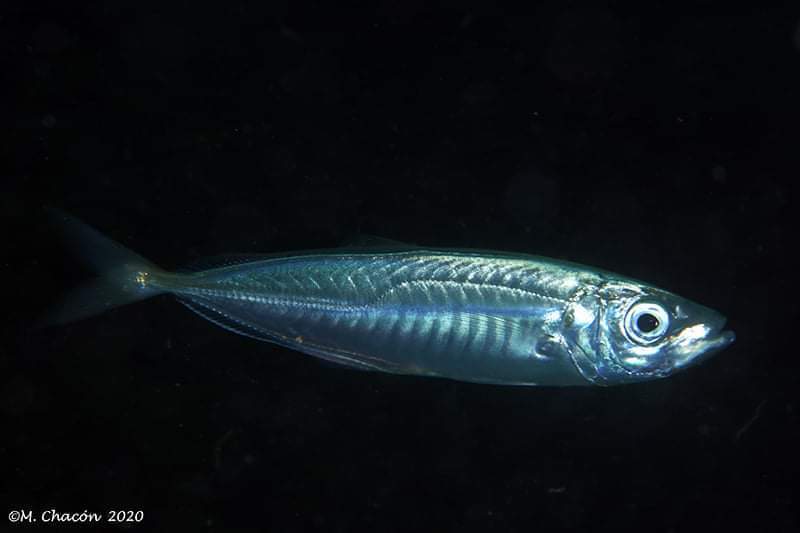
Blue jack mackerel
Trachurus picturatus · Carangidae
The blue jack mackerel is a carangid of the eastern Atlantic, recorded from the southern Bay of Biscay to southern Morocco, including the Azores, Madeira, the Canary Islands, Tristan da Cunha and Gough Island, and from the western Mediterranean; FishBase also lists Mauritania and notes that eastern Mediterranean reports need confirmation.
- Family
- Carangidae
- Max length
- 60 cm TL
- Max age
- 18 years
- Depth
- 170–370 m
- IUCN
- LC
- Climate
- Subtropical
- Diet
- crustaceans
The blue jack mackerel is a carangid of the eastern Atlantic, recorded from the southern Bay of Biscay to southern Morocco, including the Azores, Madeira, the Canary Islands, Tristan da Cunha and Gough Island, and from the western Mediterranean; FishBase also lists Mauritania and notes that eastern Mediterranean reports need confirmation. Maximum length is 60 cm TL, common length 25 cm FL, length at first maturity 24.7 cm with a range of 24–49.5 cm, and maximum reported age 18 years. It is marine, benthopelagic, oceanodromous and subtropical, with a recorded depth range of 170–370 m.
Techniques
- Shore casting —
- Boat fishing —
- Trolling —
Seasonality
Other PT regulations
Same jurisdictionBefore you keep a fish
- Read the recorded value. It is copied from the notice; if the number and the notice disagree, the notice wins.
- Check the area. Federal, state and local waters can set different limits for the same fish.
- Check the date. Seasons, quotas and closures change; confirm the current notice before you go.
Common questions
- What is the minimum size for Blue jack mackerel in Portugal?
- ≥15 cm
- Where does this regulation apply?
- Portugal (mainland)
- When was it checked?
- 2026-11-18, against DGRM — Tabela de Tamanhos Mínimos de Captura.