
Leopard shark in United States — California: 3 fish per person per day · open year-round at all depths — California ocean waters.
The recreational fishery for leopard shark (Triakis semifasciata) is open year-round, at all depths. The daily bag and possession limit is 3 fish with a minimum size limit of 36 inches total length.
Quoted from California Department of Fish and Wildlife — Current California Ocean Recreational Fishing Regulations, Southern Region
Regulation guide
Official sourcesHow leopard shark is managed
Leopard shark (Triakis semifasciata) is managed by the State of California for recreational anglers. The bag, size and season rules sit in section 28.56 of Title 14 of the California Code of Regulations, adopted by the Fish and Game Commission and enforced by the California Department of Fish and Wildlife.
CDFW classifies the leopard shark as part of the groundfish group, which the department describes as more than 90 species that live on or near the bottom of the ocean, with a few exceptions. The classification matters because groundfish rules carry their own conventions for filleting, possession and release.
The species does not appear in the rockfish, cabezon and greenling complex and does not share that complex's bag limit. It carries a standalone limit of its own, with a size rule attached to it.
Source: CDFW: Current California Ocean Recreational Fishing Regulations, Southern Region · 14 CCR § 28.56: Leopard Shark (California Code of Regulations)
Three fish a day
CDFW sets the daily bag and possession limit at three fish. The state's southern California summary states the figure directly: a daily bag and possession limit of 3 fish with a minimum size limit of 36 inches total length.
The regulation treats the daily bag as the possession limit as well. Under the general provisions, no more than one daily bag limit of each kind of fish may be taken or possessed by one person, whether the fish are fresh, frozen or otherwise preserved.
Three is the whole allowance for the species. It is not a sub-bag inside a larger shark limit, and it stands on its own in the regulation.
Source: CDFW: Current California Ocean Recreational Fishing Regulations, Southern Region · CDFW: General Provisions and Definitions (14 CCR)
Thirty-six inches total length
The minimum size is 36 inches total length. A leopard shark shorter than that must be released, regardless of how many fish are already in the bag.
Total length is the measurement basis, not fork length. For a shark this is a meaningful distinction, because the upper lobe of the tail is long and a fish measured to the fork can be several inches shorter than the same fish measured to the end of the tail.
The size limit is a floor. A fish at or above 36 inches total length may be kept, and a shorter fish may not, whatever the bag count happens to be.
Source: CDFW: Current California Ocean Recreational Fishing Regulations, Southern Region · CDFW: General Provisions and Definitions (14 CCR) · 14 CCR § 28.56: Leopard Shark (California Code of Regulations)
Open year-round at all depths
CDFW describes the recreational fishery for leopard shark as open year-round at all depths. There is no winter closure and no depth band that closes the fishery, which is a different structure from the RCG complex and its management-area calendars.
The open-water description is about seasons and depth, not about every closure. Marine protected areas and other closed areas still apply, and a leopard shark taken inside one is a violation even though the statewide season is open.
Because the fishery has no seasonal depth restriction, an angler does not have to plan a leopard shark trip around the 50-fathom line that governs southern California shelf rockfish from July onward.
Source: CDFW: Current California Ocean Recreational Fishing Regulations, Southern Region · CDFW: Summary of Recreational Groundfish Fishing Regulations
Measuring a shark
Total length is the longest straight-line measurement from the tip of the head to the end of the longest lobe of the tail. The tip of the head is the most anterior point on the fish with the mouth closed and the fish lying flat on its side.
The mouth-closed and flat-on-its-side requirements are not optional detail. They fix the two ends of the measurement, and a shark measured with its mouth open or hanging by the tail will not give the number the regulation defines.
A tape laid along the curve of the body will over-read compared with a straight line between the two points. The straight-line distance is what the rule specifies and what an officer will take.
Source: CDFW: General Provisions and Definitions (14 CCR) · CDFW: Current California Ocean Recreational Fishing Regulations, Southern Region
Filleting and possession
Section 28.56 sends anglers to the fillet rules in section 27.65(b), and because no shark-specific entry appears in that list, leopard shark falls under the catch-all for all other species: each fillet must bear intact a one-inch square patch of skin, and the fillets may be of any size.
The skin patch is the identification mark that survives processing. It lets an officer confirm the species of a fillet that no longer has a head or a tail attached to it.
The same section cross-references the descending device rule and states that leopard shark fishing rules may be changed during the year or in season by the department. A printed card or an old summary is not a reliable substitute for the current text.
Source: 14 CCR § 28.56: Leopard Shark (California Code of Regulations) · CDFW: General Provisions and Definitions (14 CCR)
What to check before you keep one
Confirm the licence. A California sport fishing license is required for any person attempting to take fish from ocean waters, and a licence bought for the year runs 365 days from the date of purchase.
Measure the fish flat, with the mouth closed, before it comes aboard. A shark that is close to the line is best left in the water, because a 35-inch fish is a release and a released fish is not a possession problem.
Check the closed-area map for the bay, estuary or beach where you are fishing. The statewide rule is open year-round at all depths, but marine protected areas and other closures remove water, and the leopard shark is a species that is often targeted in exactly the shallow, inshore places where those closures sit.
Source: CDFW: Sport Fishing Licenses and Report Cards · CDFW: Current California Ocean Recreational Fishing Regulations, Southern Region · CDFW: Marine Protected Areas
Official pages: CDFW: Current California Ocean Recreational Fishing Regulations, Southern Region · 14 CCR § 28.56: Leopard Shark (California Code of Regulations) · CDFW: General Provisions and Definitions (14 CCR) · CDFW: Marine Protected Areas · CDFW: Sport Fishing Licenses and Report Cards
Leopard shark regulations at a glance
1 jurisdictions| Jurisdiction | Area | Size | Bag | Season / closure | Closed area | Other |
|---|---|---|---|---|---|---|
| United States — California | California ocean waters | ≥36 in total length | 3 fish per person per day · open year-round at all depths | — | — | — |
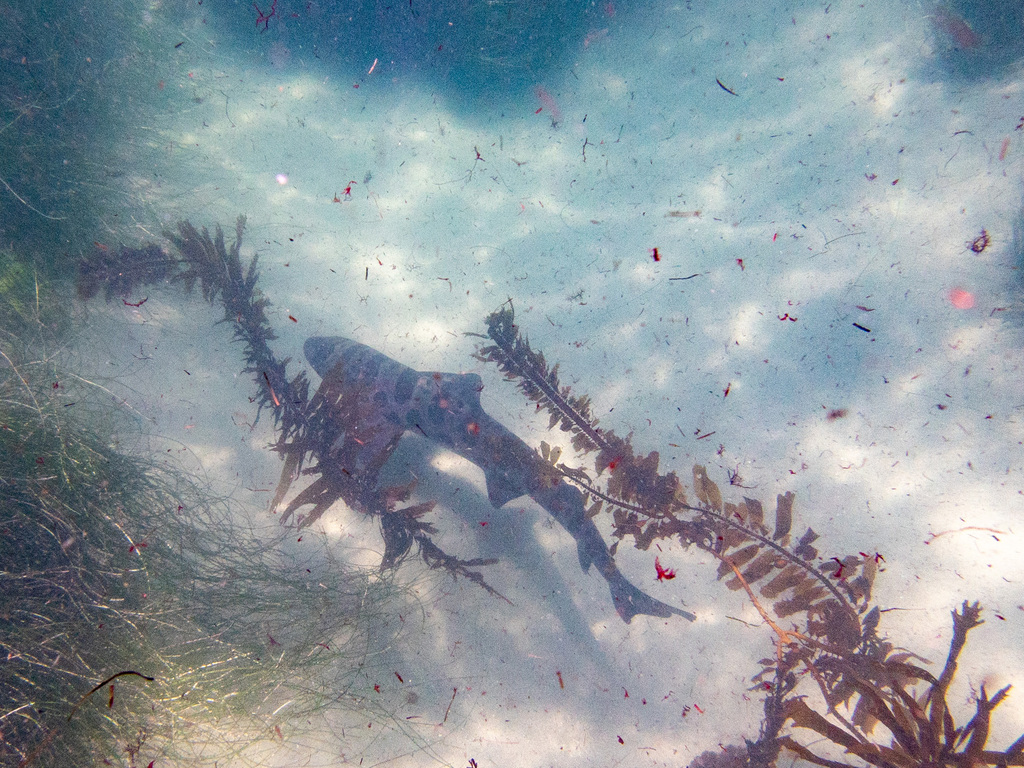
Leopard shark
Triakis semifasciata · Triakidae
FishBase does not publish a fin-ray or vertebral count for this species, so identification rests on shape and pattern. The body is elongate and fusiform with a short, rounded snout. The ground colour is grey-brown, with dark saddle bars across the back and upper flanks and small black spots scattered between and within the bars; juveniles show the strongest contrast.
- Family
- Triakidae
- Max length
- 198 cm TL
- Max weight
- 18.4 kg
- Max age
- 30 years
- Depth
- 0–156 m
- IUCN
- LC
- Climate
- Subtropical
FishBase does not publish a fin-ray or vertebral count for this species, so identification rests on shape and pattern. The body is elongate and fusiform with a short, rounded snout. The ground colour is grey-brown, with dark saddle bars across the back and upper flanks and small black spots scattered between and within the bars; juveniles show the strongest contrast. Among local houndsharks, the bars are broader and more continuous and the spotting is denser. Photograph uncertain fish before release rather than judging by colour alone.
Techniques
- Shore casting —
- Boat bottom fishing —
Seasonality
Other US-CA regulations
Same jurisdictionBefore you keep a fish
- Read the recorded value. It is copied from the notice; if the number and the notice disagree, the notice wins.
- Check the area. Federal, state and local waters can set different limits for the same fish.
- Check the date. Seasons, quotas and closures change; confirm the current notice before you go.
Common questions
- What is the bag limit for Leopard shark in United States — California?
- 3 fish per person per day · open year-round at all depths
- Where does this regulation apply?
- California ocean waters
- When was it checked?
- 2026-11-18, against California Department of Fish and Wildlife — Current California Ocean Recreational Fishing Regulations, Southern Region.