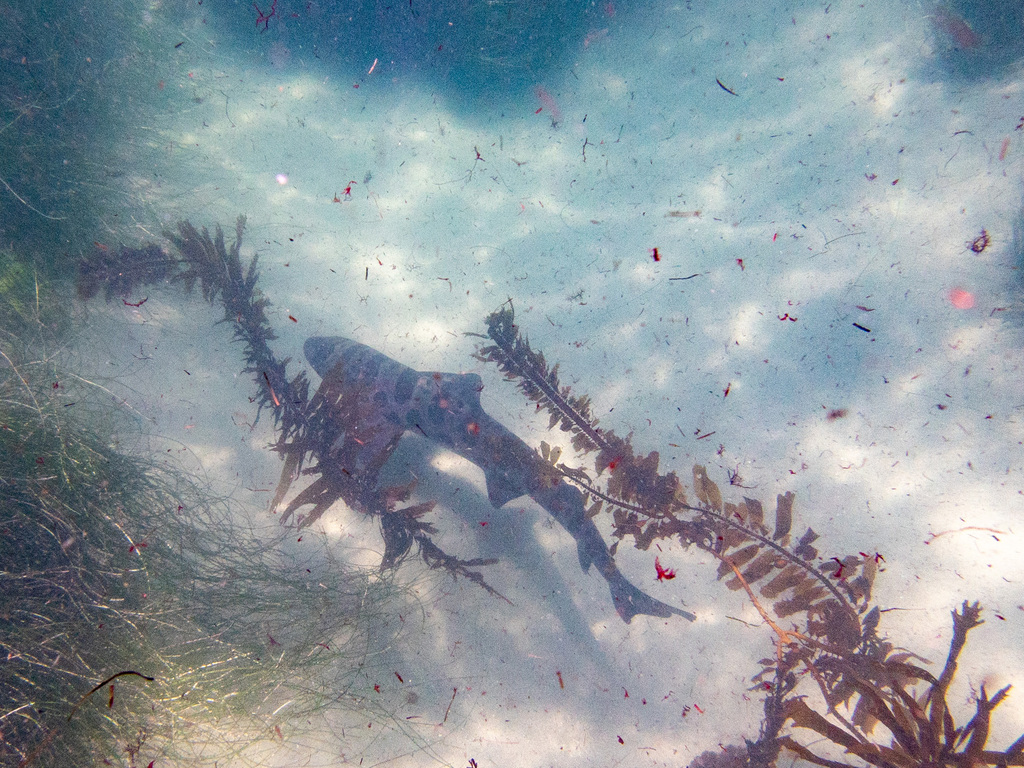
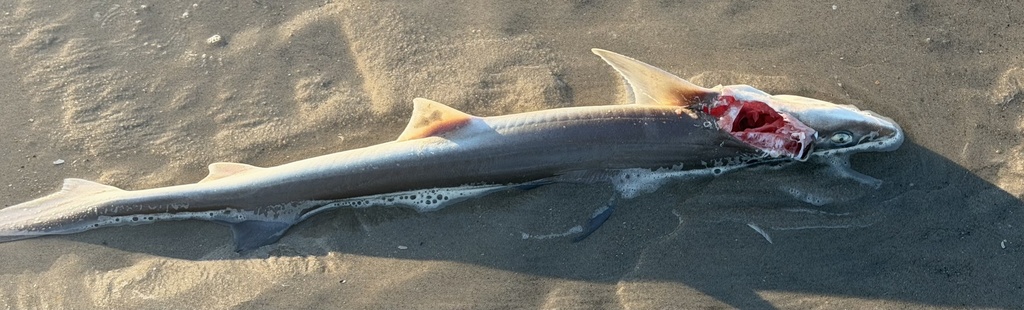
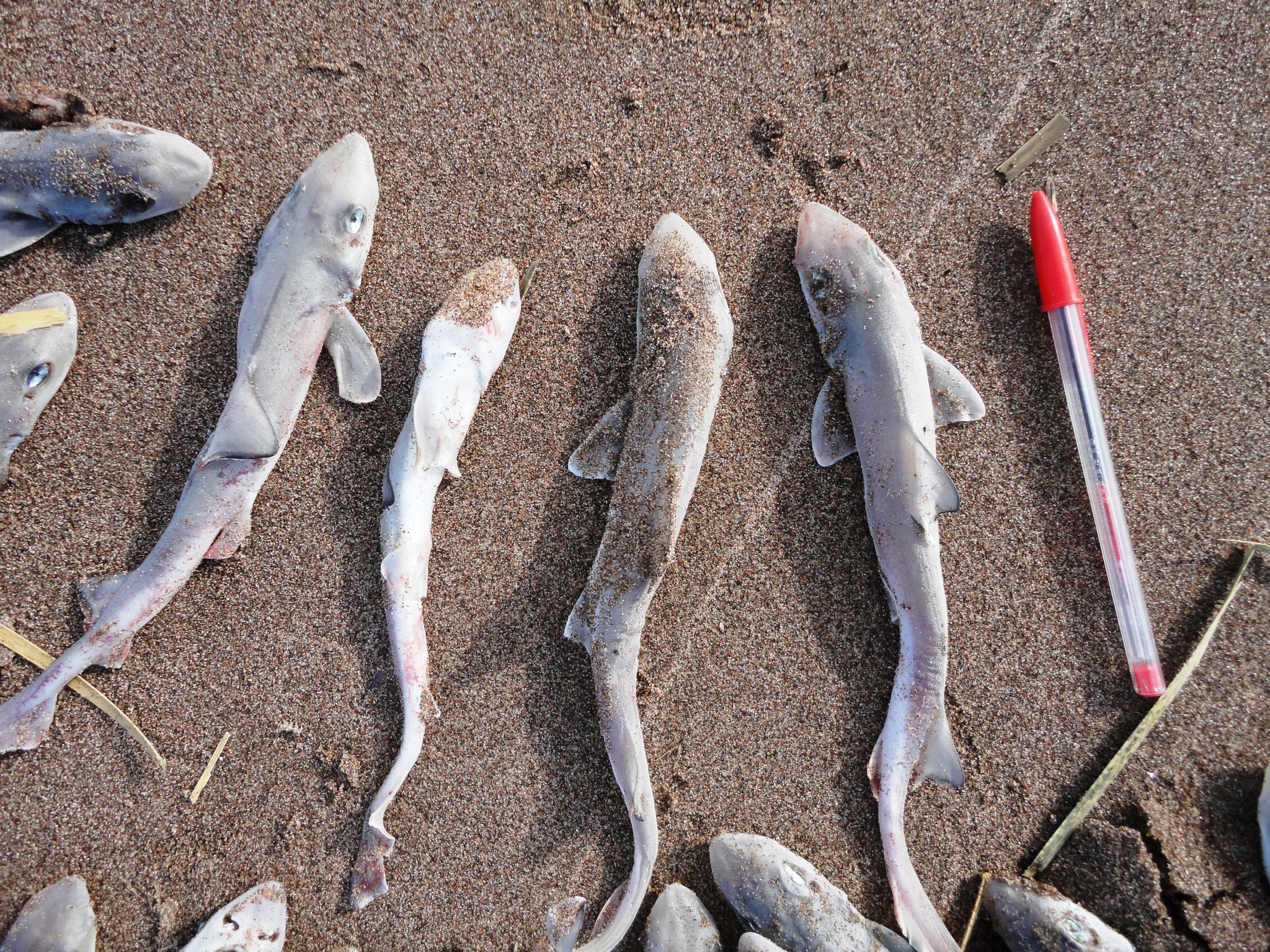
FishBase does not publish a fin-ray or vertebral count for this species, so identification rests on shape and pattern. The body is elongate and fusiform with a short, rounded snout. The ground colour is grey-brown, with dark saddle bars across the back and upper flanks and small black spots scattered between and within the bars; juveniles show the strongest contrast. Among local houndsharks, the bars are broader and more continuous and the spotting is denser. Photograph uncertain fish before release rather than judging by colour alone.
Habitat and behaviour
The recorded range is the eastern Pacific, from Oregon in the United States to the Gulf of California. It is demersal and subtropical, recorded from the surface to 156 m. Bays, estuary mouths, shallow sand flats and the edges of rocky ground all hold fish; juveniles stay in very shallow water while adults range wider. GBIF holds 74631 occurrences, 74405 from the United States and 100 from Mexico, with only single figures elsewhere. That density reflects observer effort on the US west coast, not uniform abundance.
Seasonal window
FishBase records no spawning months for the species. California keeps it open year round and at all depths, so the calendar is not the constraint; water temperature and bait position matter more. In spring and summer fish move into bays and shallows as the water warms, and retreat somewhat deeper in autumn and winter. That movement is an editorial reading. Night and the rising tide are the better windows in shallow water; by day the fish tend to cruise slowly along the bottom.
Gear and approach
Use a medium-heavy long rod from shore, medium braid, an abrasion-resistant fluorocarbon leader, a circle or wide-gap hook, and a sinker matched to the current. From a boat, a boat rod with a slightly heavier leader is enough; the drag does the work. These fish are large and strong, so leave margin in the tackle. Use a wide landing net and support the body rather than lifting by the tail. Check hook placement before cutting anything; remove the hook if possible, otherwise cut close to the hook shank. A long rod also keeps the line clear of the fish's body during the final run, and a rod holder is useful when two baits soak in a bay. In current, a heavier sinker holds better than a longer cast.
Edibility and regulations
Flesh is fair; most anglers release the fish. If kept, bleed, skin and ice it. IUCN status is LC, assessed in 2014, and CITES has not evaluated the species.
California: open year round and at all depths, three per day and three in possession, minimum 36 inches total length; Cowcod Conservation Areas are closed.
British Columbia: grouped with other sharks, zero retention.
Washington: the current shark text was not obtained; check the current notice.
Alaska: general shark rule, one per day, one in possession, two per year with a harvest record; the species is not in its usual range.
Where to look
Distribution and size come from FishBase, occurrences from GBIF and images from iNaturalist. The FishBase summary lacks morphology counts and spawning data, so the pattern description is an editorial synthesis that should be checked against photographs. The California limit is one of the few shark rules confirmed in a public summary; British Columbia and Washington treat the species very differently, so confirm each jurisdiction separately.
How to catch it
Shore casting
Fished with the listed approach, matched to the recorded depth and size.
Boat bottom fishing
Fished with the listed approach, matched to the recorded depth and size.
Regulations before you keep it
These are the published regulations for this fish. Read the number first. The notice below it is the actual regulation.
Minimum size1
≥36 in total length
United States — California · US-CA
California's minimum size for leopard shark is 36 inches total length.
The daily bag and possession limit is 3 fish with a minimum size limit of 36 inches total length.
Bag limit1
3 fish per person per day · open year-round at all depths
United States — California · US-CA
California allows three leopard sharks per person per day, with the fishery open year-round at all depths.
The recreational fishery for leopard shark (Triakis semifasciata) is open year-round, at all depths. The daily bag and possession limit is 3 fish with a minimum size limit of 36 inches total length.
Every record above names its source and the date it was retrieved. See the regulation register for the full list, or how to read these regulations.
Where these facts come from
Check these pages before you rely on a size, range or protection status.
-
FishBase — Triakis semifasciata
— FishBase · T2
-
GBIF — Triakis semifasciata occurrence records
— GBIF · T2
-
IUCN Red List — Triakis semifasciata
— IUCN · T1
-
Photo record — iNaturalist
— iNaturalist · T3