
Swordfish in Portugal: ≥125 cm lower-jaw fork length · 1 fish per vessel per day — Portugal (mainland).
Espadarte (Xiphias gladius) 125 cm. Só é permitida a retenção e descarga de um exemplar, por dia e por embarcação, do conjunto destas espécies.
Quoted from DGRM — Pesca lúdica: espécies e dimensões mínimas
The 25 kg alternative belongs to the commercial table, not the recreational rule.
Regulation guide
Official sourcesHow swordfish is managed
Swordfish (Xiphias gladius) is covered here under two national recreational systems: France, which sets a minimum for the Atlantic, Channel and North Sea, and Portugal, which lists swordfish among its recreational trophy species and links its minimum-size table to an ICCAT recommendation.
France regulates recreational sea fishing through the 2012 ministerial order on minimum sizes and the general provisions of the rural and maritime fishing code. The order applies to recreational fishing from non-commercial vessels, to spearfishing and to fishing on foot on the public maritime domain, and to French-flag pleasure vessels wherever they fish.
Portugal regulates recreational fishing through Portaria n.º 14/2014. Swordfish appears in Annex II, the list of species treated as trophies, which sets a minimum dimension and a maximum number of specimens per vessel per day.
Source: Arrêté du 26 octobre 2012 déterminant la taille minimale ou le poids minimal de capture (pêche maritime de loisir) · Code rural et de la pêche maritime, article R921-83 · Portaria n.º 14/2014, de 23 de janeiro, regime da pesca lúdica
France: 170 cm lower-jaw–fork length
Annex I of the 2012 order sets the swordfish minimum at 170 cm, expressly marked LJFL, in the table for the North Sea, Channel and Atlantic. LJFL is defined at the foot of the table as longueur maxillaire inférieur–fourche: the distance from the lower jaw to the fork of the tail.
The 170 cm entry is not repeated in the Mediterranean table of the same order. That does not mean swordfish is unregulated in the French Mediterranean, but it does mean the 170 cm figure should not be carried across to Mediterranean waters without checking the applicable international and EU measures.
The order applies without prejudice to stricter international, EU or national rules on minimum sizes or weights. Where a stricter measure applies, the stricter figure governs, so 170 cm is a floor for the Atlantic zones covered by the French table rather than a ceiling on protection.
Measuring swordfish: LJFL, not total length
The French table gives the measurement basis in the abbreviation itself. LJFL starts at the tip of the lower jaw, not the tip of the long bill, and ends at the fork of the caudal fin, not at the tip of the upper or lower lobe.
That distinction is material on a swordfish, where the bill can add a large amount to a total-length measurement. A fish that measures 170 cm from the lower jaw to the fork may be well over 170 cm if measured from the bill tip, and the regulation requires the former.
The order's measurement provision refers to the EU rules reproduced in its Annex II. Lay the fish straight, close the mouth, place the zero at the lower jaw and read to the centre of the tail fork. Do not stretch the tail or include the bill.
Portugal: 125 cm and one fish a day
Annex II of Portaria n.º 14/2014 lists espadarte (Xiphias gladius) with a minimum dimension of 125 cm. Footnote (a) to the table defines the measurement as total length from the tip of the lower jaw to the caudal bifurcation, which is the same lower-jaw–fork basis used by France.
The same annex limits retention and landing to one specimen per day per vessel for the group of billfish species in the table, which includes blue marlin, white marlin, longbill spearfish, roundscale spearfish and Mediterranean spearfish. Swordfish is part of that group, so a vessel that keeps a swordfish has used the group allowance for the day.
The recreational rule is a trophy rule: the fish must reach the minimum dimension before retention, and the daily count is by vessel rather than by angler. Retaining a second swordfish on the same boat on the same day is not permitted.
Source: Portaria n.º 14/2014, de 23 de janeiro, regime da pesca lúdica · DGRM: Pesca Lúdica — Espécies
Portugal's 25 kg or 125 cm figure
Portugal's general minimum-size table lists espadarte at 25 kg or 125 cm. That table brings together the EU and national rules implementing the ICCAT minimum conservation reference size, and its footnote refers to ICCAT Recommendation 21-08 and to the tolerance for accidental catches below 25 kg or 125 cm.
The recreational trophy table is separate and gives 125 cm only. The DGRM recreational page likewise lists swordfish at 125 cm, alongside the one-fish daily limit, and does not repeat a 25 kg alternative.
The practical reading is that 125 cm lower-jaw–fork length is the operative recreational threshold in Portugal. The 25 kg alternative belongs to the commercial minimum-size table and its bycatch tolerance; an angler should not treat a 24 kg swordfish as legal merely because the general table mentions weight.
Source: DGRM: Tabela de Tamanhos Mínimos de Captura (26/02/2026) · DGRM: Pesca Lúdica — Espécies · Portaria n.º 14/2014, de 23 de janeiro, regime da pesca lúdica
Licence, bag and marking in Portugal
A Portuguese recreational licence is required and is issued by DGRM through its electronic system, Multibanco, regional agriculture and fisheries offices, or the BMar portal. The licence is recorded electronically and can be verified by inspectors without a paper document.
The general daily catch limit is 10 kg per practitioner, or 15 kg for spearfishing, with the heaviest fish excluded. A swordfish will usually exceed that weight, so the trophy rule and the general limit have to be read together: the trophy annex authorises one specimen per vessel per day, while the general limit controls the total weight of the rest of the catch.
Every retained specimen must be marked with a cut in the caudal fin before landing. Swordfish are also subject to the general prohibition on selling recreational catch, because the framework law defines the activity as non-commercial and separately prohibits exposing, offering or selling recreationally caught specimens.
Source: Portaria n.º 14/2014, de 23 de janeiro, regime da pesca lúdica · Decreto-Lei n.º 246/2000, de 29 de setembro, quadro legal da pesca lúdica · DGRM: Licenciamento da Pesca Lúdica · DGRM: Pesca Lúdica — Espécies
ICCAT context and the two national rules
The ICCAT connection is explicit in the Portuguese table, which cites Recommendation 21-08 for the 25 kg or 125 cm reference size and for the 15% tolerance for undersized swordfish landed accidentally. That is a commercial landing tolerance, not a recreational allowance.
France's 170 cm LJFL rule is stricter than the 125 cm figure used in Portugal for recreational trophy purposes. A French-flagged vessel fishing in the Atlantic is therefore subject to 170 cm, while a vessel fishing under Portuguese rules applies 125 cm plus the one-fish daily limit.
The two rules are not interchangeable, and neither can be inferred from the other. Check the flag of the vessel and the waters where the fish is taken before applying a number, because the same fish could be legal under one national rule and undersized under the other.
Source: Arrêté du 26 octobre 2012 déterminant la taille minimale ou le poids minimal de capture (pêche maritime de loisir) · DGRM: Tabela de Tamanhos Mínimos de Captura (26/02/2026) · Portaria n.º 14/2014, de 23 de janeiro, regime da pesca lúdica
Official pages: Arrêté du 26 octobre 2012: tailles minimales, pêche maritime de loisir · Code rural et de la pêche maritime, article R921-83 · DIRM NAMO: synthèse de la réglementation pêche de loisir, septembre 2026 · DGRM: Pesca Lúdica — Espécies · DGRM: Tabela de Tamanhos Mínimos de Captura · Portaria n.º 14/2014: regime da pesca lúdica · Decreto-Lei n.º 246/2000, de 29 de setembro, quadro legal da pesca lúdica
Swordfish regulations at a glance
2 jurisdictions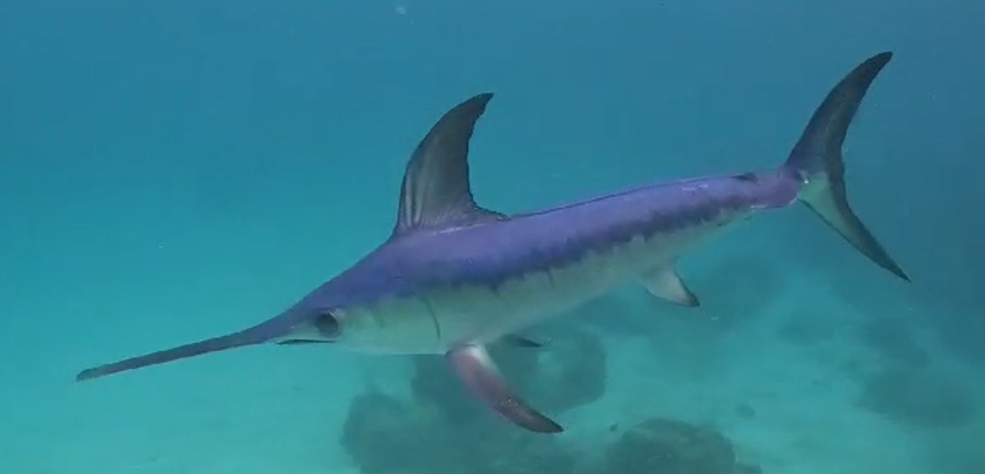
Swordfish
Xiphias gladius · Xiphiidae
Swordfish is a large pelagic billfish found through the Atlantic, Indian and Pacific Oceans, including the Mediterranean, Marmara, the Black Sea and the Sea of Azov. The flattened bill and the long body with no pelvic fins are its signature, and it has been recorded from the surface down to 2,878 m in water of 5 to 27 degrees C. It feeds on crustaceans and fish, reaches 455 cm FL and 650 kg, and is present year-round.
- Family
- Xiphiidae
- Max length
- 455 cm FL
- Max weight
- 650 kg
- Depth
- 0–2878 m
- IUCN
- NT
- Climate
- Temperate · 5–27 °C
- Diet
- crustaceans, fishes
Swordfish (Xiphias gladius) is a fish of the family Xiphiidae. FishBase gives its range as: Atlantic, Indian and Pacific: tropical and temperate and sometimes cold waters, including the Mediterranean Sea, the Sea of Marmara, the Black Sea, and the Sea of Azov. Highly migratory species. Mt DNA restriction analysis reveal that genetic differentiation occurs between populations inhabiting the Mediterranean Sea and the tropical Atlantic ocean, indicating little genetic exchange occurring between the two. It is recorded from 0 to 2878 m, in temperate water at 5–27 °C. The recorded maxima are 455 cm FL, 650 kg. Diet includes crustaceans and fishes. IUCN status: Near Threatened (NT). Chinese name: .
Seasonality
Other PT regulations
Same jurisdictionBefore you keep a fish
- Read the recorded value. It is copied from the notice; if the number and the notice disagree, the notice wins.
- Check the area. Federal, state and local waters can set different limits for the same fish.
- Check the date. Seasons, quotas and closures change; confirm the current notice before you go.
Common questions
- What is the minimum size for Swordfish in Portugal?
- ≥125 cm lower-jaw fork length · 1 fish per vessel per day
- Where does this regulation apply?
- Portugal (mainland)
- When was it checked?
- 2026-11-18, against DGRM — Pesca lúdica: espécies e dimensões mínimas.
- Do other jurisdictions set different limits?
- Yes. This register lists 2 jurisdictions for Swordfish; compare them in the table above.