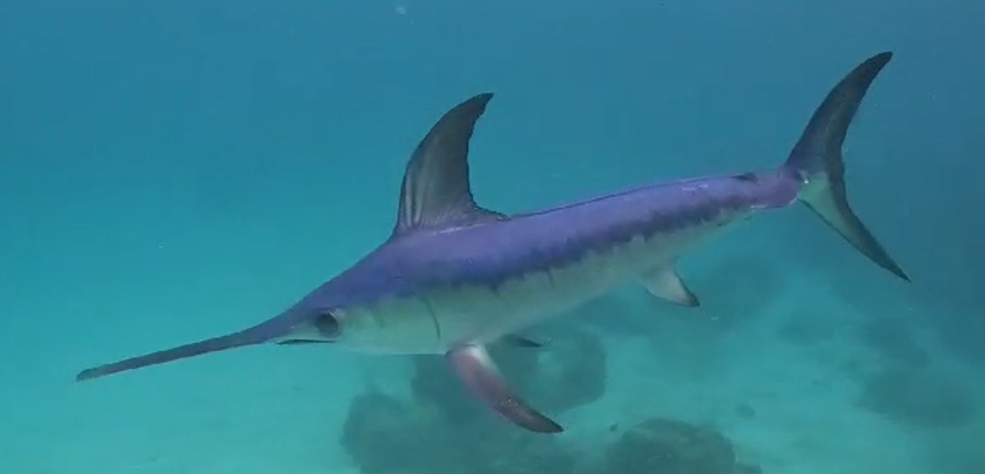
Swordfish (Xiphias gladius) is a fish of the family Xiphiidae. FishBase gives its range as: Atlantic, Indian and Pacific: tropical and temperate and sometimes cold waters, including the Mediterranean Sea, the Sea of Marmara, the Black Sea, and the Sea of Azov. Highly migratory species. Mt DNA restriction analysis reveal that genetic differentiation occurs between populations inhabiting the Mediterranean Sea and the tropical Atlantic ocean, indicating little genetic exchange occurring between the two. It is recorded from 0 to 2878 m, in temperate water at 5–27 °C. The recorded maxima are 455 cm FL, 650 kg. Diet includes crustaceans and fishes. IUCN status: Near Threatened (NT). Chinese name: .
455 centimetres, 650 kilograms, and the fish at the boat
The swordfish page opens with a gap that is easy to miss. The maximum is 455 cm FL, male and unsexed; the common length is 300 cm TL; the maximum published weight is 650 kg. The record is about 1.5 times the common length, and the weight figure belongs to the record, not to the common length. There is no maximum age on the page.
That gap is the subject of this article. A 455 cm, 650 kg swordfish is a real record, but it is not the fish most boats see. The 300 cm common length is the everyday large adult, and the maturity figure, Lm 212 cm with a range of 156–250 cm, is the point at which the fish enters the adult stock. The record sits above all three.
Two rulers in one size line
The two headline measurements do not share a ruler: 455 cm FL and 300 cm TL. On a swordfish the tail is lunate and the lobes are long, so fork length, taken at the fork, and total length, taken at the tip of the upper lobe, are not interchangeable. No conversion between them appears on the page.
A reader comparing a dock report in total length with the 455 cm FL record is comparing two rulers. The record fish could be longer in TL than 455, or the two figures could describe nearly the same animal; nothing on the page settles it. The safe practice is to name the measure with the number, and to treat a TL number from a report as a different quantity from the FL record until a conversion is found.
The gap is not a growth curve
The page gives a 212 cm maturity length with a 156–250 cm range, a 300 cm common length and a 455 cm maximum, but no age at any of those points. Without an age, the gap between 300 and 455 cannot be converted into years. A reader can say the record is much larger than the common fish; a reader cannot say how long the difference takes.
The same gap appears in the weight. The 650 kg figure is the maximum published weight, and the 300 cm fish has no published weight. A 300 cm swordfish is a large animal, but how large is not on this page. The record weight and the common length are two separate facts, and joining them with an assumed condition factor would be the writer's arithmetic, not the source's.
A sword, no pelvic fins
The morphology is short and unambiguous. Dorsal spines 0, dorsal soft rays 38–56, anal spines 0, anal soft rays 16–18. The body is elongated, blackish-brown fading to light brown below, with the first dorsal fin membrane blackish-brown and the other fins brown or blackish-brown. The bill is long, flat and sword-like, and there are no pelvic fins.
The bill and the missing pelvic fins are the two marks that settle the identification at distance. The fin-ray counts settle it in the hand. The page gives no gill-raker count, no eye diameter and no bill-length ratio, so a measurement of the bill is not something this source can support.
Above the thermocline
The environment line gives 0–2,878 m depth, usually 0–550 m, and a temperature range of 5–27°C. The biology text narrows the usual position: generally above the thermocline, preferring 18–22°C, with larvae frequently encountered above 24°C. The 2,878 m maximum is a record depth, not a working depth.
The same text describes the migration: toward temperate or cold waters in summer, back to warm waters in autumn. That is a horizontal and vertical movement at once, and it explains why a species with a 5–27°C envelope is described as preferring 18–22°C. The temperature preference is the more useful planning number; the depth envelope is the outer limit.
Thirteen spawning rows
The spawning table has thirteen rows, and they do not resolve into one season. The Atlantic row runs January–October; the Caribbean Sea, the equatorial Pacific, the Gulf of Mexico and off Florida are all-year; Ceará, Brazil, is February–March; the central Pacific is March–July; the Coral Sea is September–November; Cuba is March–August; the Mediterranean is June–September; southern Italy is March–December; São Paulo is January–March and November–December; the western South Pacific is September–December.
Those rows are locality records, not a global calendar. The all-year rows are in tropical and subtropical waters; the Mediterranean row is a summer window; the Coral Sea row is a southern-spring window. A fisherman planning around a spawn has to pick the row for his ocean, and the page gives thirteen rows precisely because one row cannot cover the species.
Mercury in the large fish
The biology text includes a sentence that belongs with the record-size discussion: large individuals may accumulate large percentages of mercury in their flesh. No threshold length, no concentration and no consumption advisory appear. It states the accumulation and stops.
That is enough to make the 455 cm fish a different food object from the 300 cm fish, but not enough to write a safe-consumption rule. The source supports caution around large individuals; the number of meals, the country-specific limits and the testing programme are outside the page. A reader who wants a mercury rule has to go to a food-safety authority, not to FishBase.
NT, commercial, and the record fish
The IUCN assessment is Near Threatened, dated 1 May 2021; both CITES and CMS return Not Evaluated. The fishery is commercial and the species is a gamefish. OBIS holds 218,138 records under AphiaID 127094, drawn from 120 datasets. As of 2026-11-08, GBIF's present-record total is 448,641: Chile at 277,916, the United States at 94,245, Australia at 12,463, Cuba at 6,309, the Bahamas at 2,737, Mexico at 2,329, the Virgin Islands at 1,186, New Caledonia at 1,167 and the Cook Islands at 1,021. iNaturalist holds 460 observations.
Chile's 277,916 is largely a record of where observers and fleets report catches. OBIS's 218,138 is the same kind of statement. It does not mean swordfish are packed tighter off Chile than off the United States. Near Threatened is a 2021 assessment, and the commercial and gamefish flags describe use, not stock status. The record fish is the top of the size table; it is not the target the page recommends.
Regulations before you keep it
These are the published regulations for this fish. Read the number first. The notice below it is the actual regulation.
Minimum size2
≥170 cm lower-jaw–fork length
France · FR
France sets a 170 cm lower-jaw-to-fork length minimum for swordfish.
| ESPADON | Xiphias gladius | 170 cm (LJFL) * |
≥125 cm lower-jaw fork length · 1 fish per vessel per day
Portugal · PT
Portugal sets a 125 cm lower-jaw fork length minimum for swordfish and allows retention of one billfish per day per vessel from the swordfish, marlin and spearfish group.
The 25 kg alternative belongs to the commercial table, not the recreational rule.
Espadarte (Xiphias gladius) 125 cm. Só é permitida a retenção e descarga de um exemplar, por dia e por embarcação, do conjunto destas espécies.
Every record above names its source and the date it was retrieved. See the regulation register for the full list, or how to read these regulations.
Where these facts come from
Check these pages before you rely on a size, range or protection status.
-
FishBase — Xiphias gladius
— FishBase · T2
-
GBIF — Xiphias gladius occurrence records
— GBIF · T2
-
IUCN Red List — Xiphias gladius
— IUCN · T1
-
Photo record — iNaturalist
— iNaturalist · T3