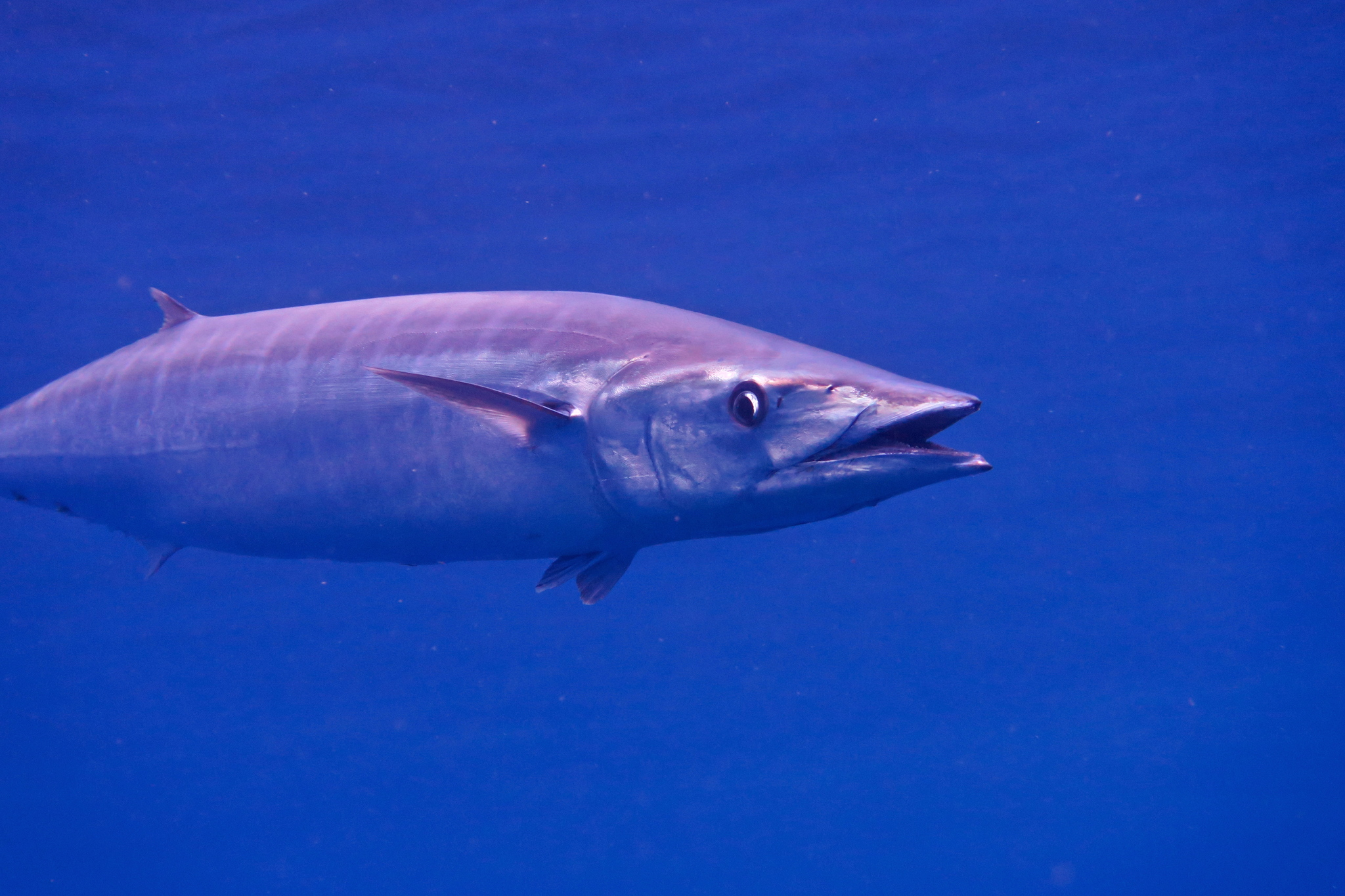
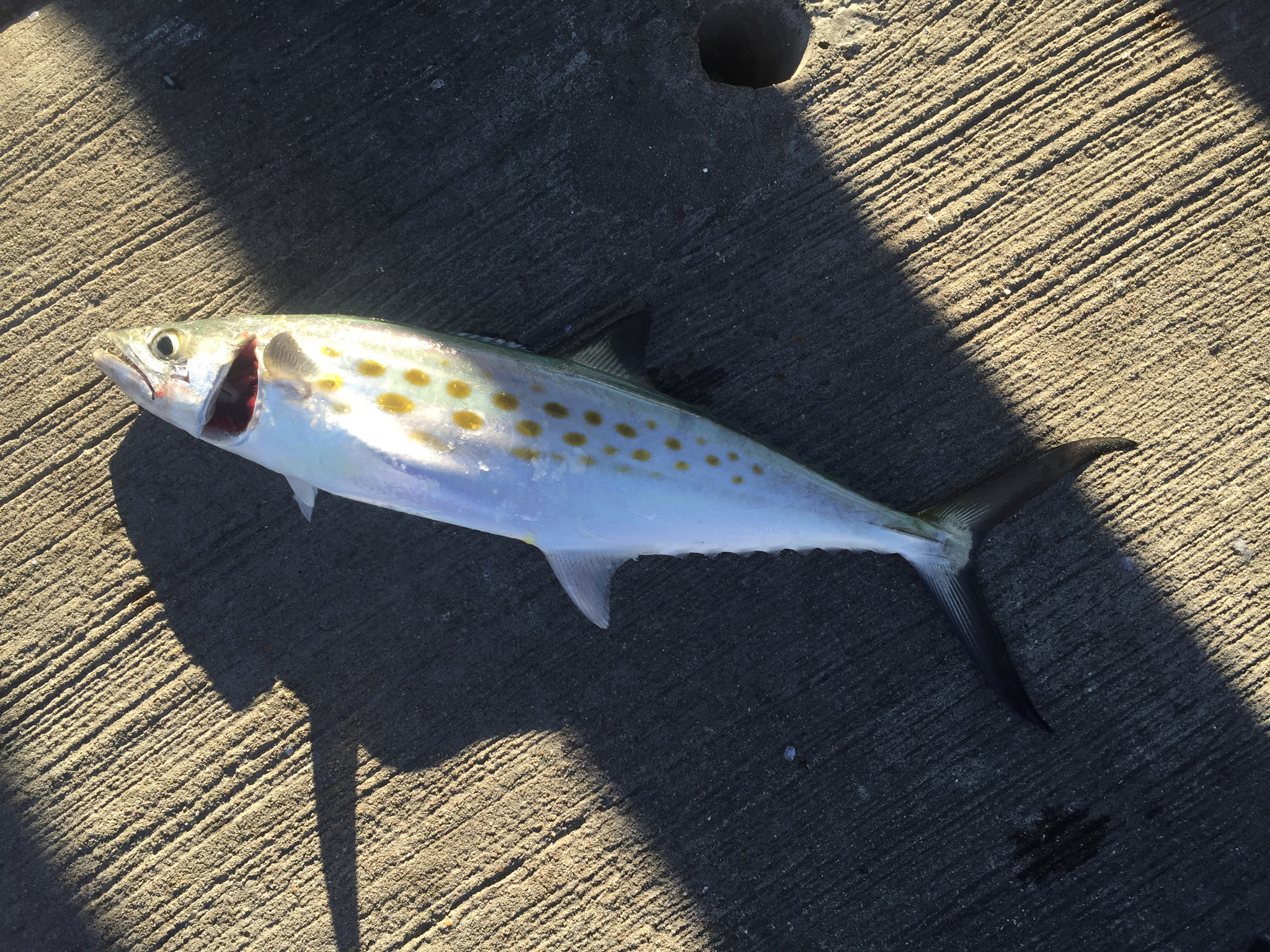
Wahoo (Acanthocybium solandri) is a fish of the family Scombridae. FishBase gives its range as: Atlantic, Indian and Pacific Oceans: in tropical and subtropical waters, including the Caribbean and Mediterranean seas. It is recorded from 0 to 20 m, in subtropical water. The recorded maxima are 250 cm TL, 83 kg. Diet includes fishes. IUCN status: Least Concern (LC). Chinese name: .
250 cm total length, 170 cm fork length
The maximum is 250 cm total length. The common length is 170 cm fork length. Total length reaches the end of the tail; fork length stops at the notch in it. So the two figures are not only different sizes, they are measured on different rulers.
The record does not convert between them. A 250 cm TL fish, measured by fork, would be shorter than 250; a 170 cm FL fish, measured by total length, would be longer than 170. The printed numbers preserve the gap rather than exaggerate it, but they do not let a reader close it.
Why the two figures use different rulers
The mixed units are not an error in the entry; they are how the source recorded each figure. The maximum comes from a reference that used total length, and the common length from one that used fork length. FishBase reports each in its original unit rather than converting one to match the other.
That is the honest presentation, and it is where trouble starts at the rail. A rule of thumb written in fork length and a fish measured in total length will disagree even when both people think they are talking about the same size. The fix is not a conversion factor from this page, because the page provides none; the fix is to measure on the same ruler.
The 83 kg maximum
Maximum published weight is 83 kg. Wikipedia repeats 250 cm and 83 kg. No common weight appears in the record, so 83 kg describes an outlier, not a typical fish.
A 250 cm fish at 83 kg is a very large wahoo. The 170 cm common length sits far below it, and the entry gives no weight for that length. The two figures describe different points in the size distribution, and the record does not build a curve between them. This entry does not either. iNaturalist carries 534 observations for the taxon.
Maturity at 99.3 cm
First maturity is 99.3 cm, with a range from 85 to 105 cm. That is the most useful number in the entry for a size-based decision, because it is the only point where the record connects a length to a life event.
Against the 250 cm maximum, 99.3 cm is well under half. Against the 170 cm common length, it is a little over half. A fish at that length is therefore not a marginal juvenile by this standard; it is comfortably past the maturity midpoint. The range of 85 to 105 cm also means that individual fish can mature across a 20 cm spread.
Depth 0 to 20 m, usually 0 to 12 m
The environment line places the species between 0 and 20 m, with a usual working band of 0 to 12 m. The species is pelagic-oceanic and oceanodromous, which matches the shallow vertical window: this is a fish of the upper water column, not a bottom fish.
The 0 m minimum is not a mistake. It places the species at the surface, and the usual band says that the top dozen metres supply most records. A trolling spread that runs deep is, by this record, fishing below where the species is usually found.
May to October, all in the northern hemisphere
The spawning table runs from May to October, with six records: Bermuda in May to August; the Mediterranean in May to October; North Carolina in June to August; the northern Gulf of Mexico in May to August; the Straits of Florida in May to October; and the Straits of Yucatan in May to October.
Every record is northern. The distribution line runs from 59°N to 48°S, so the species is present in the southern hemisphere, but the spawning table does not include a southern entry. GBIF's distributions layer is wider than the table, with 173 records across 118 countries and territories, and it still adds no southern spawning window. The record does not say whether southern spawning occurs at another time of year, and this entry does not assume one.
Ciguatera poisoning
The record's threat line reads "Ciguatera poisoning". That is the only human-health warning in the entry, and it is attached to the species rather than to a particular region or size class. The record gives no further detail: no incidence figure, no affected organs, no advice.
Ciguatera is a real constraint on how a wahoo is used, not just how it is caught. A fish that is a prized gamefish and a commercial species can still carry a risk that makes the meat unsuitable, and the record flags it in one line without qualification.
The size to rig for
Rig for the common length, not the maximum. The record calls 170 cm fork length the common size, and 250 cm total length the extreme. Keep the two on their own rulers: a 170 cm FL fish and a 250 cm TL fish are different animals entirely, and the entry gives no conversion. Use 99.3 cm as the maturity landmark, 0 to 12 m as the usual vertical window, and treat the 83 kg weight as a maximum rather than a target. The names "ono" and "hoo" used in Hawaii and the United States are angling names, not size classes; the record's own name is Acanthocybium solandri.
Regulations before you keep it
These are the published regulations for this fish. Read the number first. The notice below it is the actual regulation.
Bag limit3
5 per species per angler per day or 20 per vessel per day, whichever is less
Puerto Rico · PR
Puerto Rico's Commonwealth rules limit recreational anglers to five wahoo per species per day, or twenty per vessel per day, whichever is lower, in Puerto Rico waters.
Federal EEZ rules differ: see the separate US-FED-PR record for the 3–200 nautical mile zone.
Pesque dorado (Coryphaena hippurus), el peto (Acanthocibium solanderi) o las sierras (Scomberomorus spp.) sobre las cuotas. Se limita a cinco (5) ejemplares por especie por pescador por día o una cuota de 20 ejemplares por embarcación por día, lo que sea menor.
≥32 in fork length · 5 fish per person per day · 10 per vessel per day
United States — federal (Puerto Rico EEZ) · US-FED-PR
In the federal EEZ around Puerto Rico, wahoo must be at least 32 inches fork length, with a bag limit of 5 per person per day, not to exceed 10 per vessel per day, whichever is less.
This is the federal EEZ rule. Puerto Rico Commonwealth waters have a separate 5 per species / 20 per vessel limit.
§ 622.441(b)(2) Wahoo—32 inches (81.3 cm), FL. § 622.444(b)(2) Wahoo—5 per person per day, not to exceed 10 per vessel per day, whichever is less.
No minimum size · 2 fish per person per day
United States — North Carolina · US-NC
North Carolina sets no minimum size for wahoo and limits anglers to two fish per person per day.
Wahoo | None | 2/Day
Every record above names its source and the date it was retrieved. See the regulation register for the full list, or how to read these regulations.
Where these facts come from
Check these pages before you rely on a size, range or protection status.
-
FishBase — Acanthocybium solandri
— FishBase · T2
-
GBIF — Acanthocybium solandri occurrence records
— GBIF · T2
-
IUCN Red List — Acanthocybium solandri
— IUCN · T1
-
Photo record — iNaturalist
— iNaturalist · T3