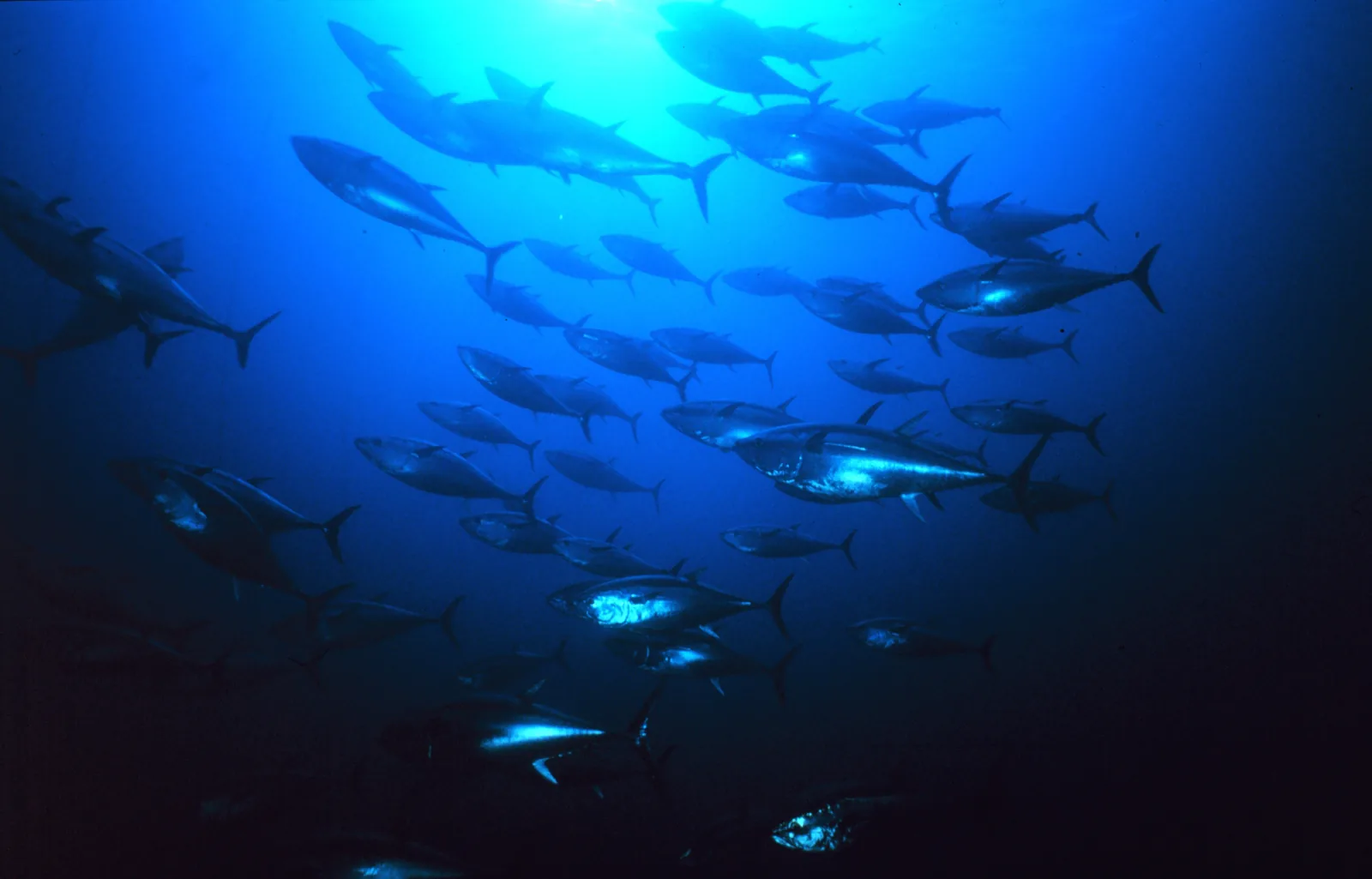
Atlantic bluefin tuna is the fish that taught a generation of anglers to distrust a single number. FishBase records a maximum of 458 cm total length and 684 kg, but also a common length of 200 cm measured to the fork, a maturity length of 103.5 cm, a maximum age of 32 years and a depth range of 0–985 m. Read those numbers in sequence and the fish that emerges is not one animal but a spread of sizes, ages and behaviours that happen to share a name and a dorsal fin count.
The 458 cm fish and the 200 cm fish
A 458 cm bluefin is a museum specimen and a record claim. A 200 cm bluefin is a large, mature, catchable fish that a charter boat might meet once in a season. FishBase lists both in the same record, and the gap between them is roughly a factor of ten in weight: the 684 kg maximum against a 200 cm fish that typically weighs 100–150 kg.
That ratio is the whole planning problem. Tackle selected for the maximum is unusable; tackle selected for a 30 kg school fish is destroyed by a 150 kg fish. The workable compromise is to build for 80–150 kg and accept that a genuine giant will either spool you or be released at the leader.
Length type: fork length versus total length
FishBase gives the maximum as total length and the common length as fork length. Those are not the same measurement, and bluefin is one of the species where the difference matters: the caudal fin is long and deeply forked, so total length runs several centimetres beyond fork length on a large fish, and the proportion changes with size.
Quotas, minimum sizes and record claims are written in different units in different jurisdictions, most commonly fork length or curved fork length. When a regulation says 115 cm, and an angler measures a fish nose to tail tip, the measurement is longer than the rule intends. Measure the way the rule is written, and note which way that is before the fish is on deck.
A 103 cm maturity length and a 32-year lifespan
FishBase puts length at first maturity at 103.5 cm, with a reported range of 97–110 cm, and the maximum reported age at 32 years. A fish that matures at about a metre and can live three decades spends a long time as a immature animal, and a long time as a spawner afterwards. That life history is why bluefin management is built on age-structured models rather than on landings alone.
For an angler the relevant consequence is that a 100 cm bluefin is a juvenile, not a small adult. It also means the largest fish in a school are not necessarily the oldest; growth slows and varies by stock, and a Mediterranean fish and a Gulf of Mexico fish of the same length can be different ages.
Depth: 0–985 m with almost all of it in the top 100
The recorded depth range is 0–985 m, but the usual band is 0–100 m. The extremes come from tagging and from deep foraging dives; the fishable water is the surface layer, where bluefin chase bait schools and where a trolled lure or a live bait is presented.
That surface concentration is why the species is accessible to small boats at all. It also explains why the fishing is so weather-dependent: a 100 m band is a band the swell can disturb, and a day of 2 m chop moves the bait and the fish with it. Temperature is the other filter: FishBase gives a 3–30 °C range, which is wide enough to be almost meaningless, and the practical version is to find the edge where a warm current meets cooler water and to work that edge rather than the open water on either side.
One spawning month in the Mediterranean
The spawning table attached to the record has a single month, June, with entries from the eastern Atlantic west of the Strait of Gibraltar and from the southwestern coast of Spain. That is a Mediterranean and eastern Atlantic spawn, tightly seasonal, and it is the reason the Mediterranean bluefin fishery has a fixed calendar rather than a year-round season.
A single-month spawn concentrates the fish and the fishing. It also makes the stock vulnerable in a way that a long spawn does not, which is why the Mediterranean fishery is managed with quotas, closed seasons and a minimum size rather than with effort limits alone.
Gear: what 200 cm of tuna does to a reel
A 150 kg bluefin at 20 knots is not a tackle test, it is a drag and line-capacity test. The reel needs 300 m of braid at a drag setting that will stop a fish without pulling the hooks, and the rod needs a short, powerful lower section to lift with. A stand-up harness is standard on charter boats; a fighting chair is a different budget.
Leader and hook choice follow the same logic. A 1.5–2 m leader of 100–130 lb fluorocarbon, a circle hook for bait fishing and a heavy split ring for poppers cover most situations. The failure modes are predictable: straightened hooks, opened split rings, and knots that were fine at the dock and fail after twenty minutes of load.
LC in 2021, after decades of quota fights
The conservation field reads Least Concern, assessed 15 January 2021. That is a recent assessment and it follows a long period in which the species was managed under intense quota negotiation. LC does not mean the stock is at a historic high; it means the assessment did not meet the criteria for a threatened category at the time.
The practical reading for an angler is that the rules, not the Red List, decide what you can keep. Bluefin is one of the most tightly regulated recreational species in the Atlantic: permits, tags, size limits, closed seasons and reporting requirements apply in most of its range, and they differ between the Mediterranean, the northeast Atlantic and the western Atlantic.
Where the records sit
The GBIF index returns 13,970 bluefin records: the United States at 7,217, an unassigned category at 1,413, Spain at 659, Croatia at 303, Mexico at 263, Canada at 258, France at 257 and Italy at 244. The American dominance reflects a long-running western Atlantic tagging and survey programme; the Mediterranean numbers reflect a smaller, more dispersed recording effort.
iNaturalist's 680 observations are sparse for a fish this famous, which is itself informative: bluefin are caught and released by specialists, and a fish at the end of a leader is rarely photographed for a citizen-science app. Use the record set to confirm that the species occurs on a coast, then use temperature breaks, bait presence and local charter knowledge to find it. A bluefin mark is a moving edge, not a point on a map.
Where and when it feeds
Tide. Tide is secondary; current edges and temperature breaks are the real structure. Fish the first two hours of current movement.
Weather. A settled sea and light wind are essential. Bluefin can be located in swell, but safety and lure presentation favour calm days.
How to catch it
Trolling
Trolled from a moving boat; suits roaming or pelagic species.
Jigging
Vertical jigging over the recorded depth range.
Live bait
Live bait presented where the fish is likely to feed.
Bait and lures
Live mackerelSkirted trolling lureLarge popperButterfly jig
Regulations before you keep it
These are the published regulations for this fish. Read the number first. The notice below it is the actual regulation.
Minimum size4
The minimum size for Atlantic bluefin tuna in Spain is ≥6.4 kg.
| Atún rojo (Thunnus thynnus) | 6,4 kg |
≥80 cm or ≥10 kg
Spain · ES
The minimum size for Atlantic bluefin tuna in Spain is ≥80 cm or ≥10 kg.
| Atún rojo (Thunnus thynnus) | 80 cm o 10 kg de peso |
≥30 kg or ≥115 cm fork length
France · FR
France sets a minimum of 30 kg or 115 cm fork length for Atlantic bluefin tuna.
| THON ROUGE | Thunnus thynnus | 30 kg ou 115 cm (longueur à la fourche) |
≥30 kg or ≥115 cm (8 kg or 75 cm for rod-and-line and troll gear)
Portugal · PT
Portugal sets a 30 kg or 115 cm minimum for bluefin tuna, reduced to 8 kg or 75 cm for rod-and-line and troll gear.
Atum-rabilho (Thunnus thynnus) | 30 Kg ou 115 cm (a)
Every record above names its source and the date it was retrieved. See the regulation register for the full list, or how to read these regulations.
Where these facts come from
Check these pages before you rely on a size, range or protection status.
-
FishBase — Thunnus thynnus
— FishBase · T2
-
GBIF — Thunnus thynnus occurrence records
— GBIF · T2
-
IUCN Red List — Thunnus thynnus
— IUCN · T1
-
Photo record — iNaturalist
— iNaturalist · T3