
Roundjaw bonefish
The tip of the lower jaw is broadly rounded, which is where the English name comes from, and the snout is the tool it uses to pick food out of the bottom rather than to crush shells. There are no dorsal spines; the soft rays number 15–19, and the anal soft rays 8–9, two counts you can check in the hand.
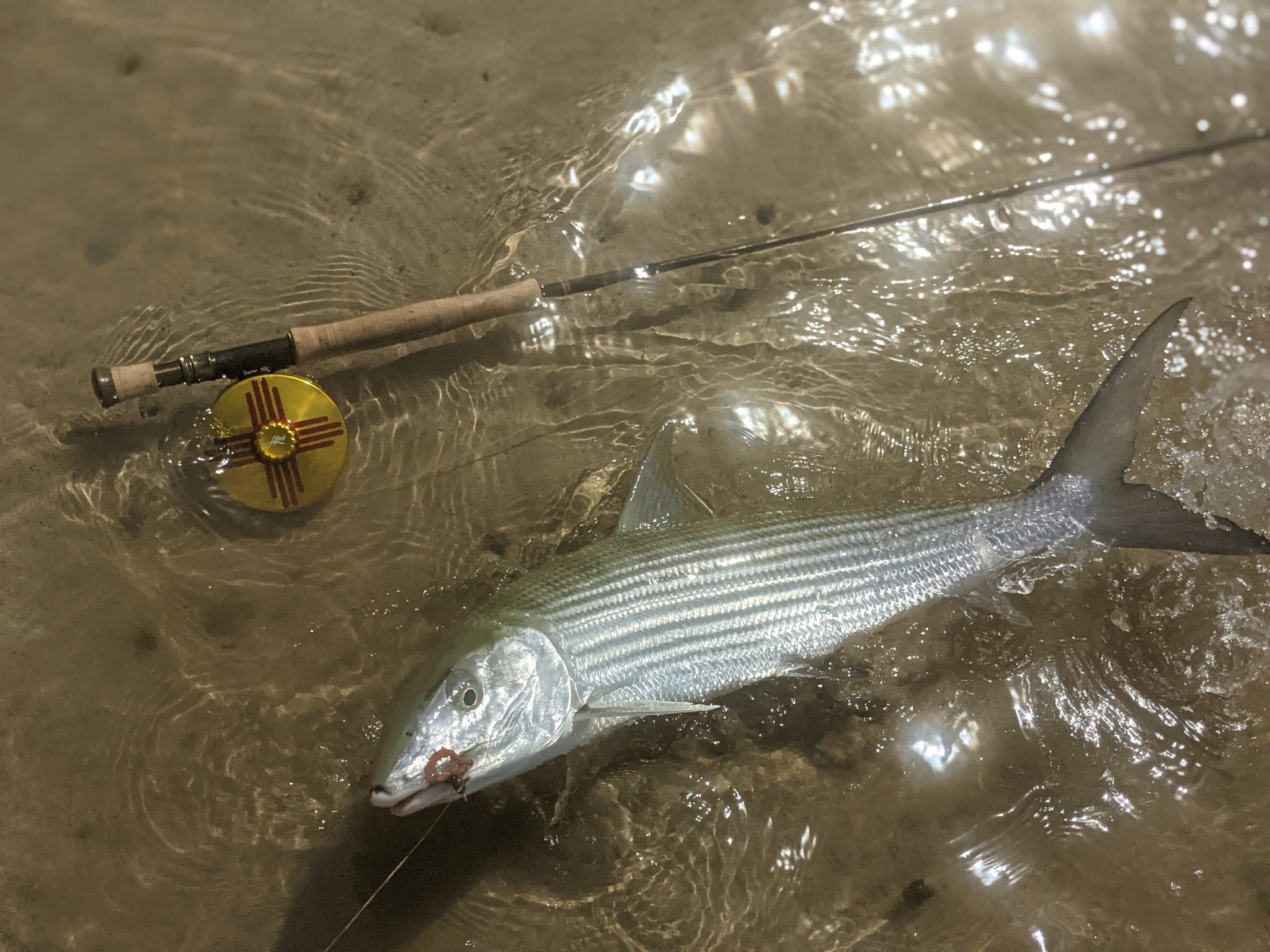
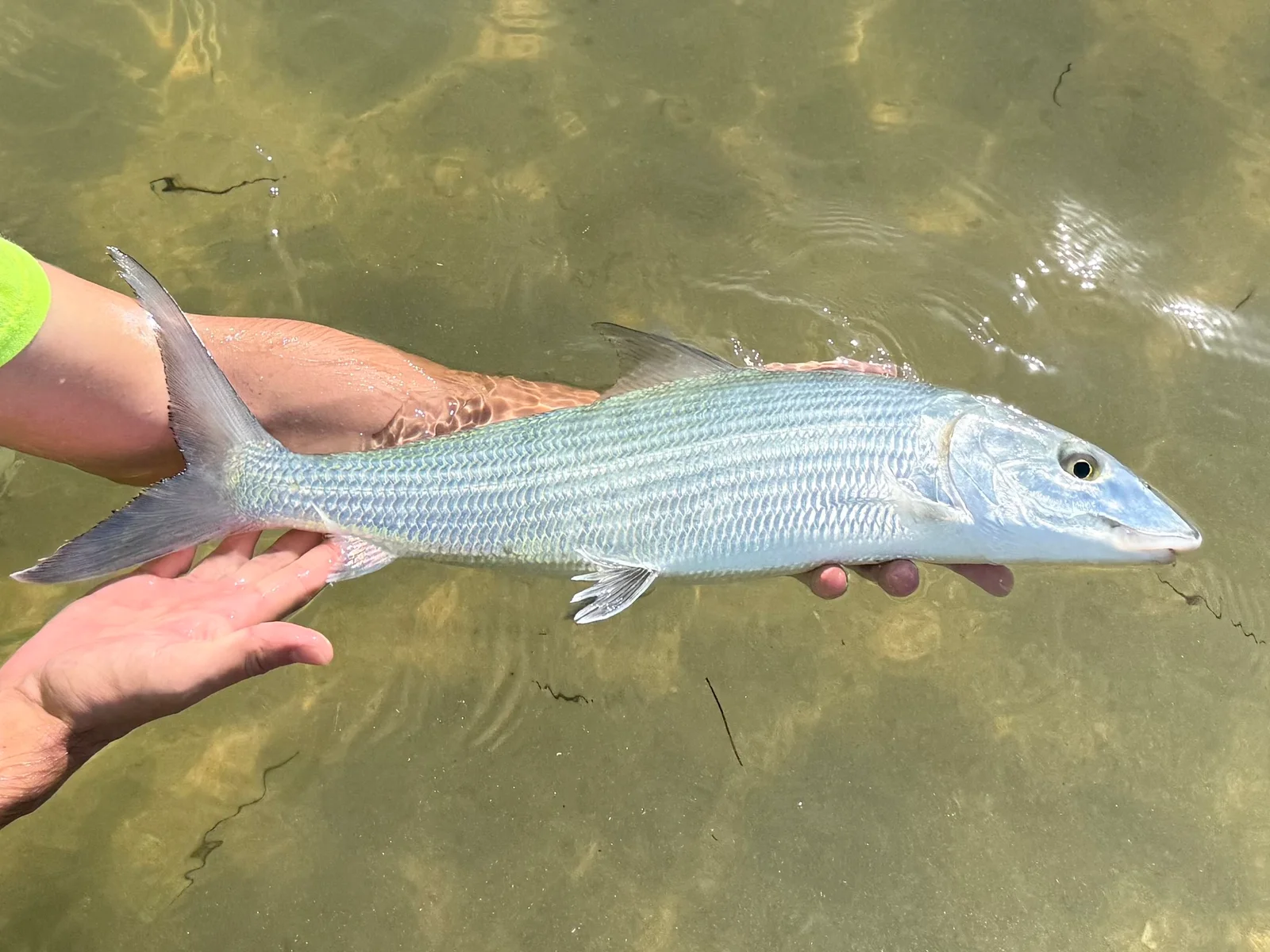
Start with the mouth. The tip of the lower jaw is broadly rounded, which is where the English name comes from, and the snout is the tool it uses to pick food out of the bottom rather than to crush shells. There are no dorsal spines; the soft rays number 15–19, and the anal soft rays 8–9, two counts you can check in the hand. Smaller fish often carry a patch of black pigment under the snout, which shows clearly when one is lifted aboard. The real trap is the other common bonefish, A. argentea, which has a yellow spot at the axil of the pectoral fin; this species has none, and that mark is more reliable than body colour. The body is an ordinary fusiform shape, oval in cross-section, silver enough to vanish against sand when the light is behind it.
Red Sea to the Tuamotus, always shallow
FishBase draws the range as a belt across the Indo-Pacific: from the Red Sea east to the Hawaiian and Tuamotu islands, north to southern Japan, south to Lord Howe Island, with Micronesia included throughout. The latitudinal limits are roughly 32°N and 32°S, between 42°E and 139°W, which makes this a tropical species rather than the property of one coastline. The country list runs from Kenya, Tanzania and Somalia through the Seychelles and Maldives to Hawaii, Guam and the Northern Marianas.
GBIF's 673 records are spread very unevenly: 443 from the Seychelles, 35 from the United States, 32 from Saudi Arabia, 23 from New Caledonia and 22 from French Polynesia. That ranking is closer to a ranking of survey effort than of abundance. The habitat line names turbid inner-reef mud flats, mangroves and sandy lagoons, three descriptions that all point at shallow, soft-bottomed, sheltered water.
Moon first, calendar second
The record gives no spawning month. What it does say is that the species migrates to mass spawn at the seaward mouths of channels on a lunar cycle. For an angler that is more useful than a month table, because the aggregations follow the moon and not the calendar.
Across a tropical belt, water temperature varies less between seasons than water level varies between tides. The record's only behavioural cue is that fish move onto the flats with rising water and drop back toward the channel mouths as it falls. So the order of planning is tide table first, moon phase second, season last. Around the turn of a big tide, fish cruising the channel mouths are usually more active, which is the reason to sit outside the mouth and wait for the current rather than run along the beach.
Reading tails and mud
The fishing happens on sand and at the edge of the reef flat. There are two ways to find fish: look for tails breaking the surface, or look for a dark stain in the water where a fish has disturbed the bottom. Once a fish is located, keep the boat or yourself up-current and let the bait drift down into its line of sight; a cast that lands on top of a bonefish ends the chance.
Small crabs, shrimp and strips of fish are the baits listed. The species picks benthic invertebrates, molluscs and small crustaceans off the substrate with its snout, so a presentation near the bottom suits it and a bait suspended high will be ignored. From shore, work the flats and channel mouths on a rising tide and keep the bait moving instead of soaking it in one spot. The fish is alert: a shadow, a motor or the splash of a lure is enough to move the school. Slow down and wait for the next tide rather than hammering the same patch.
Light gear for clear shallows
The ceiling is 90 cm and 8.6 kg, but most bites come from smaller fish. Build the outfit around seeing the line, casting accurately and controlling a fish in shallow water, not around the record.
Clear flats call for a fine braid main line and a long fluorocarbon leader, long enough that the bait sinks naturally. Carry removable light weights and adjust them to depth and current; one fixed weight will be wrong as soon as the tide changes. The mouth is small, so do not choose a wide-gap hook. The first run is straight and fast, so start with a light drag and tighten after the fish slows; in shallow water there is nowhere to give line except sideways. A large landing net helps, because a spooked fish will run along the sand rather than sound. What matters most is a quiet entry: the splash, not the breaking strain, is what empties a flat.
Fourteen inches and a permit
FishBase's human-use field reads none, while the same account notes that the fish is sold fresh in markets but seldom eaten. The two statements describe different things: main use, and what happens to bycatch.
Hawaii's rules (HAR 13-95) set a 14-inch minimum for ‘ō‘io. A non-resident recreational angler needs an NRMFL, and commercial sale requires a CML. No take is allowed inside Marine Life Conservation Districts, Fisheries Replenishment Areas and other managed areas, and the boundaries follow DAR's current maps and announcements. Catch-and-release is common for this species, and the rules leave room for it; measuring a fish before deciding is the simplest habit to keep.
What the record leaves blank
The entry draws on FishBase for taxonomy, range, meristics, diet and use, GBIF for national occurrence counts, iNaturalist for the taxon link and its 61 observations, and the Hawaii DLNR-DAR pages for state rules. Observation counts show where photographers go, not how many fish exist. The empty human-use field and the market note are not a contradiction, but the gap should be flagged whenever the record is quoted. No spawning month is recorded, which is why the season section is built around tides and moon rather than dates. Rules outside Hawaii differ, and the size and permit terms here apply to Hawaiian waters only.
How to catch it
Boat fishing
Fished with the listed approach, matched to the recorded depth and size.
Shore fishing
Fished with the listed approach, matched to the recorded depth and size.
Where these facts come from
Check these pages before you rely on a size, range or protection status.
- FishBase — Albula glossodonta — FishBase · T2
- GBIF — Albula glossodonta occurrence records — GBIF · T2
- IUCN Red List — Albula glossodonta — IUCN · T1
- Photo record — iNaturalist — iNaturalist · T3
Fish in the same water
These fish live in the same place.

Guides for this water
Technique, gear and safety guides that fit Roundjaw bonefish.