
Gold-spot octopus
The gold-spot octopus belongs to Octopodidae. This record earns its keep through its omissions: the measured fields run out quickly, the descriptive fields are absent altogether, and the honest way to read it is to keep the blanks visible instead of filling them from the habits of better-known octopuses.
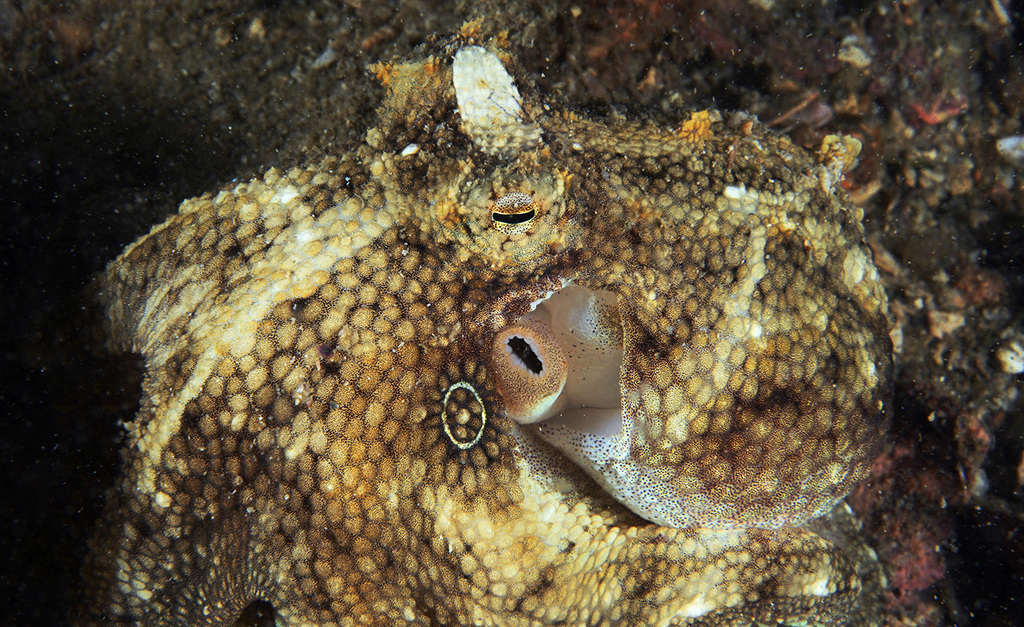
The gold-spot octopus belongs to Octopodidae. This record earns its keep through its omissions: the measured fields run out quickly, the descriptive fields are absent altogether, and the honest way to read it is to keep the blanks visible instead of filling them from the habits of better-known octopuses.
The fields that are empty
The fields a buyer would ask about are the empty ones: how long a typical adult is, when it first matures, what bottom it sits on, what it eats, and when it spawns — all five return nothing. is a name supplied by the editorial layer; the page's own name tables return nothing.
That combination is not a temporary loading error. It is the state of the record. Every one of those blanks is a question the source does not answer, and the method for this article follows from that: where a field is empty, the answer has to come from a measurement you make yourself, or it does not come at all.
20 cm TL, 0.1 kg, one year
A male or unsexed specimen is recorded at 20.0 cm TL; the weight entry is 100 g; the age entry is 1.00 years. The size block stops there: a length, a weight and an age, with no common length beside them.
Total length is worth pausing on. For an octopus, "total length" is a looser quantity than mantle length, because the arms can be extended, curled or partly lost. A 20 cm total length therefore does not pin down the body the way a mantle measurement would. No mantle figure appears for comparison, so the ambiguity stays unresolved.
The weight converts to 0.1 kg in the front matter, which is the same 100 g. There is no common length beside it, which means the page cannot tell you what a typical individual weighs or measures. One year is the whole lifespan record, not an age at maturity.
Benthic, non-migratory, 30–150 m
The habitat block gives a benthic, non-migratory animal, depth 0–150 m with 30–150 m as the usual band, temperate, between 42°N and 21°N, 110°E and 143°E. Because the usual band begins at 30 m, the shallowest part of the envelope is not its normal ground.
"Non-migratory" is a useful constraint. It says the animal is not expected to appear in a season because a stock moved in; it is either on the ground in front of you or it is not. For a benthic octopus, that makes local bottom structure more important than calendar.
Six countries, two registry rows
The distribution text covers the Northwest Pacific, with country and territory records for China, Hong Kong SAR, Japan, North and South Korea, and Taiwan region — six entries from SeaLifeBase. iNaturalist has 69 observations.
GBIF's own distribution table is much thinner: two rows, a global IUCN assessment and Osaka Bay catalogued by WoRMS. So the country list and the distribution table are answering different questions. One is a range description; the other is a short list of submitted records.
The Wikipedia extract adds a location the SeaLifeBase range does not list, saying the species is found in the Pacific Ocean "including off the coasts of New Zealand" as well as the Yellow Sea. That is a conflict between sources, not a fact to average. Country records support the Northwest Pacific range; the New Zealand sentence is a summary claim that this distribution data do not back.
Bycatch or fishery?
The human-use line says "Fisheries: bycatch". The encyclopedia entry says the species "is also commercially fished". Those two statements describe different levels of use, and neither one cancels the other. Bycatch means it is taken incidentally; commercially fished means it is sold. An animal can be both.
For the reader, the practical consequence is that catch rules may not be written around this species at all. If it arrives as bycatch, the relevant regulation may be the one covering the target species or the gear, not a species-specific size limit. Check the rule that applies to what you were actually fishing for.
Least Concern on thin data
IUCN entered it as Least Concern in July 2014. The GBIF distribution row also carries a Least Concern threat status from the IUCN Red List. The assessment sits beside a record with no maturity length, no common length, and no diet or spawning entries.
That category does not assert a healthy stock. It is a category assigned on the evidence available. When the evidence includes large gaps, the category should be read together with those gaps, not as a substitute for them.
No diet, no spawning window
The food and spawning fields are blank in this record. A closely related octopus has been studied far better, and that is exactly why borrowing its prey list or its season would be unsafe: the borrowed fact would read as a record of this species.
The missing spawning window has the most direct effect on trip planning. Without it, nothing in the record can tell you that one month is better than another. Depth and bottom are the only planning fields left, and local experience is not data from this page.
Filling the blanks on your own boat
Measure mantle length as well as total length if you can, because the page only gives total length and the two are not interchangeable. Weigh the animal whole after draining, record the date, the depth and the bottom you were working, and note whether it came on the target gear or as bycatch.
Take a photograph before the arms curl. With no body-shape or hard-part record on the page, the photograph is the only identification evidence you will have that is independent of the name. And write the scientific name: " " and "Gold-spot octopus" are labels, while Amphioctopus fangsiao is the taxon the record belongs to.
How to catch it
Boat bottom fishing
Anchored or drifting boat, bait or lure worked near the recorded bottom.
Handline
Handline fished vertically; simple and direct.
Where these facts come from
Check these pages before you rely on a size, range or protection status.
- FishBase — Amphioctopus fangsiao — FishBase · T2
- GBIF — Amphioctopus fangsiao occurrence records — GBIF · T2
- IUCN Red List — Amphioctopus fangsiao — IUCN · T1
- Photo record — iNaturalist — iNaturalist · T3
Fish in the same water
These fish live in the same place.
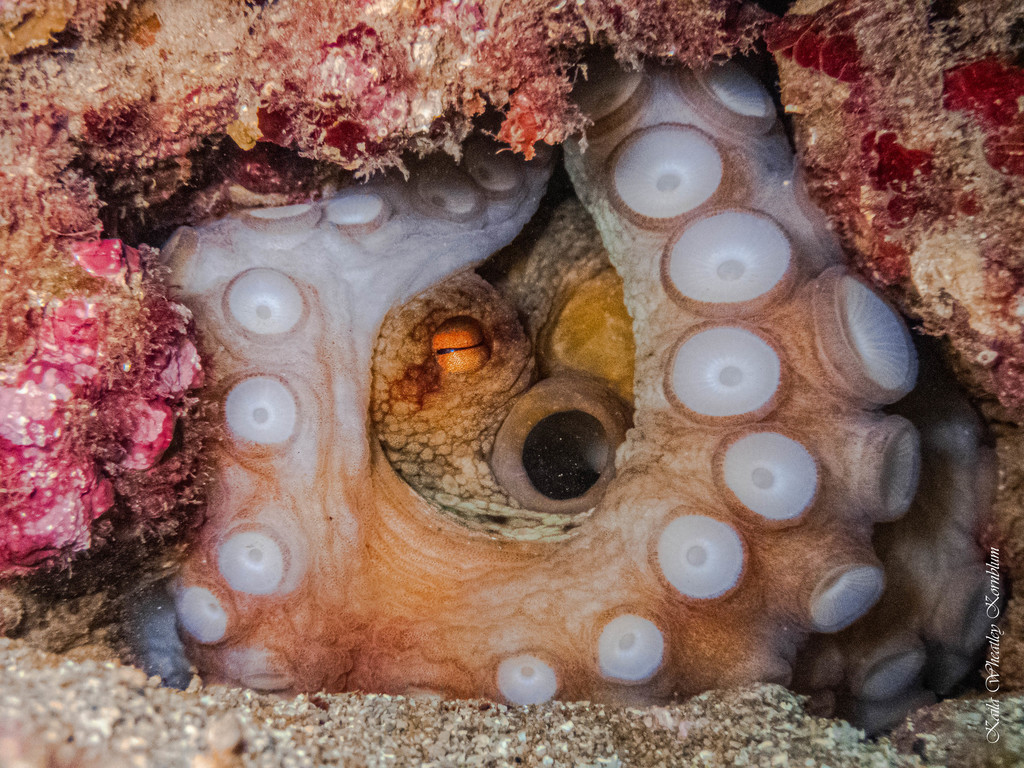
Common octopus
- Family
- Octopodidae
- Depth
- 0–347 m
- Season
- Jan, Feb, Mar, Apr, May, Jun, Jul, Oct, Nov
Whiparm octopus
- Family
- Octopodidae
- Depth
- 1–200 m

Acoupa weakfish
- Family
- Sciaenidae
- Depth
- 1–20 m
- Season
- Jan, Feb, Mar, Apr, May, Jun, Jul, Aug, Sep, Oct, Nov, Dec
Guides for this water
Technique, gear and safety guides that fit Gold-spot octopus.