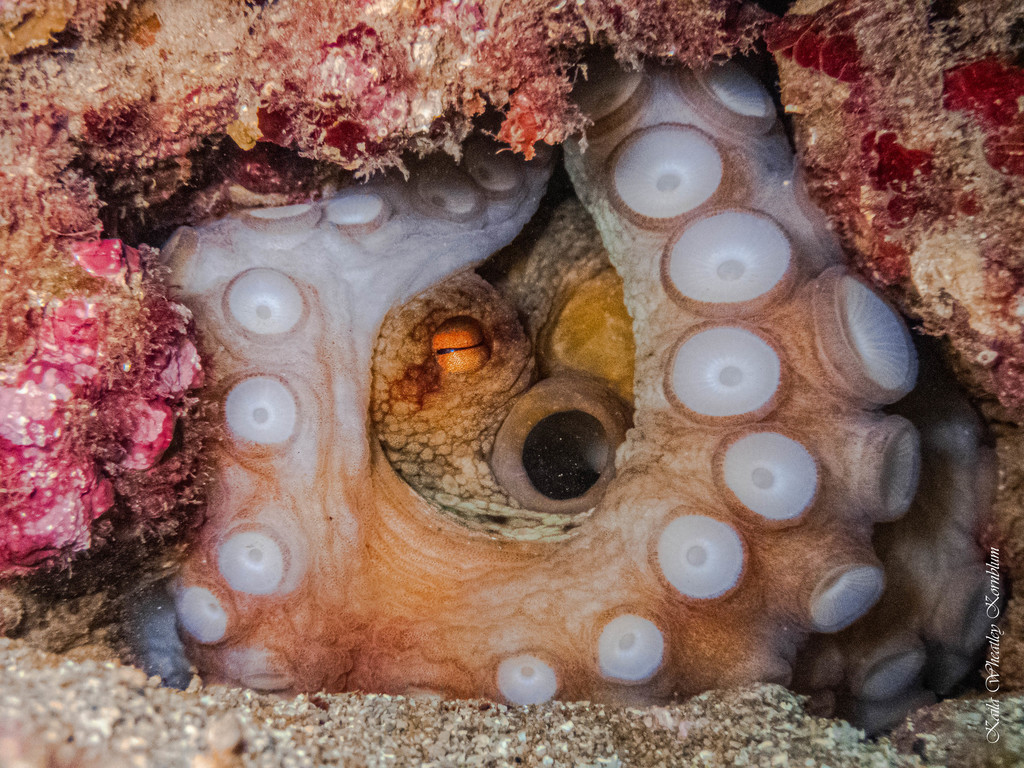
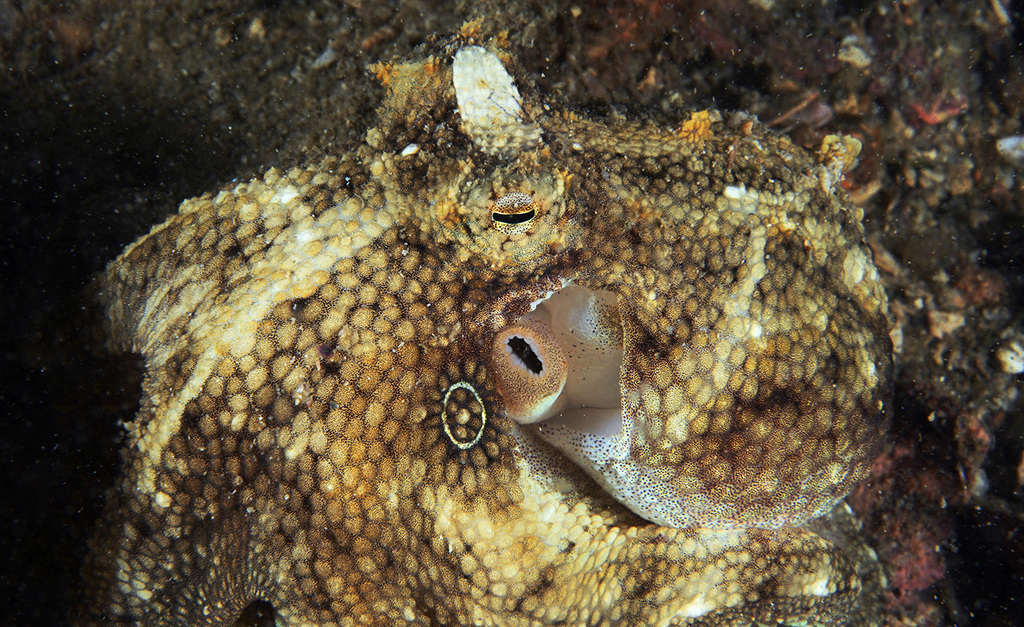
The common octopus is the cephalopod most coastal anglers meet by accident: on a jig that stopped falling, in a trap, or wrapped around a crab-pot rope. It is not a fish, and the record says so plainly — class Cephalopoda, family Octopodidae — which means the measurements that matter are not the ones a bass angler would reach for first.
An animal measured by its mantle
SeaLifeBase lists a maximum total length of 180 cm for males and 120 cm for females, with a maximum published weight of 10 kg. Those total-length figures include the arms, and the arms are most of what an octopus is; the working measurement is mantle length (ML), and the recorded length at maturity is 8–11.3 cm (Lm), which for a cephalopod is read as mantle length. If you are checking a catch against a local minimum size, find out which measurement the rule uses before you put a tape on the animal. Treating an arm span as a body length is how legal octopus get released and undersized ones get kept.
The ground it chooses
The species is recorded as reef-associated and oceanodromous, from 0 to 347 m with a usual range of 0–100 m, over rocky, sandy and muddy bottoms from the coastline to the edge of the continental shelf, including intertidal and subtidal ground. It is circumglobal in temperate and tropical seas, with a preferred temperature of 26 °C. GBIF's 23,803 preserved occurrences are led by Spain (10,993), France (5,936), Portugal (1,920), the United States (727) and South Africa (566); iNaturalist adds 11,140 observations. That distribution is enormous, and it is exactly why "an octopus mark" is a poor plan: the animal is common, but the cover it uses is local.
How a take feels
The source does not describe hunting behaviour, so the following is inference from the habitat record. An octopus is a sit-and-wait predator that uses crevices, weed edges and the undersides of rocks; a lure that stays still interests it less than one that moves, pauses and falls again. On a slow-pitch jig the take often arrives on the fall, and it registers as weight rather than a run — the jig stops dropping, or the line goes heavy and stays heavy. A bait fished on the bottom near rock is taken the same way, quietly, with the animal apparently glued to the ground. The mistake is to strike hard: the hook is usually already in the arm web, and a hard jerk tears it free.
Rocks, sand and the edge between them
If you can choose one kind of ground, choose the seam. Rock and sand meet in patches that offer both den sites and the open bottom an octopus crosses to hunt, and a mud line at the mouth of a bay does the same job. Work the shallower end of the recorded range first: 0–30 m sits inside the usual band, and it is where a sounder still shows structure and a jig does not need a long drop. Deeper is not automatically better. The record's ceiling is 347 m, but the usual range stops at 100 m, and nearly all the ground an angler can work lies well inside it.
A short life, a short season
The spawning table lists January to July plus October and November, from a record in the Canary Islands. The life cycle is blunt: adults are gonochoric, and males and females usually die shortly after spawning and brooding respectively; embryos hatch into a planktonic stage before settling into a benthic life. For an angler this explains why the population turns over quickly and why a big, old animal is a rare encounter rather than a reliable target. It also makes the "season" a reproductive window rather than a promise of a run; local water temperature, for which the source gives a 26 °C preference, is a better guide than a month on a calendar.
The commercial shadow
SeaLifeBase notes that the species is taken by amateur fishers and in small- to large-scale harvest across its range, that the greatest fishery effort is off northwest Africa, and that it is one of the most valuable octopod species in the Mediterranean, marketed fresh or frozen. IUCN lists it as Least Concern, assessed 8 April 2016, and human use is recorded as commercial fisheries. Least Concern is not a licence to take everything: octopus are short-lived and locally dense, so a small area can be cleaned out long before a global assessment notices. Check local rules for cephalopods, traps, closures and minimum sizes; no official text was verified for this page.
The 180 cm trap
The headline number is the one most likely to mislead. A 180 cm total length sounds like a giant, and a 10 kg maximum weight sounds like a reason to bring heavy tackle; neither is a reason to fish for a record. The maturity range is 8–11.3 cm (Lm), and most encounters are in that order of size. A medium spinning rod, a jig in the 20–60 g class and a leader that can survive a rock are enough to work the ground described here. If you are using a trap, the local escape-gap and soak rules decide the design, not the record's maximum size.
After the take
An octopus arrives with a beak, ink and a grip that can open a cut. A wet towel or a gloved hand, a flat surface and a container with a lid are more useful than a ruler at that moment. Measure the mantle, not the arms; photograph the animal on a plain background if you intend to log it, and return undersized animals promptly. iNaturalist's 11,140 observations suggest that many people are already recording this species, and a clean photo with a location is a small contribution to a very large dataset.
How to catch it
Boat bottom fishing
Anchored or drifting boat, bait or lure worked near the recorded bottom.
Handline
Handline fished vertically; simple and direct.
Trap fishing
Trap or pot fishing; check local rules before using.
Regulations before you keep it
These are the published regulations for this fish. Read the number first. The notice below it is the actual regulation.
Minimum size3
Spain requires common octopus to weigh at least 1 kg; the Mediterranean rule does not apply in Balearic internal waters.
| Pulpo *(Octopus vulgaris)* | 1 kg |
The minimum size for Common octopus in Portugal is ≥0.750 kg.
Polvo-vulgar (Octopus vulgaris) | 0,750 kg
≥750 g
United Kingdom · UK
UK waters require octopus to weigh at least 750 g.
| Octopus | Octopus Vulgaris | 750 grams |
Every record above names its source and the date it was retrieved. See the regulation register for the full list, or how to read these regulations.
Where these facts come from
Check these pages before you rely on a size, range or protection status.
-
FishBase — Octopus vulgaris
— FishBase · T2
-
GBIF — Octopus vulgaris occurrence records
— GBIF · T2
-
IUCN Red List — Octopus vulgaris
— IUCN · T1
-
Photo record — iNaturalist
— iNaturalist · T3