
Spotted wolffish
Spotted wolffish is a long, heavy-bodied bottom fish of the North Atlantic and adjacent Arctic. It lives between 25 and 600 m, grows to 180 cm and 27.9 kg, and is recorded mainly in the colder months, with the season running from October into January.

The habitat keyword row is empty. That is the fact this page has to start with, and it stays a fact: the existing record does not cover substrate for this species. Everything else in the row — depth, size, spawning, distribution — is present, and the page can work from those without filling the blank.
The empty keyword row
FishBase's habitat field carries no rocky, sandy or muddy entry for the spotted wolffish. The absence is recorded as an absence. The blank neither claims every bottom is used nor that all are avoided; it records that no substrate was coded.
This is a different situation from a species with three keywords and no ranking. Here there is nothing to rank. Any statement about the bottom would have to come from somewhere other than this source, and the page will say so rather than manufacture one.
What the record does cover
The depth range is 25–600 m, with a working band of 100–400 m. The working band spans 300 m inside a 575 m total. Maximum length is 180 cm, common length 120 cm, maximum weight 27.9 kg. Maturity is 55 cm, with a range of 50–60 cm. The distribution runs across the North Atlantic and adjacent Arctic: western Greenland and Nova Scotia to Massachusetts in the west, Spitsbergen to the Scandinavian coast, Iceland and southeast Greenland in the east.
GBIF's 13 distribution assertions follow that shape. They name the Gulf of Maine, the Gulf of Saint Lawrence, Davis Strait, Hudson Strait, the Arctic Sea, European Marine Waters, the Northwest Atlantic and the Swedish EEZ; only three carry a country code (Sweden 2, Norway 1), and those three are the only ones that can be joined to a national boundary. None of those assertions is a substrate record either.
iNaturalist's taxon page records 57 observations for the species. They document where the fish was seen, not what it was sitting on.
100–400 m is the usable line
The usual range is the only ranked depth statement in the source: 100–400 m. Both 25 m and 600 m are outer bounds; neither comes with a frequency of capture.
For a trip, 100–400 m is the planning number. It is deep bottom work in most of the range, and it is the band where the distribution records cluster. The shallow and deep bounds are not targets; they are the edges of what has been reported.
Why the blank is not filled here
The diet row lists crustaceans, fishes, worms and echinoderms. That is four prey groups, and none of them is a substrate. A prey list says what to bait with; it says nothing about whether the bait belongs over rock, sand or mud.
So the page stops at the edge of the evidence. With the habitat field blank, the diet line cannot stand in, and the GBIF records are spatial rather than geological. The substrate question remains open, and it should stay open until a source actually codes it.
The spawning window
Spawning is recorded in January, October, November and December, from the North Sea. It is a single record, and it does not give spawning depth.
The winter months are usable as a calendar, but not as a location. Nothing in the record ties the spawning window to the 100–400 m band or to any bottom. A trip in those months can use the dates; it cannot use them to choose a mark.
120 cm is the common fish
Few entries in this set carry a common length, let alone 120 cm; most leave it blank. Against a 180 cm maximum, the ordinary fish is two thirds the length of the largest, and the 27.9 kg maximum should be carried separately because no length is paired with it.
Maturity at 55 cm is far below the common length. That means the ordinary fish is well past maturity, and the release discussion is not about a knife-edge threshold. The source gives no maximum age, so the age of that 120 cm fish is unknown.
Ninety per cent, Canada
Wikipedia reports that the Canadian population declined by about 90 per cent from the late 1970s through the early 1990s, particularly in the northern part of its range, and that the species is classified as threatened in Canada.
FishBase gives NE, not evaluated. The two statements operate at different scales: a national assessment and a global field. The page carries both and does not use the Canadian figure to describe the whole Atlantic.
How to fish an unstated bottom
Start in the 100–400 m band. Use the sounder to find any change in ground hardness, and treat each change as a test rather than a known habitat. Log what comes up with each drop — fish, gear damage, snags — because that is the only substrate information this page can help you generate.
Do not assume a bottom type, and do not assume the fish does not care. The record is silent, and silence is not a preference. The 120 cm common length and the Canadian decline are the two numbers to carry; the substrate is the question to answer on the water, one drop at a time.
Where these facts come from
Check these pages before you rely on a size, range or protection status.
- FishBase — Anarhichas minor — FishBase · T2
- GBIF — Anarhichas minor occurrence records — GBIF · T2
- IUCN Red List — Anarhichas minor — IUCN · T1
- Photo record — iNaturalist — iNaturalist · T3
Fish in the same water
These fish live in the same place.

Atlantic wolffish
- Family
- Anarhichadidae
- Depth
- 1–600 m
- Season
- Jan, Feb, Oct, Nov, Dec
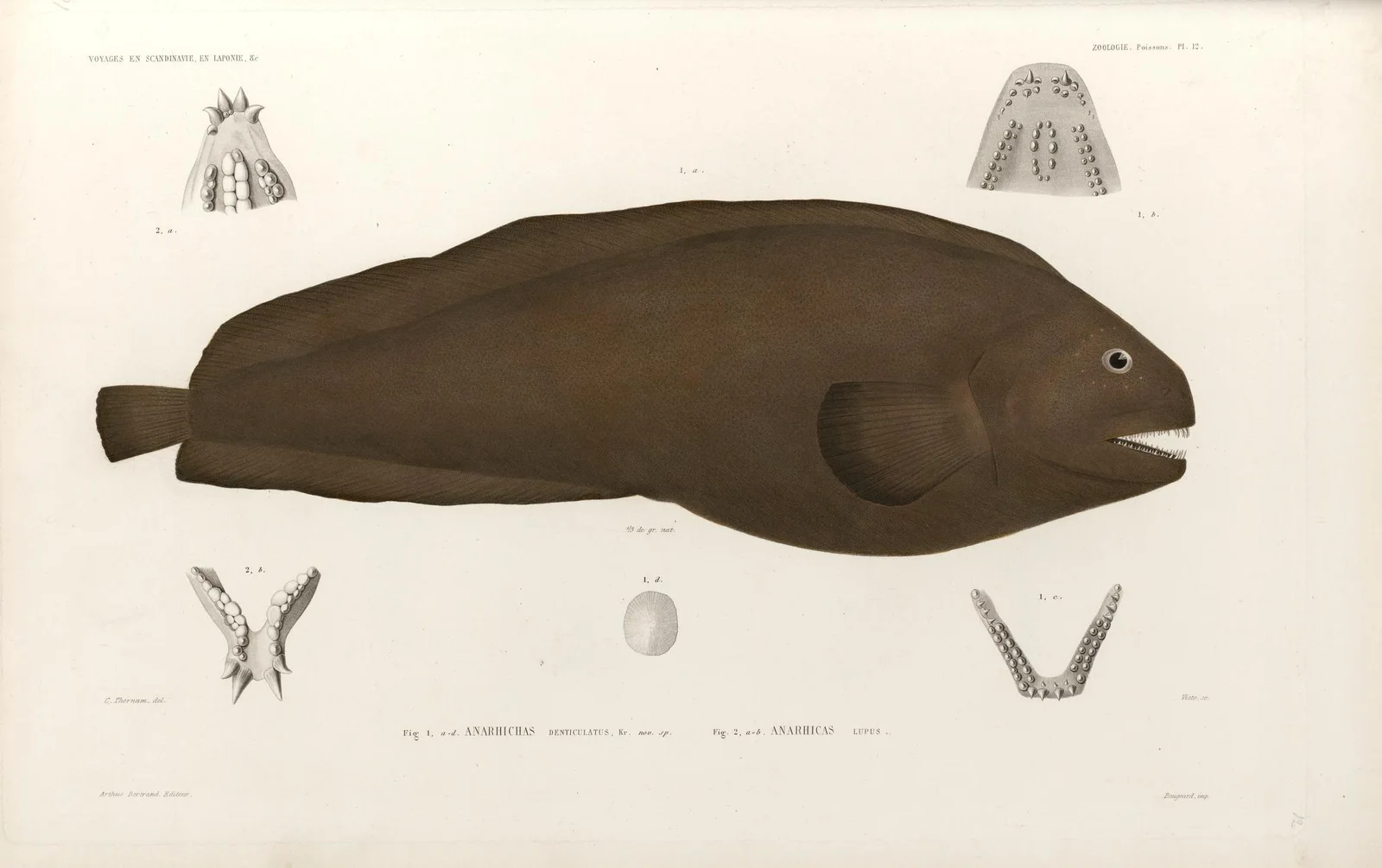
Northern wolffish
- Family
- Anarhichadidae
- Depth
- 60–1700 m

Acoupa weakfish
- Family
- Sciaenidae
- Depth
- 1–20 m
- Season
- Jan, Feb, Mar, Apr, May, Jun, Jul, Aug, Sep, Oct, Nov, Dec
Guides for this water
Technique, gear and safety guides that fit Spotted wolffish.